by alan

1950s Chelsea Flower Show Exhibits

June 5, 2017 in Articles, Machinery


Showing new machinery and ideas to the public at shows has always been a great way to promote a company and the machinery too. Even back in the 1950’s the Chelsea Flower Show had many new machines on show, many of the machines have become firm favourites with collectors and of course the machines are still useable today.  

Since Chelsea 2017 has just finished, here are a few vintage images from the Chelsea shows in the 1950s.

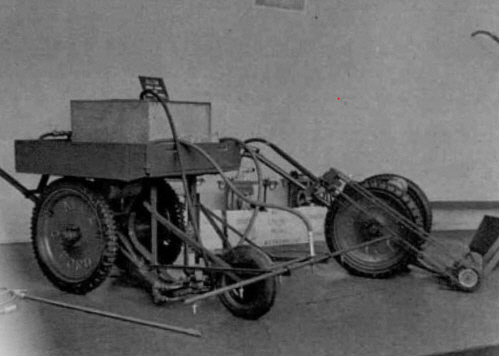
1953: Exhibited by John Allen & Sons, Oxford, and showing some attachments including the carrier and also a mower on the right-hand machine.

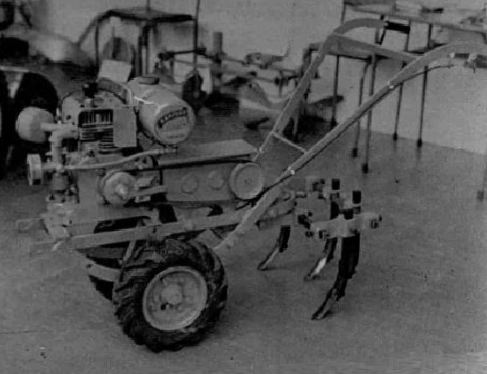
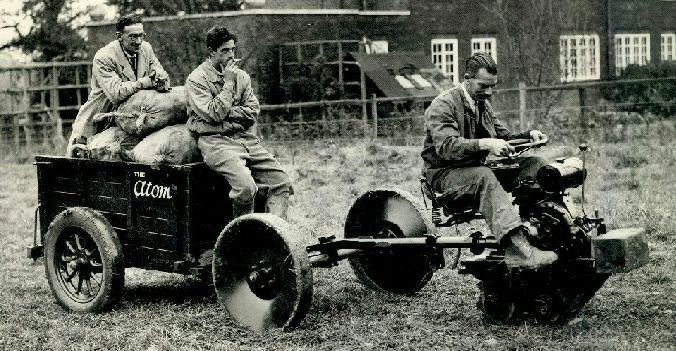
1953 : Barford Atom. Note the attachments in the background.

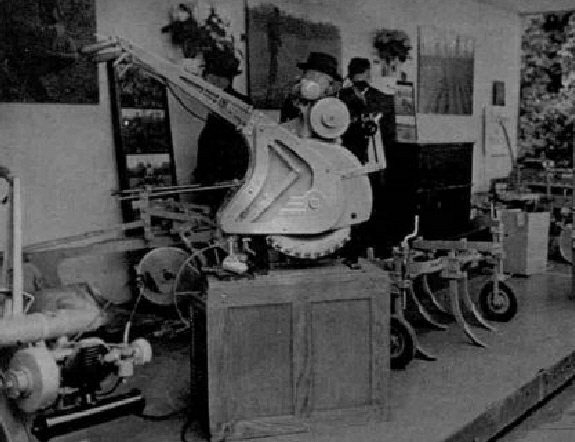
1952: Ransomes, Sims and Jefferies Vibro Hoe and other exhibits. Was this before the Vibro Hoe was released and sold to the public?


1955: A well used image but shows the Tarpen battery powered lawn edger being demonstrated

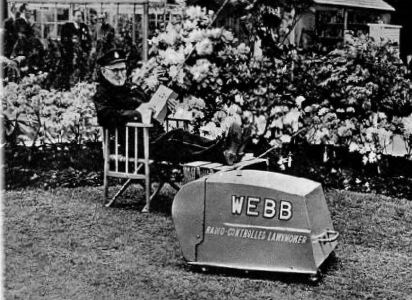
1959: One of a series of well known images showing the Webb Radio-Controlled Lawnmower being demonstrated. Other images show the crowds watching the demonstration.

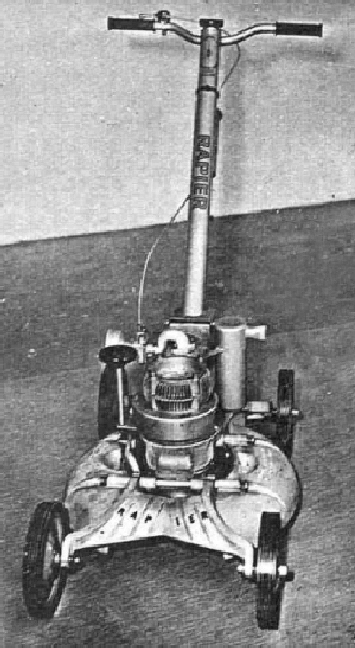
1957: Rapier Mower by Farmfitters Ltd. Available as a petrol or paraffin model from £42.10s. 

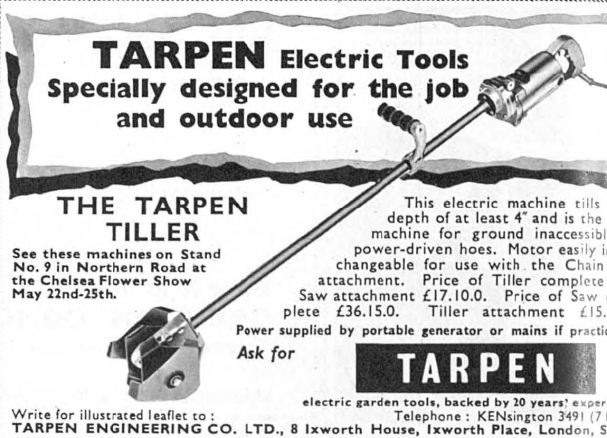
1956: Tarpen Tiller advert showing they will be at Stand No.9 at the Chelsea Flower Show 1956.

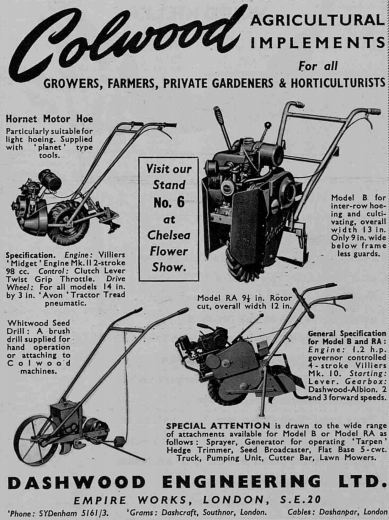
1953: Colwood exhibits for Stand No.6 at the Chelsea Flower Show 1953.

by alan

UK’s Oldest Bolens Tractor (and Australia too)

May 17, 2017 in Articles, Machinery

Bolens Ride-a-matic


This isn’t a trick question but does anyone want to guess when Bolens introduced their two-wheeled garden tractors to the UK?

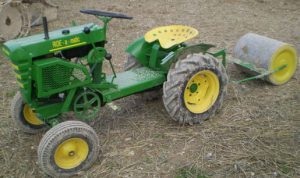
We are all used to seeing the Bolens four-wheeled garden tractors, as in the image on the right, with the appealing Ride-a-matics being introduced in 1959, but the two-wheeled tractors were even earlier – in fact much earlier.

Newspaper research suggests that the very first Bolens were brought to the UK in September 1927, probably a couple of decades earlier than any of us would have guessed. Feedback from Bolens collectors suggest that it was originally thought that Bolens where not imported here before 1959, but newspaper adverts show the two-wheelers were here 32 years earlier.

Australia were four years earlier than us with a Bolens hitting their shores in 1923. Newspaper article at the bottom of this page.

In the UK, the book Seventy Years of Garden Machinery describes early American machines but not that they were imported here, it mentions that two-wheel machines were first imported into the UK in the early 1960s but nothing before. (Admittedly it’s not an easy thing to find out)

Shown below is the very first UK Bolens advert known. It is from the Western Daily Press in Bristol dated 10th September 1927. It is an invitation for everyone to attend a Demonstration of the Bolen’s Tractor at the Agricultural & Horticultural Research Station, Long Ashton, Bristol on the 15th September 1927 at 2pm. That’s 90 years ago this year.
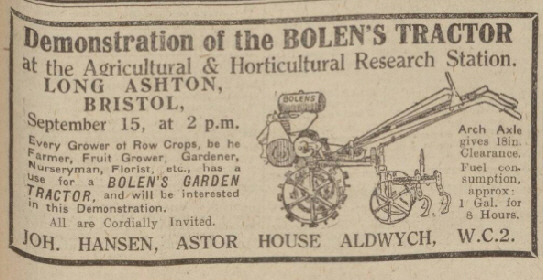
Bolens 1927 Advert – Possibly a Model A power hoe made 1921-1926?

Conveniently this is followed the next day by a report of the tractor and how it performed at the previous days demonstration. 
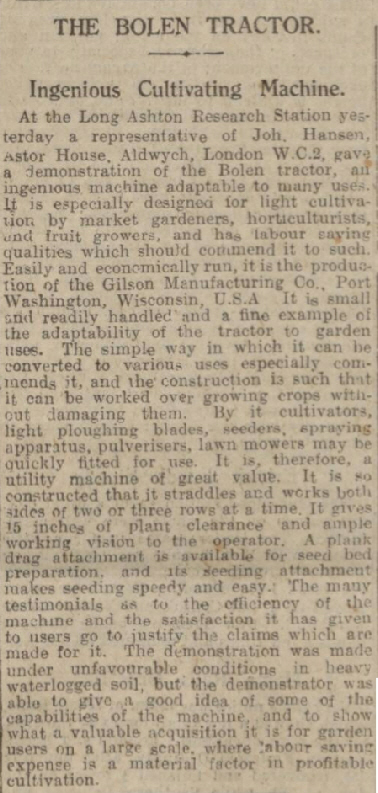
Bolens Tractor 1927 Report from Long Ashton, Bristol.

The advert from 16th September 1927, image right, says:

“Ingenious Cultivating Machine. At the Long Ashton Research Station yesterday a representative of Joh. Hanson, Astor House, Aldwych, London W.C.2. (Note: Joh. Hansen also imported other machinery from the USA including the 1930s Little Wonder hedge trimmer) gave a demonstration of the Bolen tractor , an ingenious machine adaptable to many uses. It is especially designed for light cultivation by market gardeners, horticulturalists and fruit growers, and has labour saving qualities which should commend it to such. 

Easily and economically run, it is the production of the Gilson Manufacturing Co. Port Washington, Wisconsin, U.S.A. It is small and readily handled and a fine example of the adaptability of the tractor to garden uses. The simple way in which it can be converted to various uses especially commends it, and the construction is such that it can be worked over growing crops without damaging them. 

By it’s cultivators, light ploughing blades, seeders, spraying apparatus, pulverisers, lawn mowers may be quickly fitted for use. It is, therefore, a utility machine of great value. It is so constructed that it straddles and works both sides of two or three rows at a time. It gives 15 inches of plant clearance and ample working vision to the operator. A plank drag attachment is available for seed bed preparation, and it’s seeding attachment makes seeding speedy and easy. The many testimonials as to the efficiency of the machine and the satisfaction it has given to users go to justify the claims which are made for it. 

The demonstration was made under unfavourable conditions in heavy waterlogged soil, but the demonstrator was able to give a good idea of some of the capabilities of the machine, and to show what a valuable acquisition it is for garden users on a large scale, where labour saving expense is a material factor in profitable cultivation.”

And then…..nothing……absolutely nothing about Bolens until 14 years later when an advert appears in the Gloucestershire Echo on the 19th September 1941. Advertising a shipment of Bolen’s Market Garden Tractors complete with Ploughs, Potato raising ploughs and Cultivating Equipment. The distributors are B.S. Bird & Co. (Gloucester) Ltd. Does anyone know anything about B.S.Bird & Co. ?
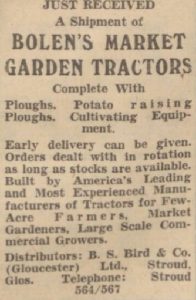
1941 Bolens as sold by B.S. Bird & Co (Gloucester) Ltd, Stroud.

This is followed (image below) on the 6th November 1942 by a private advert in the Western Mail selling a 5hp Bolens Tractor with complete ploughing and cultivating tools and potato lift – as sold in the 1941 advert above! The address is Rose Tree Farm , Llanmartin, South Wales. Importantly the price of £180 is mentioned for the purchase earlier that year. 

1942 private advert for a 5hp Bolens Tractor

A couple of years later (image below) on the 16th February 1944, a Bolens tractor with implements appears in the Birmingham Mail. Advertised by Mason & Westcott, Pinvin, Pershore, Worcestershire for a price of £120 in as new condition.

1944 advert for a Bolens Tractor at Pershore, Worcs. Price £120.

Notice how these Bolens are so far all huddled around one corner of the UK and except for the advert below are within 60 miles radius of Long Ashton, Bristol?

On the 9th December 1948 an advert (image below) in The Cornishman newspaper advertises the sale of 2 Bolens tractors and implements. 

Selling at public auction on the 10th December  1948 at Godolphin Cross, Breage, Helston, ‘Two-wheeled Bolens tractor with forward and reverse gears, complete with plough, cultivator, bankers, hay cutter, potato lifter, harrow (new): Two-wheeled Bolens tractor with forward and reverse gears, this tractor has scarcely done any work, complete with implements. Both tractors are fitted with flywheel ignition.’
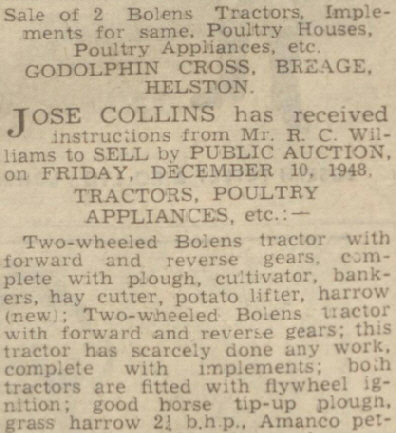
1948 Bolens advert for two tractors with plough, cultivator, hay cutter, potato lifter and harrows

And then once again….nothing……nothing until the Ride-a-matics of 1959. This is the complete opposite of Trusty Tractors and other makes where private adverts pop-up often and in different places too, perhaps Bolens didn’t make an early impact and there weren’t many about? Any ideas?

In Australia a newspaper article appears in Adelaide on the 15th March 1924 – image below. Mr Archie McLean of Victoria had imported a Bolens Power Hoe nine months earlier (making it about June 1923). Mr McLean states that the machine cost £60 and 2/6 per day pays for the petrol. 

Other Australian newspaper reports say that by May 1927 both the Bolens ‘D.J.” Power Hoe and the Bolens “Hi-Boy” tractor were available in Australia.
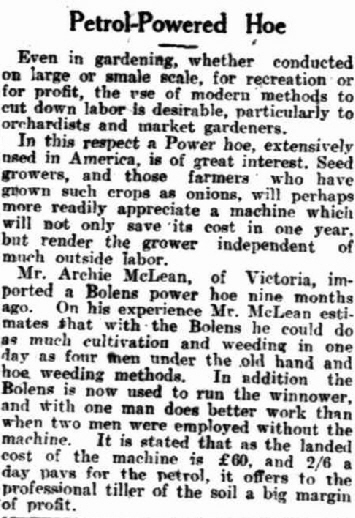
1924 Australian Bolens Power Hoe Article


Has anybody got, or seen, or heard of a 1920’s Bolens in the UK? Where did they go.

Thanks to Sandi & Roger for their help with identifying the 1927 Bolens picture in the first advert.
by alan

Machines and original engines

May 7, 2017 in Articles, Machinery


Villiers Engine Advert

Occasionally we see posts on the VHGMC forum asking if a certain machine had a particular engine fitted from new or is it a replacement engine.

A machine may get an engine transplant over it’s lifetime. Maybe the swap is because the engine has expired, maybe it was easier to put on another engine as it was cheaper than replacing worn parts or indeed the machine may have the correct engine type but swapped from a different machine and hence the colours or ID plates no longer match the receiving machine. There are many reasons. 

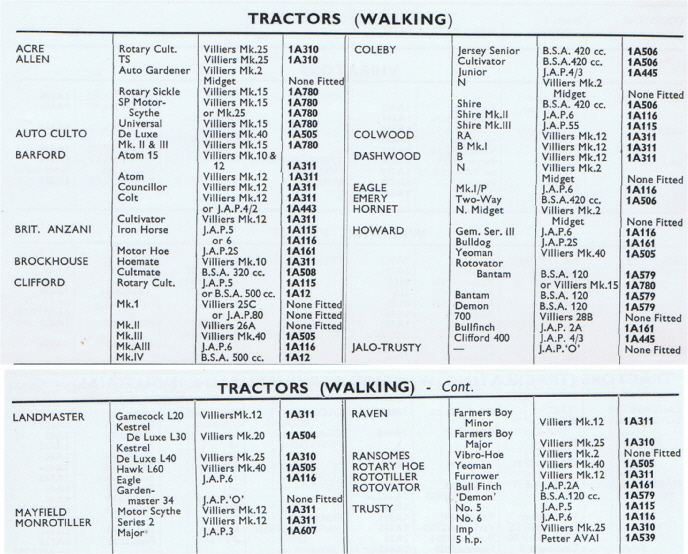
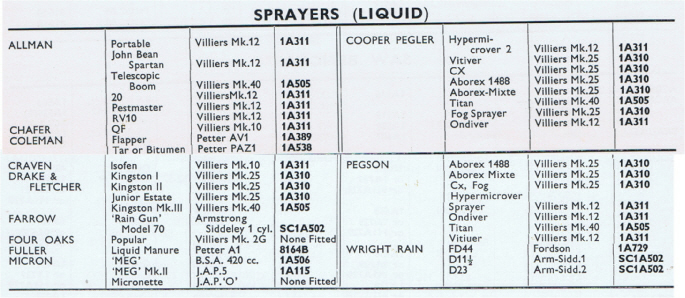
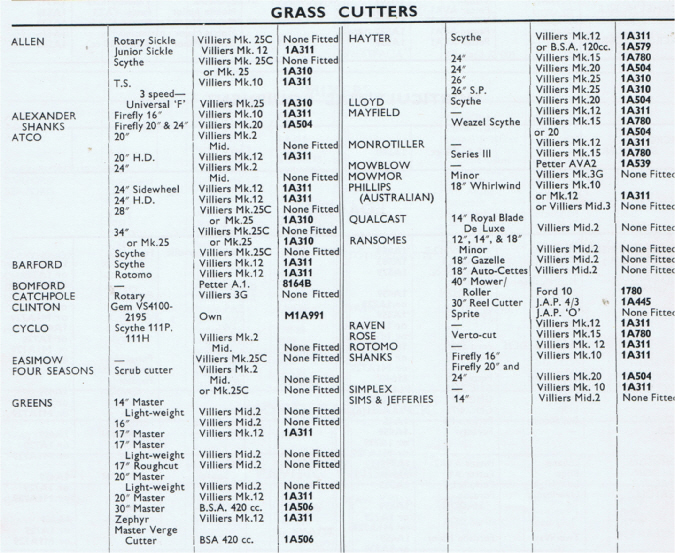
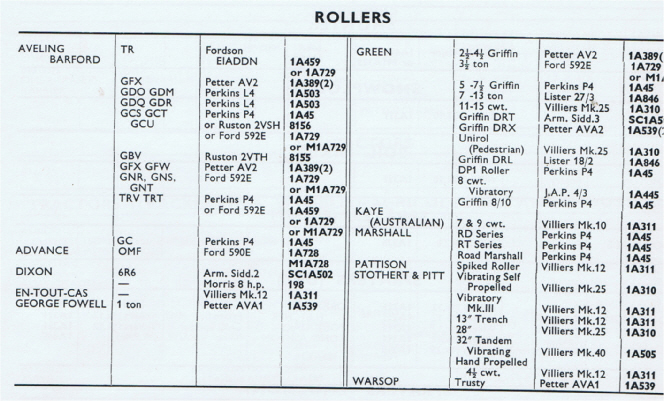
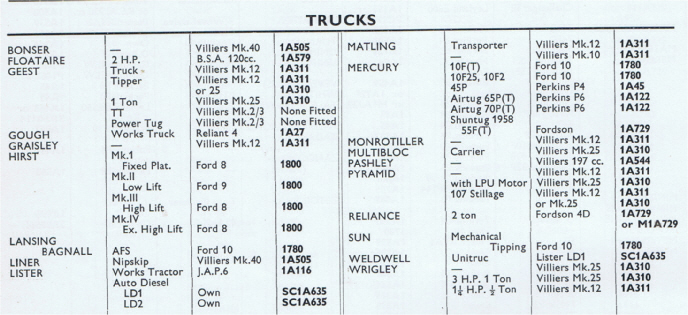
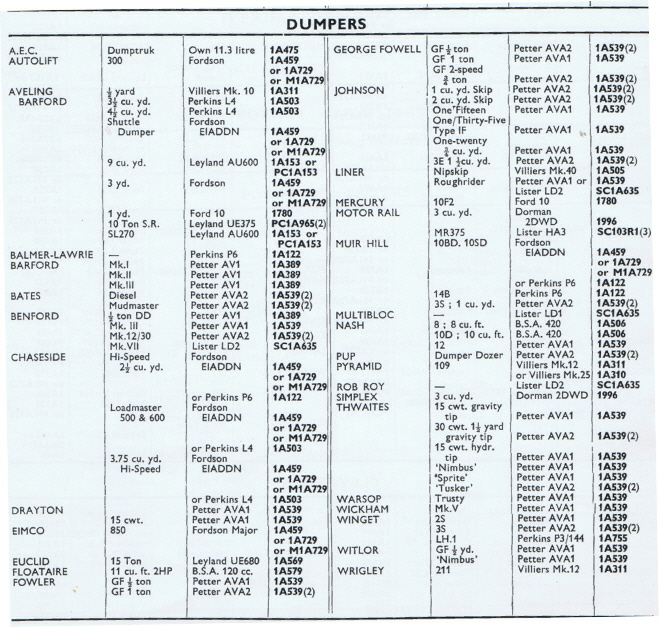
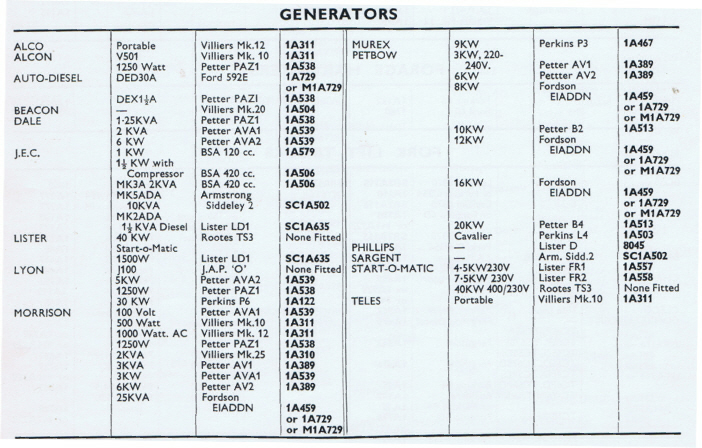
Coming across a 1965 Gaskets and Oil Seals catalogue the other week there is a list of vintage machines with their engines, list reproduced below. This isn’t an exhaustive list but nevertheless it is interesting to see the original specified engines with their machines listed alongside some popular manufacturers. 

There are a few interesting items within the pages such as a battery charger made by Dale with a Villiers Mk.20 engine. A Byron elevator with a JAP 2S engine (Probably the same as Byron who made the tractors). An Acre soil shredder with BSA 320cc engine, and Teles Chainsaws with various Villiers engines. 

Of note is an En-Tout-Cas (of the posh tennis courts) roller with a Villiers Mk.12 engine. An engine powered En-Tout-Cas roller to match the En-Tout-Cas tennis court is very upmarket indeed! I’ll make an assumption that the roller was possibly a re-badged machine, maybe a Stothert & Pitt as they used the same engines.

Below are the pages relevant to vintage horticultural machines – check to see which engines were fitted on each machine. Is your’s there?

The columns in bold were the recommended head gasket reference numbers.

Click on the images for slightly larger versions.

Walking Tractors Engine List

Sprayers (Liquid) Engine List

Sprayers (Dry) Engine List

Soil Mixers Engine List

Grass Cutters & Mowers Engine List

Soil Shredder Engine List

Chainsaw Engine List

Rollers Engine List

Trucks Engine List

Batter Charger Engine List

Flxible Drive Tools Engine List

Dumpers Engine List

Generators Engine List

by alan

Ryan and Horwool turf equipment

April 14, 2017 in Articles, Machinery

We probably all know the name of Horwool and their ride-on triplex mowers and the Landscaper 1200 tractor – see them in the Horwool gallery. In the 1960’s Horwool, based in  Romford, were also the agents for the American built Ryan turf equipment which was shipped over to the UK.

Ryan still make lawn care equipment ( https://www.ryanturf.com/about-ryan/ ). The most interesting piece of equipment from the 1960’s being the range of turf cutters that cut the rolls of turf that are laid for new lawns. These machines have knobs and levers and many moving parts and would probably make a fascinating horticultural exhibit at a show although I doubt we’d be allowed to strip the showfield at Newark Tractor Show as an attraction – but it’d draw the crowds.

1965 Ryan Turf Cutter sold by Horwool

The 1960’s machines seem to differ very little from their modern day equivalents. The turf cutters pictured right, from the 1965 brochure, were capable of cutting three acres of turf per day per machine, that’s just under 15,000 square yards. The machines automatically cut-off the turf at the correct length and had different types of blades for varying turf conditions. 

Powered by 7hp Wisconsin engines or 9hp Briggs and Stratton engines on the larger machines, they had a disc clutch and disc brake for the automatic turf cut-off. 

The only down-side I can see is that there still needed to be a man on his knees rolling up the turf behind the operator and stacking it on pallets. The brochure does show that the turf can be either rolled up or laid flat on pallets.

Has anyone got an old UK Ryan turf cutter? I’m sure that there will still be some in use today as they would be well looked after if they were heavily relied upon.

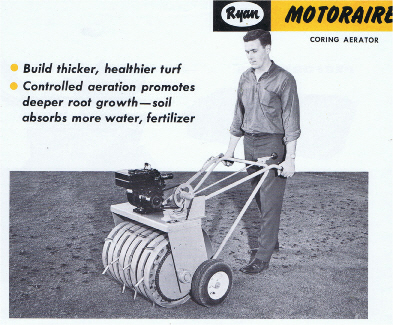
Ryan also produced the Motoraire, pictured belowwhich much like Sisis machines “removes cores of soil to open up the soil and let air, moisture and fertilizer down into the grass root zone” . Ryan add that “Aeration with a Ryan Motoraire should be used for maintaining healthy turf and for rebuilding and rejuvenating turf of poorer quality“. 

Powered by what appears to be a Briggs and Stratton engine rated at 3hp, Ryan recommend the Motoraire for “beautifying school playgrounds, athletic fields, hospitals and industrial plant grounds and home lawns, it is also highly recommended for…use by landscapers, lawn maintenance companies, rental companies and nurseries“.

1964 Ryan Motoraire as sold by Horwool in the UK


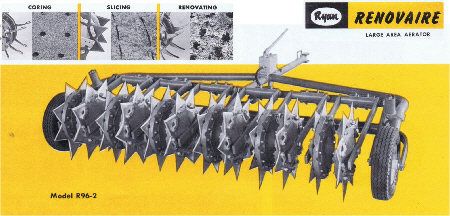
Ryan machines were not just limited to walk-behind machines, there’s also the tractor mounted Renovaire. This machine, image below from 1964, could do coring, slicing and renovating of turf and was “designed for fast, economical aerating of large turf areas” such as golf courses, sports pitches and parks. 

The operating speed when working is up to 10mph and when not working the 8′ wide machine can be transported on it’s 4.00 x 8″ pneumatic tyres behind a truck or car at reasonable driving speed on a field or site. 

1964 Ryan tractor-mounted Renovaire


Horwool also had some of their own turf equipment. There is the Powarake, and also the Powaroll, both great names

The Powarake, pictured below left, was a 3 1/2 hp, BSA powered lawn de-thatcher. With a centrifugal clutch it had 100 self-cleaning flexible steel tines and mechanically lifts thatch and debris from the lawn. Apparently tree roots, curbs and stones will not damage the tines which run at 1200 RPM. 

The  Powaroll, pictured below right, had a 3hp Briggs and Stratton engine and featured reverse for maneuvering in tight spaces. When the roller was filled with water it weighed in excess of a quarter of a ton which gave effective levelling and compaction of the ground.

Horwool Powarake and Powaroll

For reference and anyone researching Horwool, the address on the brochures is:

Horwool (Manufacturing ) LTD
Upper Bedfords
Lower Bedfords Road,
Romford,
Essex,
England.

by alan

Homemade or Serious Idea?

April 1, 2017 in Articles

Home Made Exhibit C

Home Made Exhibit C

Occasionally weird and wonderful machines turn up. But are they serious ideas, homemade affairs or ideas destined to be recycled for decades? Read on to find out about one.

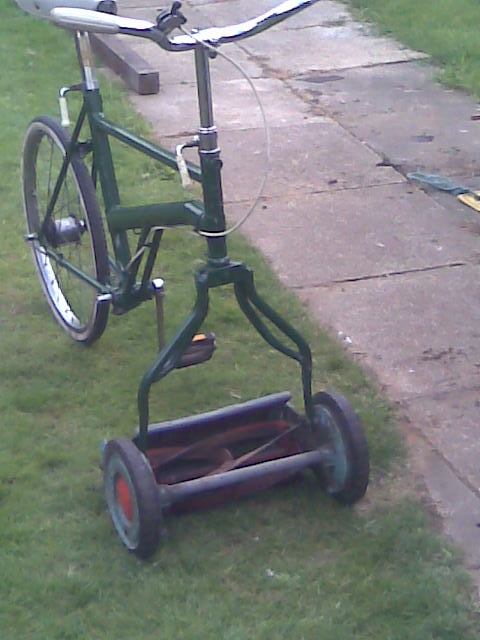
Whether they work or not one definitely homemade machine which everyone seems to be aware of is the bicycle lawnmower. The image on the right is one that we found in the photo galleries archive.

Having seen a brochure image here we’ve worked out that the mower is probably a 1960/70s Qualcast E.1 with a 12″ cut, we don’t know what the bike is.  

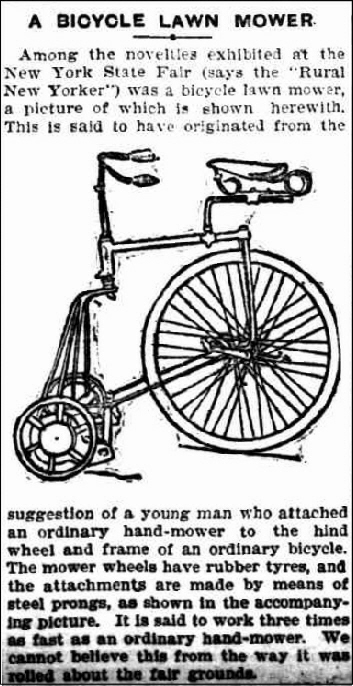
However, to usurp the 1970’s bicycle mower by the best part of a century, we found (image below) in the pages of an 1888 newspaper a reference to ‘A Bicycle Lawn Mower‘ exhibited at the New York State Fair. Although of a more precarious nature it came from the ‘suggestion of a young man who attached an ordinary hand-mower to the hind wheel and frame of an ordinary bicycle‘. 

It would seem that some ideas neither go out of fashion nor become successful.

fff

An 1888 bicycle lawn mower.


by alan

Before Starting Engine…

March 19, 2017 in Articles

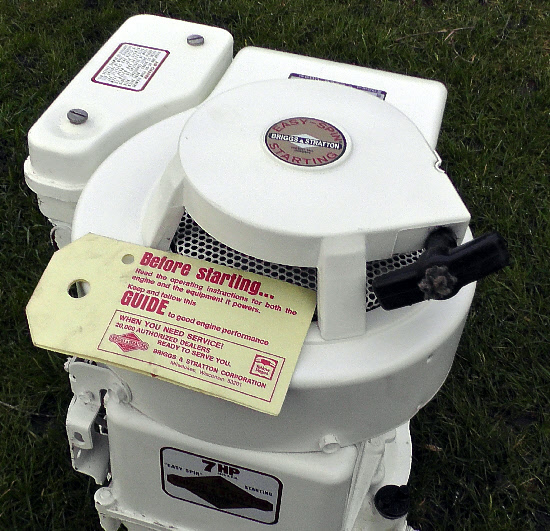
Briggs and Stratton engine with 1976 engine maintenance card

Briggs and Stratton engine with 1976 engine maintenance card

Engine maintenance is of the utmost importance, for without a running engine we are going nowhere apart from the workshop to do some problem solving. 

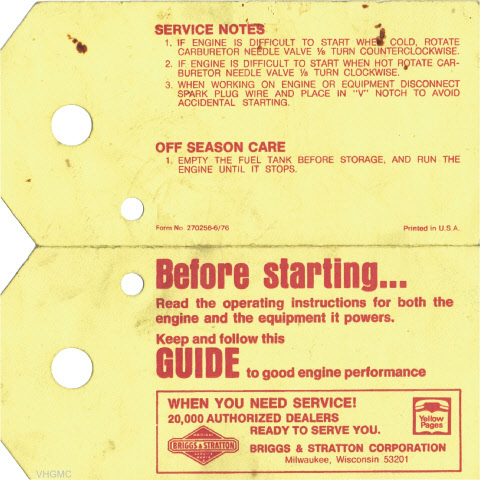
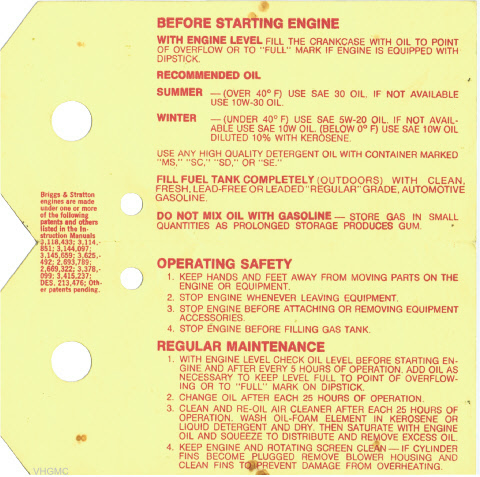
Illustrated right and shown as a full scan at the bottom of the page is a 1976 dated Briggs and Stratton engine instruction guide supplied with a new B&S engine and usually attached to the engine or pull cord.

These instructions were issued with engines as an important piece of information for the operator and as such contain the message ‘Keep and follow this guide to good engine performance‘ but we wonder how many instruction guides were kept or did they end up oil-stained on the workshop bench to be discarded at a later date?

Before Starting Engine…

The B&S guide details the recommended oil levels and also the oil to be used in summer (over 40F or 4C) and winter (under 40F or 4C) and colder (under 0F use SAE 10W oil diluted 10% with kerosene). These engines would have been supplied worldwide and powered many implements in varying temperatures from mowers in summer to snowblowers in the depths of winter. 

Looking at the offerings of cheap and cheerful mowers at a DIY store over the weekend we noticed they still have labels with instructions, although limited sometimes to just informing the operator that the engine contains no oil and needs purchasing separately. I know of someone who omitted to fill a new mower engine with oil and it had a very short life indeed. 

As we know, dragging the mower out at Easter, chucking in some of last years winter-stored fuel and hoping it starts is not the best idea, sensibly the B&S guide recommends for ‘Off Season Care’ to ‘Empty the fuel tank before storage and run engine until it stops’. For a new season then ‘Fill fuel tank completely (outdoors) with clean, fresh, regular grade automotive gasoline’. 

According to the B&S guide for regular maintenance the engine oil should be checked before starting the engine and after every five hours of operation. Also change the oil after each 25 hours of operation, re-oil the air cleaner at 25 hours, washing the oil-foam element in kerosene or detergent and then dry, saturate with engine oil and squeeze to remove excess oil – I remember that from college years ago. How many domestic lawnmowers get that treatment nowadays? 

Finally ‘Service Notes’ on the guide helpfully advise that if the engine is difficult to start when cold then rotate the carburetor needle 1/8 turn counterclockwise, if it’s hard to start when hot then turn it 1/8 turn clockwise. ‘When working on engine or equipment disconnect spark plug wire…to avoid accidental starting’  – I’m sure we all know stories about someone accidentally starting an engine via turning the mower blade.

Briggs & Stratton Engine Maintenance Card

1976 Briggs & Stratton Engine Maintenance Card – Side 1

Briggs & Stratton Engine Maintenance Card - Side 2

1976 Briggs & Stratton Engine Maintenance Card – Side 2

by alan

1936 Catalogue Sprayers

February 21, 2017 in Articles

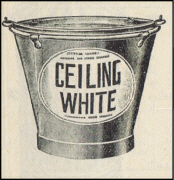
A popular paste distemper. 28Lbs for 4/6.

A popular paste distemper. 28Lbs for 4/6.

It’s 1936 and we are looking through the latest catalogues for a new sprayer, the choice is wide with sprayers to suit every budget and every spraying need. A new sprayer may be needed because there’s a new job such as whitewashing to be done as in the image on the right, or perhaps the old sprayer has started to fail and corrode from sulphur or lime, or even there’s been some dubious chemical through the old sprayer such as Corry’s ‘Weed Death‘ which was advertised as ‘Better than Arsenic‘ for killing weeds and plants, their adverts were a bit grim and macabre, we’ll thoroughly wash our hands and move on.

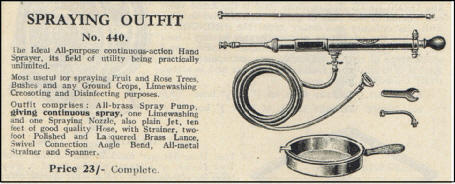
Whatever the reason for a shiny new sprayer, they start at a low-price point, or as we say in Yorkshire ‘For the more economically-minded man’. An all-purpose hand sprayer for spraying fruit and roses, bushes, crops, limewashing, creosoting and disinfecting was available for 23/- as in the image below. This was probably a good entry point sprayer but a pneumatic sprayer would be even better…..

1936 Complete all-purpose spaying outfit

1936 Complete all-purpose spaying outfit

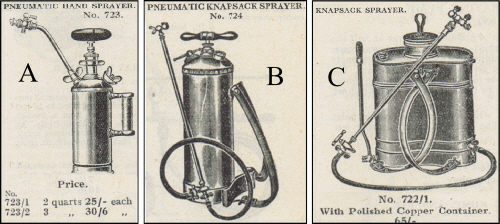
For the greenhouse a small handheld pneumatic sprayer would be ideal as in image A below. This sprayer ‘being made with tubular handle is most useful for spraying grapes, rose trees, and tall plants out of reach of the ordinary sprayer by fixing same on pole or ordinary bamboo lance‘ – so now we know why some sprayers have hollow handles!

The knapsack sprayers in images B and C were able to hold a greater volume of liquid with B being able to spray corrosive liquids too. Knapsack sprayer C had to be specified with a tinned copper container in order to spray corrosives such as lime and sulphur. This knapsack sprayer was quoted as being ‘The strongest and best finished Knapsack Sprayer on the market‘ with the best leather shoulder straps and a 39 inch lance. 

Pneumatic hand sprayer and knapsack sprayers

Pneumatic hand sprayer and knapsack sprayers

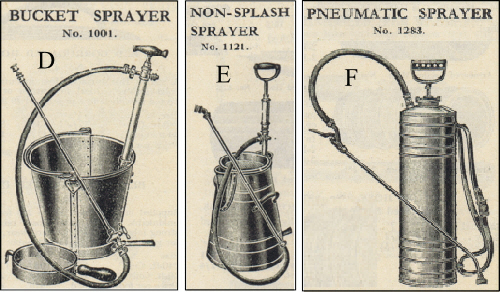
The pneumatic sprayer in image F below was particularly suitable for disinfectants and insecticides and could either be carried on the back or sat on the ground during use. The bucket sprayer D and Non-splash sprayer E were also ground-dwelling sprayers. The bucket sprayer is a very common item often seen at sales, complete with a four gallon bucket and a double-action brass spray pump it also came with an all-metal strainer to keep lumps out of the mixture when filling and cost 35/- complete in 1936. 

The Non-splash sprayer in image E was ‘an entirely new departure in spraying machine construction…built on the lines of a milk churn..with a zinc gauze strainer thereby obviating all danger of the liquid splashing when being transported‘. It was fully guaranteed to give many years excellent service and was also 35/- or 39/- with lever handle.

Vintage bucket sprayers including non-splash and pneumatic

Vintage bucket sprayers including non-splash and pneumatic

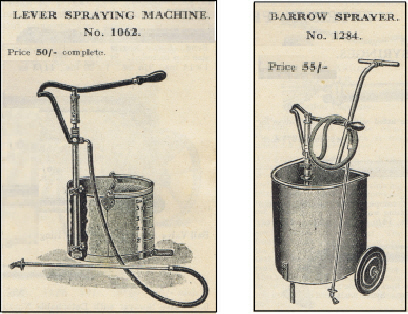
The lever spraying machine, image below left, was suited to large areas of limewashing, the lever action enabling a high pressure to be gained and a finer spray too. The hose connection could be swapped over so the machine could be used either left or right-handed. The barrow sprayer, right image, is another lever-pump sprayer suitable for all classes of spraying with the pump being detachable so the barrow could be used for carrying water, rubbish or many other goods and as a multipurpose item was painted green rather than being unpainted, was this so it blended into the garden better or just a selling point?

Lever spraying machine and a barrow sprayer

Lever spraying machine and a barrow sprayer

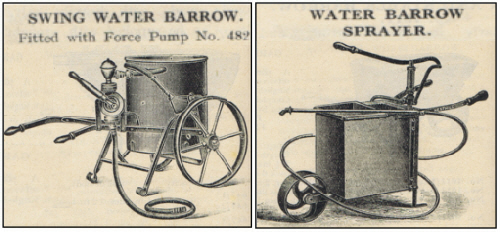
But in the world of sprayers bigger with more gadgets could be better. The single-wheeled water barrow sprayer in the right image below has a galvanized tank measuring 16″ x 18″ x 12″ (10 gallons) which is painted inside and out, with an anti-spill rim and sprayers for plants, a jet for windows and also for car washing too. The first car power washer documented?

We have included here the swing water barrow on the left because it’s so advanced for loading water into itself with a hand-powered 1 & 3/4 inch semi-rotary pump with air vessel. Ideal for carrying water about for cleaning up after white washing the buildings. Price? A 40 gallon barrow with rotary pump and wheels for 96/- . 

Vintage Swing Water Barrow Sprayers

Vintage Swing Water Barrow and Barrow Sprayer


Note:
Although the sprayers are unmarked there’s a reference to Westhill sprayers, more than likely the sprayers were mainly from that one supplier. 


by alan

David Brown & Bolens

January 31, 2017 in Articles, Machinery

Did Bolens inspire the David Brown colour scheme?

Did Bolens inspire the David Brown colour scheme?

Collecting and preserving a machine is often much more than just having the physical machine itself, although one machine is never enough and the collecting bug bites hard. Also accumulating brochures, leaflets and memorabilia about a certain manufacturer can add to the interest, sometimes it’s also vital to have the extra information when rebuilding or desperately trying to reconstruct a machine from a heap of parts and some rusty tinwork. It’s all about research and a worthwhile investment, or so we convince ourselves as we buy another vital brochure on the internet. 

There are some members who have an interest in David Brown (photos in the gallery) . Searching online there’s a terrific amount of David Brown related information including not only the typical brochures and literature but also factory photographs, films, and machine history. There’s even have a David Brown museum (I’ve visited) with tractor exhibits and there’s a museum visit video on Youtube. 
David Brown Colour Chart

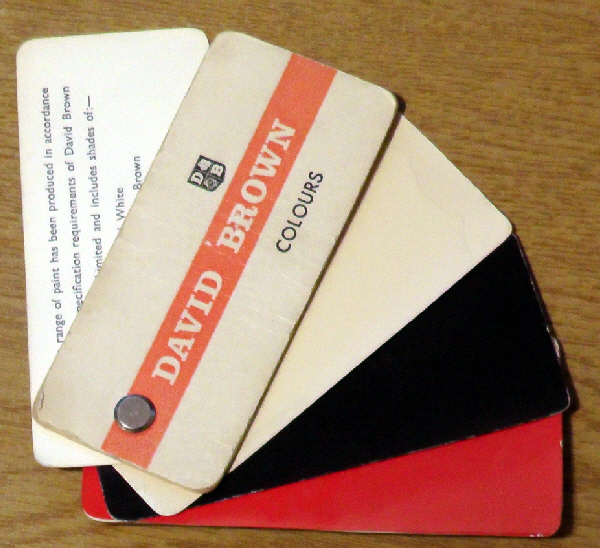
David Brown Colour Chart – Orchid White, Metallic Chocolate Brown, Poppy Red. Inspired by Bolens?


However even some items escape being in a museum and a few years ago I acquired a 1960’s David Brown factory issued colour chart, shown on the right, it’s something no one seems to have seen before, it’s small and fragile and that may account for few surviving.

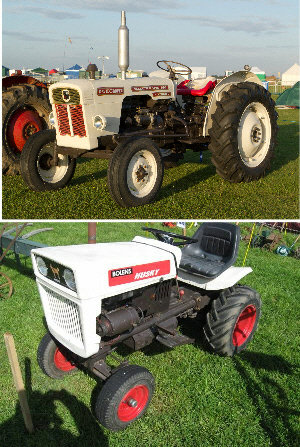
What’s more interesting, and more detailed information can be found on the internet about it, is that the David Brown orchid white colour scheme from around the mid 1960’s onwards was apparently inspired by the livery of Bolens garden tractors – namely the white and brown scheme similar to that of the photograph of the Bolens at the top of the page . This colour scheme is shown in the David Brown tractor photo above it.  A fascinating piece of history.

See more Bolens and their various colour schemes in the Bolens gallery

You never know what small pieces of history or documentation may turn up either on the internet, on a stall at a show or from another VHGMC member or a member of the public. If you haven’t already seen Charlie’s Rototiller on the forum then have a look to see what can turn up. 

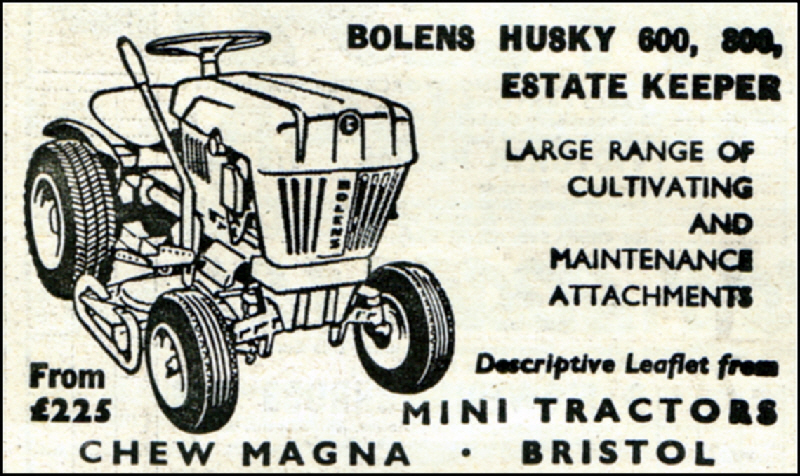
A 1964 Bolens Husky Advert. £225.00. Mini Tractors, Chew Magna, Bristol.

A 1964 Bolens Husky Advert. £225.00. Mini Tractors, Chew Magna, Bristol.

by alan

Vintage Snow Blowers UK

January 11, 2017 in Articles, Machinery

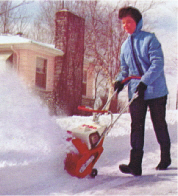
Moving snow with a Toro Snowpup

Moving snow with a Toro Snow Pup – late 1960’s brochure image, American but from a UK brochure.

As it’s winter we have had a look to see what vintage snow-moving equipment exists in the UK.

There’s blade attachments for various machines such as the Allen scythe, Merry Tiller and Barford to name just three. But more specifically we looked to see if there are any vintage snow blowers or snow throwers in existence. 

We are all aware that in the USA there’s a big range of snow moving machines for residential use from the large manufacturers. A 1962 American issue of ‘Popular Science’ informs us that amongst the manufacturers were: Ariens, Bob-Cat, Bolens, Eska, Graveley, Jacobsen, Jari, Motor-Mower, Reo (of Wheelhorse), Sears and Roebuck, Simplicity, Snow Bird, Snow-Boy, Storm King and Toro. Most of these manufacturers are very well known to us and so it’s not hard to image that some of those 1960’s and 70’s machines may have made their way over to the UK.

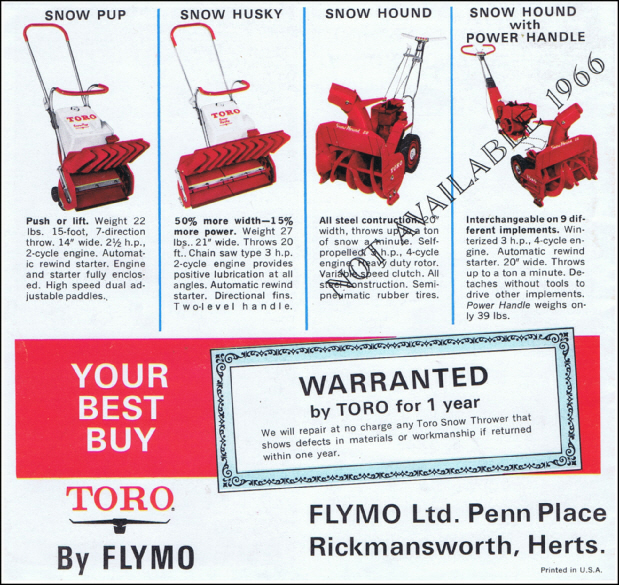
Toro Snowblowers 1966

Toro Snow blowers 1966

These American specification machines varied in HP from 2.5Hp (Reo) up to 7.25HP (Simplicity) and their width of cut from 16″ (Jacobsen) to 36″ (Simplicity). The means of propulsion also varied between self-propelled or being pushed by hand. 

The only evidence we have  that describes snow blowers being marketed in the UK is a 1966 brochure by Toro although to be fair we don’t know how many were ever sold. The fold-out leaflet bears the address of Flymo Ltd, Penn Place, Rickmansworth, Herts in 1966. Image on the right.

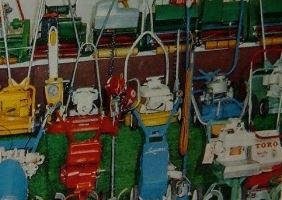
The Toro models available were the Snow Pup and Snow Husky. The Snow Pup had a 14″ wide cut and 2.5HP engine and able to throw the snow 15′. The Snow Husky was larger with a 3HP engine, 21″ wide cut and a 20′ throw. The UK brochure image below shows a Toro snow blower in the bottom right corner of the dealerships lineup of various machines.

Toro

This 1967 UK catalogue photo shows a  Toro Snow Blower tucked away in the bottom right corner

Currently Toro are the only pedestrian snow blowers we can find evidence of although we do know that both Bolens and Snapper did market and sell later in the UK, their machines occasionally appearing on auction sites.

Do you have a vintage snow blower in the shed or know of any that were UK bought machines?

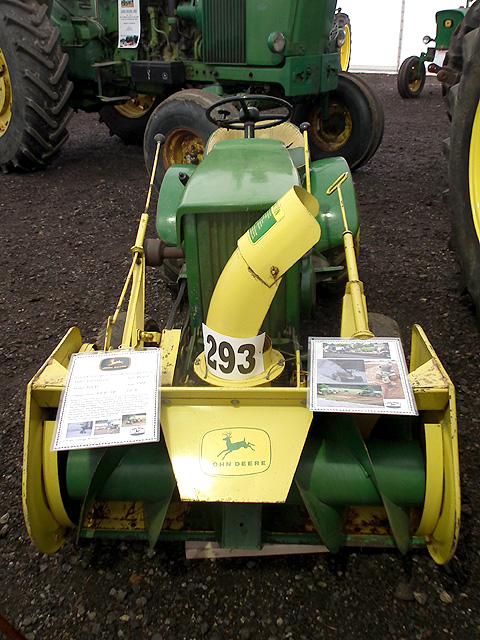
John deere 110 with Snow Blower UK

John Deere 110 with Snow Blower UK

Of course snow blowers are not just pedestrian machines and there are numerous manufacturers that made blowers to fit their garden tractors. 

John Deere made snow blowers for their range of 1960’s and 70’s garden tractors from the 110 models onwards and one appeared at Newark Tractor Show a couple of years ago. Image right.

Wheel Horse also manufactured snow blowers for their tractors, they sometimes appear again on internet auction sites. Interestingly a1967 wheel Horse advert view the advert here states that although a snow blade/plow is available (they are quite common second-hand) there is no mention of a snow blower – perhaps they were short of space in the advert. Although a few years later a 1975 brochure (by Mountfield, Maidenhead) and price list for Wheel Horse lists a 37″ snow blower for the Commando tractor at £195, a 42″ snow blower for the Charger and Raider tractors at £210 and a 48″ snow blower for the D series tractor at £240, all plus vat. 
Other tractor manufacturers listing snow blowers for UK sale (whether any were sold here or not is unknown) include Roper with their 1980’s tractors having 42″ snow blades and 40″ snow blowers, the tractors appear occasionally but never seen the blowers.
International Harvester with the 1960’s Cub Cadet tractors (brochures marked as Harvester House, City Road, London) produced a range of snow moving equipment to compliment their tractors although none has appeared in the UK yet.

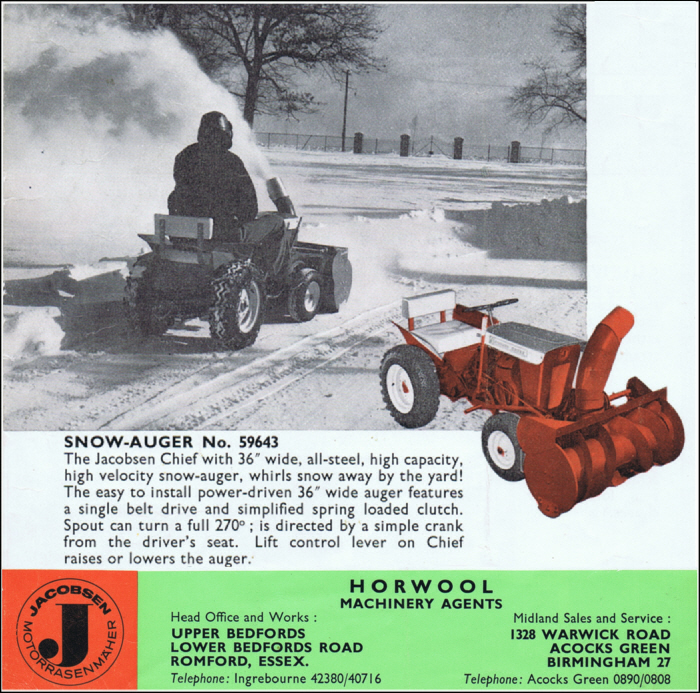
jacobsen-chief-snow-blower

Jacobsen Chief in a UK brochure

It just shows that because something is in a UK brochure intended for the UK doesn’t mean the implements ever reached UK shores. Alternatively, perhaps they were in such small numbers that either none have yet surfaced or none have survived?

Jacobsen, marketed by Horwool from their Romford and Birmingham offices had the Snow-Auger in their brochure. The Jacobsen tractors appear with snow blades in the UK but has anyone got a Jacobsen Chief with a snow blower as in the image on the right? An image of the Jacobsen with a blade can be seen here in the gallery.

There’s nothing like a UK machine though and Westwood kitted out their garden tractors with optional snow plough and a wide vision canopy. Image at the foot of the page

Sure it’s no snow blower but the additions it does have gives the machine a little added versatility and would sure be a good reason to play out in winter. 

Finally, one question we came across, and a bit of a tongue twister is: “How much snow should a snow blower throw when a snow blower’s busy throwing snow?”.

Can anyone add to this UK snow themed article?

westwood-ready-for-winter

Westwood ready for winter duties

by alan

Atom Tractor – Switzerland

December 31, 2016 in Articles, Machinery

Barford Atom Single Wheeled

Barford Atom Single Wheeled at Tractor World, Newbury.

Researching the history of a machine can be fascinating and sometimes brings up how and where machines have been distributed throughout the world, often all it takes is a photograph or a nagging question and before we know it a whole shed load of information appears. This is very true of the Barford Atom Tractor as mentioned in the December 2016 issue of ‘The Cultivator’ magazine, members can download a copy here. A single-wheeled Atom was exhibited at Tractor World, Newbury in October, and Charlie photographed another at the Museum of English Rural life (MERL) also in October. Below is some more information about the single-wheeled Atom tractor.

Prototype

1945 Prototype by Mechanised Horticultural Implements of Hampshire.

According to the excellent reference book 70 Years of Garden Machinery, Mechanised Horticultural Implements of Hampshire demonstrated a prototype Atom tractor in 1945 with a planned name of Atom Major. The image on the right from the VHGMC archive is of the prototype which varies greatly from the final machine and had hardly any resemblance to what went into production. Click the image top-right from Newbury to see the machine.

We also have a 1947 photograph, below right, of the inventor, a Mr G.H.F. Knight along with the now production ready single wheeled Atom, this is the point where the tractors went into proper production when Barford Ltd became involved in the manufacturing and marketing. 

But there’s additional information which takes the Atom on a little known journey to Switzerland. I suppose this article could be called ‘Little Atom’s Big Swiss Adventure’ as they obviously had high hopes for their machine and must have gone to great lengths to set up numerous demonstrations.

April 1947. Mr G.H.P. Knight (left) inventor of the Atom Tractor, and the Earl of Portsmouth. They are both directors of Horticultural Implements LTD, which have entered into an agreement whereby Barford (Agricultural) LTD undertake the whole of the manufacture and selling of this miniature tractor. As of May 1947 less than 100 Atoms are in use.

April 1947. Mr G.H.P. Knight (left) inventor of the Atom Tractor, and the Earl of Portsmouth. They are both directors of Horticultural Implements LTD, which have entered into an agreement whereby Barford (Agricultural) LTD undertake the whole of the manufacture and selling of this miniature tractor. As of May 1947 less than 100 Atoms are in use.

In 1948 a newspaper article ran:  ‘Grantham’s Atom tractors, smallest in the world, and manufactured by Barford Ltd have gone to Switzerland this week, where, following demonstrations as from next Wednesday it is hoped to capture the Swiss market.’

The article continues with: ‘Three machines have been sent and a vine sprayer has been produced, this special machine being designed for operating on the very narrow terraces of the Swiss countryside to keep down disease among the vines by spraying them with insecticide’.

It would seem that transport issues and getting to Switzerland had to be resolved at the last minute as ‘In view of transport difficulties the company decided to convey the machines from Grantham to Geneva on their own lorry, but this vehicle supplied a few years ago by the Grantham Motor Company had already covered 30,000 miles. With time running short in which to make it suitable for the journey, it was sent to the Motor Company for whom the Ford Motor Company provided a new engine, which was installed within two days. New tyres were fitted, the lorry repainted and it left on Sunday.’ Mr Thatcher of sales staff left to make preparations in Switzerland, and today Mr Parsons, general manager goes by air to Geneva to take charge of the demonstrations which are to be given at many centres. Lord Portsmouth and Mr Knight (in the ‘Inventor of the Atom’ image above) join the party at Geneva. The Atom is already finding a good market in New Zealand, Kenya, South America, the Channel Islands and Eire.

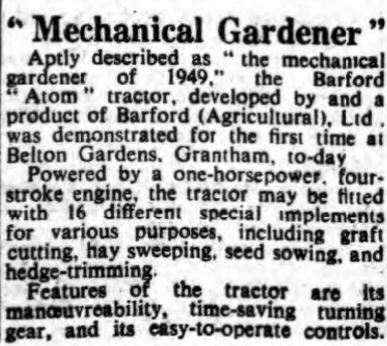
The following year a UK newspaper article appeared describing the Atom as “The mechanical gardener of 1949”.  and that it had just been demonstrated for the first time at Belton Gardens, Grantham. Powered by a one-horsepower, four stroke engine, the tractor could be fitted with 16 different special implements for various purposes. (image below).

Barford Atom April 1949 - UK advert

Barford Atom April 1949 – UK advert

Click the images for larger versions.

Has anyone else got any more information? Let us know!