
Forum Replies Created
-
AuthorPosts
-
March 17, 2025 at 7:01 pm #43537vhgmcbuddyKeymaster
Modest progress on flywheel assembly. I and Mark ,my long suffering associate, have re-installed the points assembly, and determined that points appear to open at prescribed 5/32″ before TDC. We await delivery from UK of coil etc to determine that there really will be a spark.
Meanwhile, looking at the cutter bar, we are short of one Blade Pad – the triangular casting that is adjusted to keep the blades in contact with the “fingers” (don’t know correct term) I wonder if anyone knows a supplier, or has one for sale.
Regards Dave SeabrookMarch 17, 2025 at 9:17 am #43516vhgmcbuddyKeymasterHi could anyone help us identify this please.
Attachments:
March 4, 2025 at 8:32 pm #43472vhgmcbuddyKeymasterMany thanks, I was debating that this might be an option. Thanks for the input.
March 3, 2025 at 3:11 pm #43469vhgmcbuddyKeymasterMany thanks to Andy and Kevin for their posts.
After great attempts I am sure that I will not be able to get the flywheel off the crankshaft.
Cutting it off with an angle grinder does not appeal, and would need a correct replacement and the need to set the timing
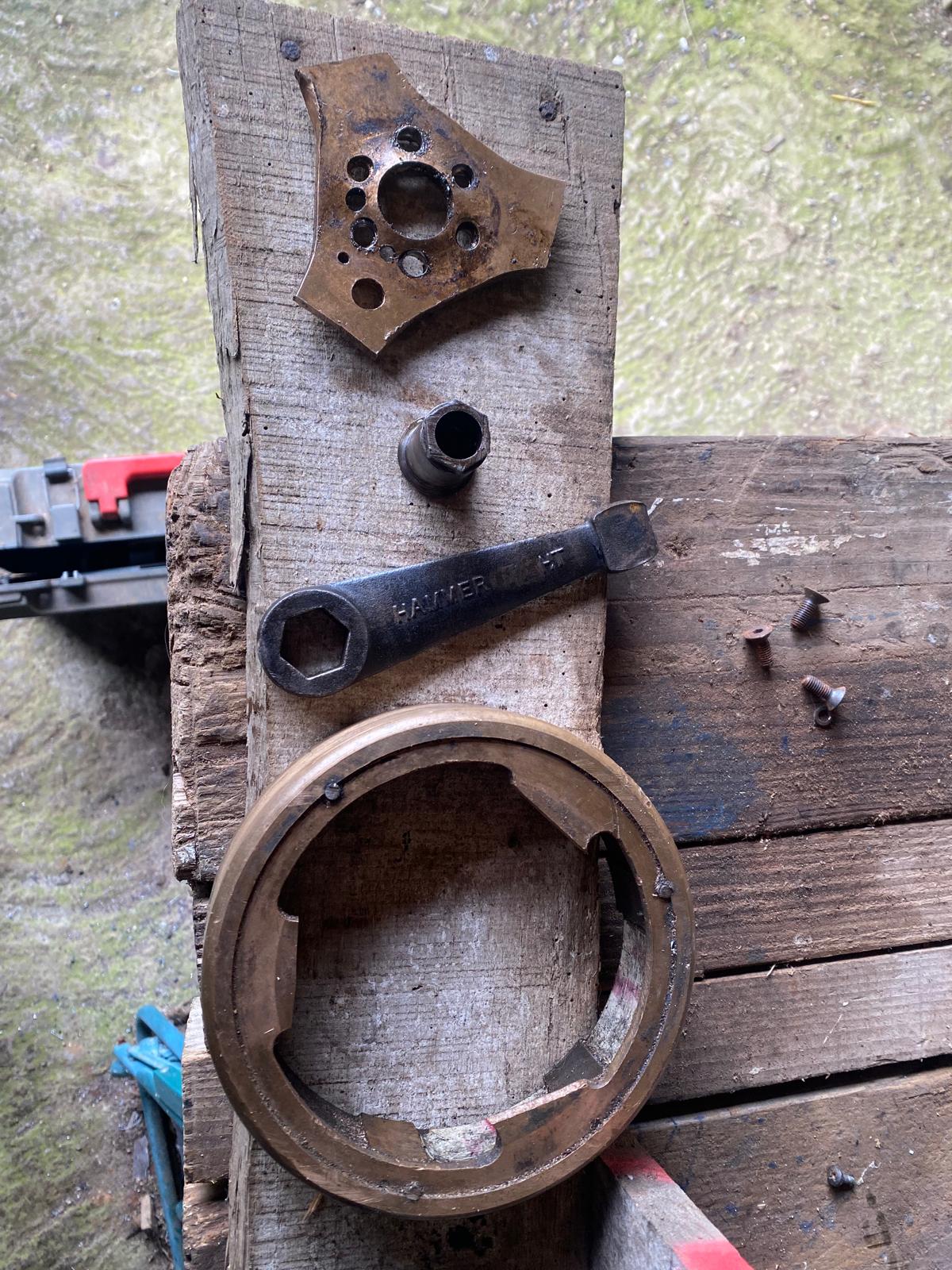
The plan is to take the remains of the brass wheel off the crankshaft (drill out the rivets :see photo) and replace it with the wheel from a flywheel assy from Ebay (cost £17) Before fitting the replacement wheel I will have access to the points but not to the coil fixing which is screwed from the back of the armature plate. The original cam on the flywheel boss should be correct for
the points timing. Proceeding to the Kettering system, I will not connect the capacitor or the coil, as these will be fitted externally, and the coil needs one wire from the points. A coil
will cost about 30€ compared to th VilliersParts rewind for £80 plus carriage to & from France.
I already have a battery and of course it will have to be recharged on the bench
Thanks again for your interest: no doubt there will be ups & downs. I will, if I may, let you know how it goes
Regards.Dave SeabrookMarch 3, 2025 at 1:18 pm #43468vhgmcbuddyKeymasterIf the remains of the flywheel wont come off with a puller you will have to carefully cut it off and split it with a grinding disc.
IF the crank isn’t ruined then there is no reason why you shouldn’t just fit a new coil, condenser and points and away you go.
Way cheaper, and less bother than messing with coils and batteries.February 26, 2025 at 7:17 am #43463vhgmcbuddyKeymasterThank everyone for there help much appreciated.
February 24, 2025 at 9:07 pm #43461vhgmcbuddyKeymasterNothing like lighting the touch paper then standing well back!
As said previously you own it, so please do what you see fit, there are no hard or fast rules. Just one point I need to pull you up on. original condition is brand new, not pulled out of a barn with rust on!
There are those which say they conserve for the future (what ever it holds) I’ll keep my thoughts to myself on that one.
In our end of the field the age of the machines we handle are mostly irreplaceable, with parts missing where we have to have parts made at the foundry, then machine them out, so painting is part of the process but again its not for everyone. What ever you do you’ll make a lot of knowledgeable friends here!February 24, 2025 at 5:59 pm #43455vhgmcbuddyKeymasterHi Andy,
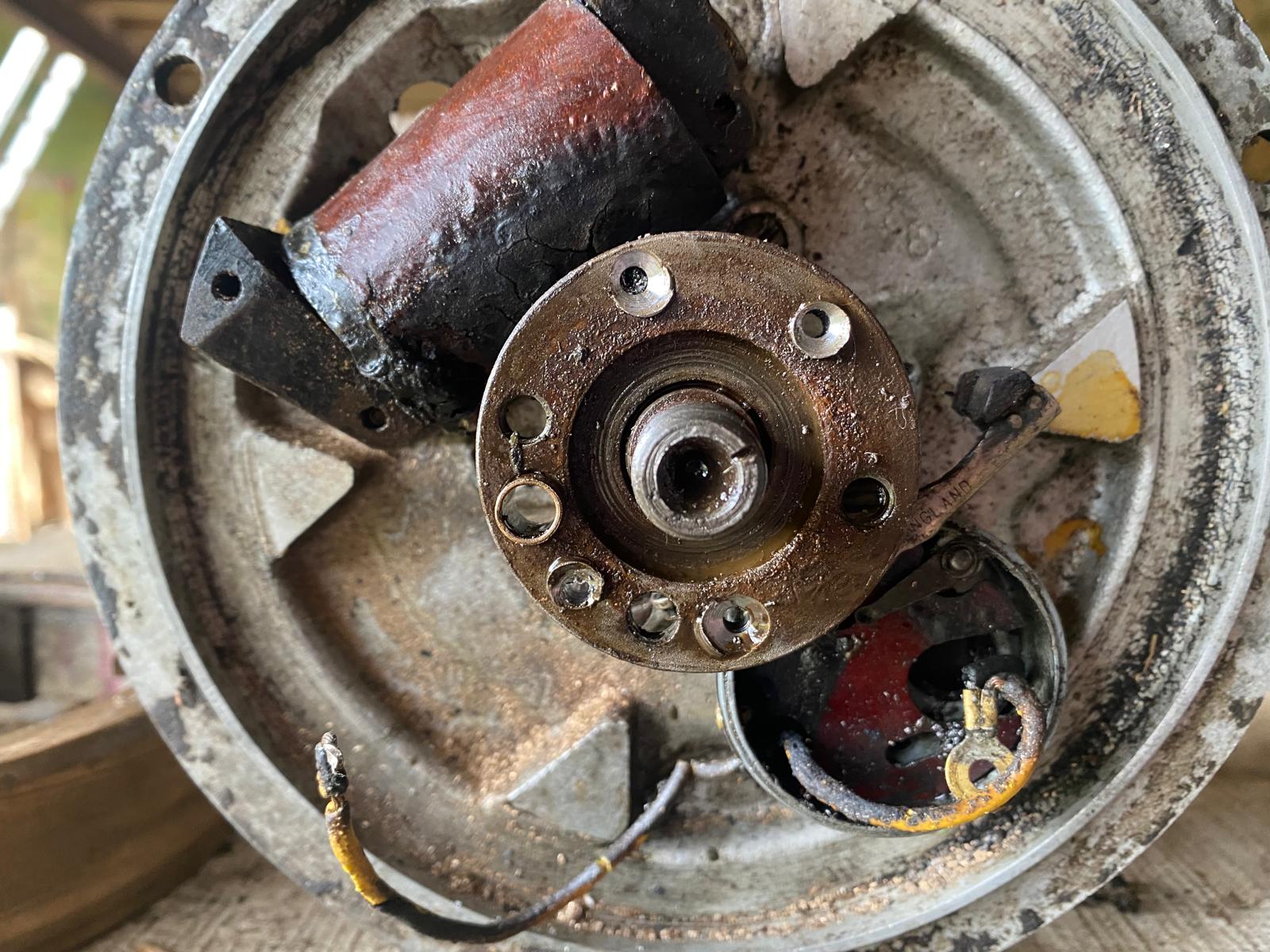
Here are a couple of photos of story so far. Visiting family have helped me dismantle the old boss which, as you can see from the photo, is still stuck on the crankshaft, and we now have prepared my ebay flywheel to replace it without disturbing the boss, and hence timing.The next phase is to reinstall the points and check the timing and, if OK, wire in a Kettering type ignition system. This way we abandon the Villiers coil and capacitor, using only the points to time the spark.
Best wishes…… DaveAttachments:
February 23, 2025 at 7:52 am #43447vhgmcbuddyKeymasterSorry my apology I have been working a Villiers and it was stuck in my head. You are correct they both are fitted with JAP engines and I am looking for a spark plug recommendation for these JAP engines. Most automotive parts retailers dont even have catalogues now and if you ask for a listing for a JAP stationary engine they ask which Japanese car do you have?????
Many thanksFebruary 22, 2025 at 10:48 am #43438vhgmcbuddyKeymasterHi Dave,
Many thanks for the post. Just to clear up one point about ignition systems on small engines and tractors. They all work along the same principle with a current flowing through the primary windings of the coil generating a magnetic field. Which in turn saturate the secondary windings with lines of magnetic force. When the current flowing through the primary is interrupted, the magnetic field rapidly collapses, which cuts through the secondary, generating a very high voltage which seeks a path to ground. This arcs through the spark plug electrode gap, producing the spark that ignites the fuel/air mixture.
Obviously the higher the low tension voltage in the primary, the greater high tension one is generated in the secondary, thus a bigger spark. With a points/condenser system, just as the points open, the current that was flowing through them seeks a path to ground. The primary coil has a degree of resistance which prevents this. During the opening sequence, the points have a tiny gap and the current can arc and go to ground through that, its an easier path than through the primary windings. The purpose of the condenser (a capacitor in all but name) is to take the current away from the points as they open and store the electrons until the points close again when the current will then flow though the primary. The capacitor has two functions, to prevent arcing at the points and to store electrons so they can be used to boost the current when the points close. More current though the primary and the speed at which the current is stopped from flowing through the primary increases the rapidity of the collapse of the magnetic field which generates a higher voltage in the secondary. The condenser is a vital part of the points system and one that is often over looked when a service or overhaul is carried out. I know this to my cost, wish I had studied ignition systems in more detail when I was younger. I got to the level of understanding the principles, but not how the different components operated in unison and the actions of each upon the others. Could have saved hours of trying to start motorcycles, garden tractors and mowers. Have found from experience and research small engines need a 6mm air gap spark to operate well. Under cylinder compression conditions, it is harder for the HT current to pass a gap. So for it to pass say a 0.025” gap consistently and with sufficient intensity under pressure, a 6mm air spark gap is a reasonable equivalent. A spark from a plug resting on ground is no test at all.
In the Kettering system the primary is supplied with a permanent low tension current from a battery. With magnetos, the current is supplied when the magnet passes close to coil of copper wire wrapped around a soft iron core. Lines of magnetic force that go in one direction are produced in the iron core as the north end of the magnet passes over it. These lines change direction when the south end passes over. The point at which the lines of force change direction is called flux reversal and in that instant a voltage spike occurs in the primary and it is when the points open. In the transistorized module you have mentioned, there is a sensor that ‘sees’ the flux reversal, the sensor operates the transistor, which is in simple terms is a switch, just like the points are. Current is stopped from flowing to the primary. The big advantage of the transistorized system over the points/condenser type is the time it takes to stop the current flowing through the primary is almost instant and complete. The collapse in the magnetic field is more rapid, the voltage generated in the secondary higher. With points there is some milliseconds where the current is going to ground through the contact surfaces just as they part, even with a good capacitor. The collapse in the magnetic field is not as rapid.
Have had an 8mm air gap spark from a transistorized module and modern engines are generally easier starters than the old stuff us silly buggers mess about with. But have found as long as a spark of 6mm is obtained with the lower state of tune of an industrial engine, it is perfectly adequate.
To stop interference to TV’s there is a resistor in most plug caps. If you had a very weak spark, you may use a non resistor type. But have found if I achieve a 6mm spark, the resistor type is OK.
If you still want to do a Kettering system, think you will need a two wire 6v ignition coil. In the UK they are available on ebay as cheap as chips, presume its the same in France. Personally if the replacement flywheel is the same as the original, I would still get the hub off and take it from there. Would not be keen on using the machine without fan cooling and the affect of the flywheel inertia. If the coil tested good, would fit a Meco unit. Maybe if the coil was duff, I could contemplate a total loss battery system. The faff of the limitations of the battery would put me off. Much prefer to get it out of the shed, check the fuel, turn it on, choke, tickle, a pull on the rope and off she goes.
Phew, hope I have explained everything in terms you may understand. Expect an electronic engineer would do a better job than me at it. Off now to continue working on a nearly new MacAllister strimmer that is very hard to start because it has a 4mm spark. It is a piece of Chinese plastic crap, but have managed to get the coil off. Got to see if I can get an after-market replacement. Am a big fan of transistorized ignition, but have found a few that underperform. Am not sure if the vibration and heat generated by a small engine damages the circuit components over time. I have no way of testing them, so its just a replacement job.
Grahame
February 22, 2025 at 8:02 am #43437vhgmcbuddyKeymasterMany thanks for yet more useful facts and suggestions. To Andy – yes you are right : my photo shows me holding the outer rim of the flywheel which I have cut away in an attempt to get better access to points and for heat. My post on Feb mentions this . The steel shaft of the f/wheel assy. is still siezed onto the crankshaft.
To Grahame: Thankyou for telling me about Mr Kettering. The site of DENSO shows a neat drawing
of the circuit. I find that Mr Kettering was American, probably not connected to the town in
Northants – which I know well having lived in Market Harborough for may years. Thanks also for pointing out that a six volt ign. coil will be just as good as 12v. I happen to have a 6v recharg.
battery salvaged from some long forgotten scrapped machine
If I might digress, I am intrigued by the need for contact breaker points in the system. On my 2 – stroke strimmer and my Briggs & Stratton 4 – stroke lawn mower. the ign, coil is similar to Villiers, and the magnet on the flywheel whizzes past it (as close as card thickness) and this makes a spark; there are no opening contacts and, I think, no capacitor. Similiarly, on DENSO circuit for Mr Kettering, no capacitor is shown. In the Old Days I used to think that a cpacitor in this sort of circuit was included to eliminate high frequency static which would interfere with reception on the newfangled television sets. Maybe that was for some other machines.
Best wishes to all……….DaveFebruary 21, 2025 at 9:33 am #43427vhgmcbuddyKeymasterAndy, fully concur, if all the components in a magneto coil, points, condenser set up are good. Then so is the spark. Angus Shapland concluded that a Meco transistorized unit was not superior to a good points system. He liked them because it got rid of the condenser and after he had serviced a machine with points for a customer. It was then laid up for a while in damp conditions and when brought out again, would not start. The customer moaned, but he found all that was wrong was corrosion on the points. The Meco unit eliminated that problem, it was ‘fit and forget’. Have a Gravely L with a Bosch mag, a Trusty with a Jap 6 with a Wipac CJ mag and a Hayter Condor with a Kohler K181 with a flywheel mag. To all three, after a light hone of the points and resetting achieved a spark at 6mm. Left the original condensers in place and they all started easily and tickover is smooth. As an experiment I replaced the condenser on both the Gravely and the Kohler with a polyester film capacitors, there was no improvement. But I also have engines that could not attain a spark at 6mm, but would at 4mm. The coil tested fine, the points were clean and set up correctly. Starting was difficult and tickover erratic. This was especially a problem with manoeuvring a Trusty in tight spaces. The mags were Wico Series A’s, spark was 4mm, one had a condensor that failed a megger 500v test of a 200M ohms requirement, the other passed it. Fitted capacitors and both mags sparked at a 6mm gap. The improvement in the overall machine’s performance was remarkable. Have had transistorized ignition modules on engines that are difficult to start. The spark gap was 4mm or less, even though the coil passed a manufacturer resistance test. I replaced the module with cheap non-OEM ones and the spark exceeded 6mm, the engine was fixed. But I digress (hugely).
Back to David’s flywheel and I have another idea. If the hub HAS to come off, try using a 4” thin blade on a disc cutter with a longitudinal cut. From the replacement flywheel calculate the depth of cut that would be just touching the crank at any given point on the hub. Where the radius of the disc limits the cut near the armature plate, drill 1/8” holes at ¼” centres, then enlarge them with a ¼” bit. With feeler gauges measure the gap in the cut, put some steel wedges (chisels or screwdrivers) in the cut and tap tight. Measure the cut gap again to see if its parting. Try to remove the hub with a puller, if this initially fails, apply some heat to the hub. Still no go, do a similar cut on the opposite side of the hub. If that still fails, go down the pub to drown your sorrows and curse the time you ever contemplated messing around with a knackered old piece of machinery. If its any consolation, I’ve been there many times.
Grahame
February 20, 2025 at 6:54 pm #43423vhgmcbuddyKeymasterThanks Andy, I did not know that. Have never worked on the close cousins of the Mk 25c. Have become a bit anal about magneto ignition. For years I subscribed to a school of thought that if engine had compression, fuel and a spark from a plug resting on ground. It should go. If the spark was blue and fat, as opposed to weak and yellow, all the better. But after reading technical information from Brightsparks, speaking to the owner and trying one of their capacitors. I realized that not only was the plug spark test no real test at all. But how an apparently good magneto could be greatly improved with a top performing condenser, or a modern capacitor. I now have a golden rule that if I cannot get a 6mm air gap spark, I work on the ignition system until I do. The difference in engine starting and tickover between a 4mm air gap and 6mm one is remarkable.
February 20, 2025 at 3:49 pm #43419vhgmcbuddyKeymasterWish to correct and clarify what I posted yesterday about changing a magneto flywheel. I said it was just the cam lobe and magnet position that was important. Upon reflection, this was misleading, there are other factors too. Including: coil position on the armature plate, magnet to coil air gap and points cam feet position. Everything has to operate in complete synchrony for a good spark to occur at the correct time for the engine.
If the part number is the same on different Villiers model’s flywheel, then they should be interchangeable. But if the part number is not the same, then there is a risk it will not work, or even fit. Of course none of this will matter if David is going to use the Kettering ignition system. As long as the points open at the correct time for the engine. At a push, could even get away with not using the flywheel rim. Modern two stroke motorcycles do not have them. But the engine will sound like a motocrosser when in work and is more likely to stall.
Am going to see if my potentiometer is going to work at the weekend. Have a 14.4v drill battery that is reading 18v. If its successful, will post it, because it will be an easy and cheap way of powering a total loss battery system. Most folks have a battery drill and charger.
February 19, 2025 at 3:40 pm #43412vhgmcbuddyKeymasterHi Dave,
Personally I would do the easy and/or cheap options first. If the multimeter tests are within the range indicated and the points are clean and correctly adjusted. But there is still no, or just a very weak spark. Suspect the condenser and as you say, you can fit one externally. Only fit new, not second hand or NOS. Would enquire at Villersparts if their square type is a modern capacitor and if so get one, or one from Brightsparks, or a 630v 220nF / 0.22uF capacitor locally. If the coil appears OK, but access to the points is so poor you cannot do the degree of work required to get them in good condition. Would fit an externally mounted Meco or Nova ignition unit. Angus Shapland (aka wristpin) has fitted lots on Villiers Mk25c’s and speaks highly of them. It appears the only problem with them is the voltage induced by the flux reversal has to be high enough to trigger the module. It is suggested 3v is needed, so the flywheel needs a bit of a spin. If the primary coil is poor, or there is a short in the circuit, then this may not be enough.
If the coil is duff, then things get a lot more difficult. You could as you say, make up a total loss Kettering ignition system and leave the points in place. However, I would firstly check the timing which should be 5/32” BTDC. If someone was so hamfisted as to overtighten the captive nut, I would not trust them to get the timing correct either. Would be great if you could get the screws undo that hold the brass flywheel onto the hub. But if you could do that, I am presuming you could access the coil and points sufficiently to remove them if required. Then am not sure if fitting the flywheel you have got from ebay will be of any benefit. Other than because you have damaged beyond repair the original when you removed it. If you are still going for the total loss ignition system, then if the magnet is in the incorrect position on the flywheel, it will make no difference. Would be surprised if the magnet was not aligned with the points cam lobe anyway. When the magnet passes over the soft core of the coil and flux reversal occurs, the voltage to the primary jumps. It is at that instant the points open, current ceases to flow through the primary (a good condenser is needed), the resulting collapse of the magnetic field induces very high voltage in the secondary which seeks a route to ground. So the lobe on the flywheel has to be synchronized to the position of the magnet on the rim. As the Mk25c does not have a keyway, you can adjust the timing. A problem that could occur in swapping the flywheels of different models could be the difference in magnet length and cam lobe profile.
If import duties and carriage from the UK are prohibitive. You could always try the single wire energy transfer system I posted on the 9th February. You will still need the 6v motorcycle coil for the Kettering system. The only extra would be 100g of 22swg enamelled wire and the time it would take to strip and then rewind the coil. For the total loss system you will need a battery and the time it takes to make a mounting for it. The coil, wire or battery could all be sourced in France. Am thinking of making a bit of test equipment with the battery I use in a cordless drill and fitting a potentiometer to regulate the voltage.
Lots of choices, but think you have settled on a course of action. Wish you the best of luck and keep us posted to how you get on.
Grahame
-
AuthorPosts