
Forum Replies Created
-
AuthorPosts
-
March 24, 2022 at 3:41 pm #38705vhgmcbuddyKeymaster
The engine is an Atco-Jap 4 stroke 600 cc.Which had a mechanical oil pump
Interesting to see 4-stroke with an oil compartment in the fuel tank, but no sign of a return pipe, so was it a total loss system requiring regular replenishment?
Also interesting that the later post war wide cut machines were 28 and 34” . I wonder what the thinking was to drop the 36” machine when all the opposition still offered one of that width?March 22, 2022 at 3:14 pm #38692vhgmcbuddyKeymasterHello
Thanks for that Charlie. I need info on the engine in this model. Think mine may be seized as when I took off the head there was a small piece of what looked like a broken ring on top of the cylinder. Is it a Jap engine. Anyone selling or making the springs in the picture. Where can I get gaskets for the engine and body?
Regards
John
Attachments:
March 21, 2022 at 10:05 pm #38677vhgmcbuddyKeymasterHi
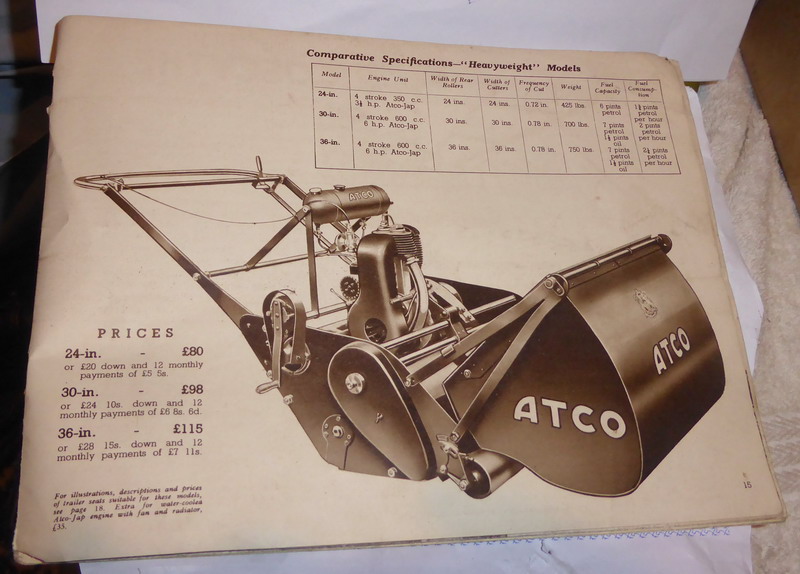
What you have there is a pre war Atco, your model was made from 1939, there was three sizes in the range, 24 inch, 30 inch and 36 inch machines, the range was actually called the Atco Heavyweight range
They were designed for extensive areas of grass on large estates, cricket, football pitches and playing fields. Yours had the capability of cutting up to 1 acre per hour.
The engine is an Atco-Jap 4 stroke 600 cc.Which had a mechanical oil pump, Amal carb and a Wico magneto, and a fan cowl cooling system. The rear roller is split into three, which has a full differential drive for easy turning.
The cutting cylinder should be six bladed, and there is a cutter release which enables the machine to run without the cutting cylinder engaging so the machine can be used to roll only.
The front rollers should be in 5 sections made of cast iron, very heavy. As can be seen in the picture which is from the Atco 1939 brochure, the grass box sits within a frame so that when emptying, it tips forward.
The finish on this range of machines included chromium plating on the exhaust pipe, handles and controls.
Hope this helpsAttachments:
March 20, 2022 at 6:40 pm #38670vhgmcbuddyKeymasterTry George at Villiers Parts. Most Amal carbs have a small ID number stamped into the body somewhere, often where the body clamps to the manifold. If you are emailing him send him a decent image of your carb.
March 20, 2022 at 11:45 am #38668vhgmcbuddyKeymasterHello
Picture of mine
John
Attachments:
March 13, 2022 at 9:05 pm #38662vhgmcbuddyKeymasterHi Collin
Just been looking at the Gamage’s roller, OK Gamage’s sold this roller with their name on it, like a lot of Ironmongers did, Allan is quite right T Greens of Leeds did make many garden rollers under their own name and others, the termination for this type of implement selling is and was called catalogue machines.
However in this case, Green’s did not make rollers for Gamage. Infact there was a society which evolved within all the different manufacturers of garden rollers.
It was Qualcast of Derby who made the Gamage roller, now with the history laid to one side, let me try and sort your problem out!
The reason why your roller is ceased, at some point it has been left outside in the elements, where water has got into the journals where the axle is, now what you cannot see from looking at it at the moment is what is inside. Your roller has two castings that you can see, the idea is as you turn a corner, they should independently rotate different ways on that axle, where they will be ceased is in the middle, as well as slightly on each end.
What you do. First remove the handle from the two bolts on either side. Then you need to make a cradle on the ground of say two concrete blocks of at least 6 inches high, place a timber plank on top (to cushion) then place the roller on its side on top so the axle is clear of the ground.
Now the axle on the top can be worked on, there are many ways to do this, but to help free the journal pour diesel around the axle and leave for a couple of days, What I have done in the past is to heat up the side axle bracket with oxygen and propane, there is a bolt which fixes it to the axle which needs removing, with heat that then can be removed, which will open up your way to the journal, if you need to add pressure or shock by using a hammer only do it by hitting the axle and only then with a piece of wood between your hammer and the axle. do not hit the casting! A couple of days should free it, then once you get the axle out keep it well greased on replacing it. – best of luck.
Regards
AndrewMarch 12, 2022 at 4:03 pm #38661vhgmcbuddyKeymasterProbably 10am, usually is. Best to go in the morning. I don’t think they charge for spectators but most people make a donation, it’s run in aid of charity.
March 12, 2022 at 1:00 pm #38659vhgmcbuddyKeymasterShould be there in the playpen!
March 10, 2022 at 8:46 pm #38653vhgmcbuddyKeymasterHello Alan,
If you read the post I sent to Charlie it was meant for you regarding garden roller circa 1924.
Kind regards Colin
March 10, 2022 at 8:42 pm #38652vhgmcbuddyKeymasterHello Charlie,
looked up Gamage garden rollers on the internet and found a picture of one just like mine by the Royal Collection Trust with the headline garden roller 1924 Queen Mary’s Dolls House Windsor whatever that means, and concluded my roller was from that circa.
Kind regards
Colin
March 7, 2022 at 11:14 pm #38647vhgmcbuddyKeymasterIf my suspicions are correct you are known as Moorcroftman and the grass box you are having problems with are for a Ransomes Ajax!
Please be aware metal sheeting which this box is made from can age harden, so where possible heat should be applied first, this can be with a simple blow torch or if your workshop is better equipped a oxy-acetylene kit with a rosebud torch. When warmed you can use the round end of a ball pain hammer, and place the box on anything hard, as long as its the same shape as your finished box. OR use a panel beaters maul behind. Hitting it can stretch the metal so be careful, if a crack appears, its best to braze the area, as welding could do more damage if heavy handed by burning a hole. If however you find it too difficult, then look for a company that does ducting work, ask them nicely or offer them a drink!
After writing this I could do with a drink as well!!!
Kind regards
AndrewMarch 6, 2022 at 6:25 pm #38645vhgmcbuddyKeymasterYes it appears you are struggling, then lets try another way, which mower did your grass box come from? What material is it made from where the dents are?
In addition to the above, why not post the name of your post town, as there may be someone in your area who can offer hands on help.
March 6, 2022 at 3:19 pm #38644vhgmcbuddyKeymasterYes it appears you are struggling, then lets try another way, which mower did your grass box come from? What material is it made from where the dents are?
Just trying to help
Regards
AndrewMarch 5, 2022 at 8:31 pm #38643vhgmcbuddyKeymasterHey Charlie
Thanks for the information, I tried the companies house route but strangely nothing listed there.
I will try the other places you mentioned & see if anything turns up there.
It would appear that the company was not in business very long by the looks of things.Regards
Martin1972
March 5, 2022 at 10:04 am #38638vhgmcbuddyKeymasterWill do when I can get someone to show me how to do it from my phone. Not having any success
David
-
AuthorPosts