Horticulture

by alan

Quiz 2025 – As Seen On TV

December 13, 2025 in Articles

Here are twelve questions for a short quiz.

The theme this year is mowers that have been on TV or in magazines, and sometimes associated with well-known people.

It shouldn’t be a challenging quiz. If you have seen Only Fools and Horses, One Foot in the Grave, marvelled at Jim Bowen on Bullseye, watched Wallace & Grommit, or know who sang ‘Green, Green Grass of Home’, then this is the ideal quiz to pass a few minutes.

A pencil and paper are handy to write down the answers.

As always, the answers are at the bottom of the page.

Questions:
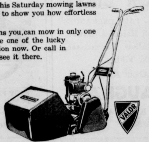
Q1: Who had a gold-painted Valor Ironcrete mower?

1: Which famous Welsh singer was photographed in 1967 at their Shepperton home with a gold-coloured Valor Ironcrete petrol-powered lawn mower?  It was said that this mower was specially painted and presented in recognition of their worldwide No. 1 hit with ‘Green, Green Grass of Home’ in 1966.

A: Tom Jones
B: Dame Shirley Bassey
C: Sir Harry Secombe
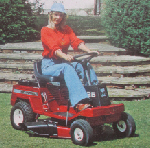
Q2: Did Victor Meldrew use a Mountfield?

2: In the 1990s TV comedy series One Foot In The Grave, Victor Meldrew played by Richard Wilson was always having mishaps. In one episode, he accidentally inhaled some fertilizer and got very high and jolly, before climbing aboard a ride on mower. Eventually driving into a house and shredding a carpet, as well as other disasters. But what was this rear-engine ride-on mower that was popular in the UK?

A: Reo Lawn Skiff
B: Mountfield M25
C: Toro Whirlwind

Q3: What mower does Grommit own?

3: In the brilliant Aardman Animations 2024 film Vengence Most Fowl, what type of lawnmower does Wallace & Grommit own? And used by Norbot the gnome to unhelpfully tidy-up Grommit’s cottage garden but instead destroying it.

A: Cylinder mower
B: Rotary mower
C: Hover mower
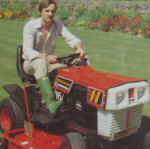
Q4: Maybe Rod Stewart didn’t have a Westwood.

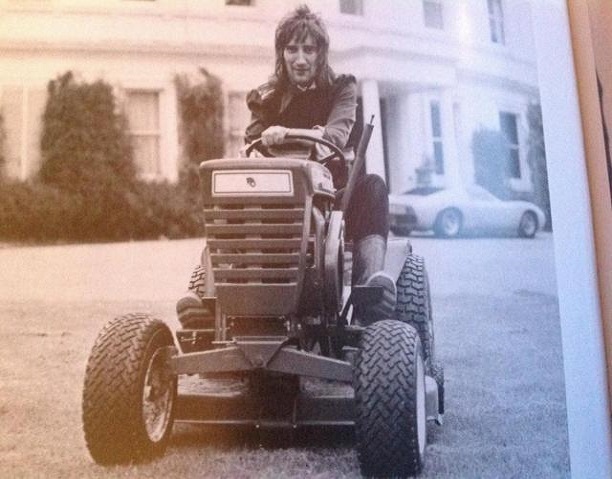
4: In 1973, Rod Stewart, of singing fame, was photographed in the UK sitting on his red-painted, Kohler-powered, ride-on mower/garden tractor outside his house. But what make was Rod Stewart’s tractor? (Clue: Only one of them was being made in 1973).

A: Westwood
B: Countax
C: Wheel Horse
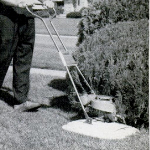
Q5: What was a lot less bovver than a hover?

5: In 1983, television adverts for a certain mower used the slogan ‘It’s a lot less bovver than a hover’. One advert featured the actor Nicholas Smith – who also starred as Mr Rumbold in Are You Being Served? But what mower brand was being sold in the adverts, which was (allegedly) better than the hover mowers? 

A: Qualcast
B: ATCO
C: Hayter

Q6: In 1980, who advertised Wheel Horse tractors?

6: In 1980, Mountfield adverts for Wheel Horse tractors featured which Scottish motor racing champion? He also advertised the tractors in the USA. Among other races, he won the 1965 Italian Grand Prix, but obviously not on a Wheel Horse. Who was he?

A: Jim Clark
B: Colin McRae
C: Jackie Stewart
Q7: Who advertised Webb machines?

7: In the mid-1970s, which TV personality, who presented Gardeners’ World, did Wolseley Webb recruit to lead their sales campaign of mowers and tillers? It is the earliest presenter – but which one was that?

A: Percy Thrower
B: Geoff Hamilton
C: Geoffrey Smith

Q8: What did Forest drive?

8: In the 1994 USA film Forest Gump, which real make of ride-on mower, with a Turtle inspired logo, did Forest use?

A: Tortrak
B: Snapper
C: Snap-Jack
Q9: Who got dragged about by an ATCO mower?

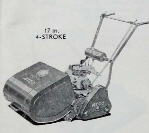
9: In the 1965 comedy film The Early Bird, about Grimsdale Dairy,  which slapstick actor (dressed as a milkman) gets dragged around a garden by an ATCO cylinder lawnmower before ending up in a pond? (I think the name Mr Grimsdale! might give it away).

A: Eric Sykes
B: Norman Wisdom
C: George Formby
Q10: Did Rodney buy mower engines, rotavator or tools?

10: In the 1983 episode of Only Fools and Horses named ‘Healthy Competition’, Rodney and Mickey were tricked by Del Boy into buying which horticulturally-related item at auction?

A: A rotavator which wouldn’t rotavate
B: A heap of old lawnmower engines
C: A collection of woodwormed vintage garden tools
Q11: Did Granville buy a Hayter Kestral?

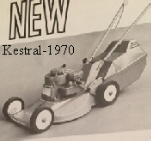
11: In 1982, the TV series Open All Hours featured the episode ‘The Ginger Men’. In the episode, Granville buys a second-hand mower with the intention of fitting the engine to his shop bike. What make of British mower did he buy? (and consequently leave on the shop floor for the bun salesman to fall over).

A: Suffolk Punch
B: Hayter Kestral
C: Landmaster Sovereign

Q12: What amazing prizes could be won on Bullseye?

12: The original version of the darts quiz show Bullseye aired from 1981 until 1995. It was presented by Jim Bowen, who was often quoted (or misquoted) using the words “super” and “smashing” to describe things. Anyway, which of these super, smashing prizes could be won on Bullseye for just “the throw of a dart”?

A: Black & Decker H1 Hover Mower, together with a B&D electric lawn rake, a Fisons lawn spreader, a bag of lawn weed & feed, and a pair of lawn edging shears. 
B: 5-door Morris Ital car in white paintwork
C: £2000 clothing spending spree – possibly at C&A

Answers:

1: A: Tom Jones. He was presented with a gold-painted Ironcrete Valor mower in 1967. He had sold over one million copies of his recording of ‘Green, green grass of home’ – hence the grass connection with mowers. It was obviously a sales and marketing tactic by the Ironcrete company, who were based in Birmingham and some distance from the Shepperton home of Tom Jones, so not a local company. Here is a picture (Note: It is an external link to alamy.com)

2: B: Mountfield M25. Victor Meldrew drove a Mountfield rear-engine model M25 in the TV series One Foot In The Grave – causing mayhem along the way. You can watch the clip on Youtube here (Note: It is an external link to Youtube). The mower does have a custom-made rear grass collector, presumably for comic effect when mowing the carpet and ejecting the cuttings!

3: A: Cylinder mower. Wallace & Grommit owned a cylinder mower which they used as part of their ‘Gnome Improvements’ household maintenance business. Grommit also owned a strimmer, which Norbot used in the garden.

4: C: Wheel Horse. Rod Stewart was photographed in 1973 with his red-painted Wheel Horse mower. The model looks like a Raider 10 or similar. He didn’t have a Westwood as in the photo – that was a red herring…or a red Westwood. Here is a picture (Note: It is an external link). Westwood didn’t make their own branded tractors until 1976, and Countax until 1990.

5: A: Qualcast. Nicholas Smith (aka Mr Rumbold in Are You Being Served?) also appeared in adverts for Qualcast mowers.

6: C: Jackie Stewart. In 1980, Scottish motor racing champion Jackie Stewart featured in magazine adverts for Wheel Horse garden tractors. In fact, in 1980, Jackie Stewart also filmed a Wheel Horse advert in Florida for the USA market.

7: A: Percy Thrower. In the mid-1970s, Percy Thrower advertised Wolseley Webb mowers and tillers. Gardeners’ World started in 1968 with Percy Thrower as the first presenter until 1976 when Arthur Billitt took over. Followed by presenters Geoff Hamilton from 1979 (1979 to 1996), and Geoffrey Smith from 1980 (1980 to 1982). Alan Titchmarsh took over from 1996.

8: B: Snapper. In the 1994 film Forest Gump, Forest used a real American-made Snapper ride-on mower for mowing his lawn and then public spaces around Greenbow, Alabama. The other answers, Tortrak and Snap-Jack were made up.

9: B: Norman Wisdom. The film ‘The Early Bird’ was the first Norman Wisdom film in colour. Norman Wisdom (as Norman Pitkin) worked for Grimsdale’s Dairy in competition with Consolidated Dairies. Not all goes well, and Norman gets dragged around a garden, through a fence, a greenhouse, and into a pond by an ATCO cylinder mower. https://en.wikipedia.org/wiki/The_Early_Bird (Note: It is an external link to wikipedia).

10: B: A heap of old lawn mower engines. Del Boy had originally bought the engines but took them to auction and tricked Rodney into buying them. The clip can be seen on Youtube here (Note: It is an external link to Youtube).

11: A: Suffolk Punch. Granville bought a red-painted Suffolk Punch mower with the intention of fitting the engine to his bike.

12: A, B, and C: All three answers are correct. And yes — a Black & Decker mower, lawn rake, and various other lawn products did make an appearance as prizes. Bullseye was, after all, renowned for its eclectic prize selection, ranging in value, desirability, and, one suspects, their proximity to the nearest Argos-type warehouse. While the show often had a Mini Metro as the star prize, the Morris Ital also made an appearance.

—————————————-
Footnote:
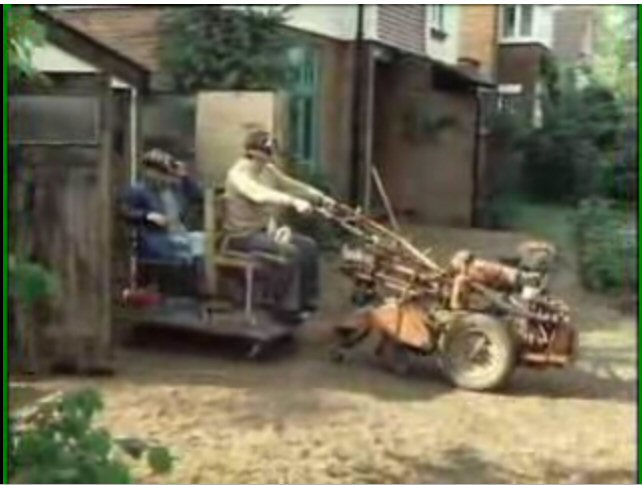
The Howard Gem as featured in The Good Life from 1975 onwards

This year’s twelve questions are all about mowers. My apologies to non-mower collectors. I did set out with good intentions to find examples of rotavators, hand tools, sprayers and other implements that might have been on the tv or had celebrity ownership. The search turned up very little, except for the obvious Howard rotavator from The Good Life, as in the picture.

However, there have been many appearances of mowers on TV, so that must be the go-to horticultural item for TV purposes.

Who remembers the Anchor butter advert from 1993? I’m told that the mower still exists somewhere, but does anyone know where? Apparently, there was only one machine and that was built from spare parts for the commercial, then digitally copied to make it appear there was more than one. The Anchor advert can be seen on YouTube.

Also, a club member can be briefly seen with his Dennis mower in the opening scenes of the 2002 film The Gathering Storm about Winston Churchill. The mower scenes were set in 1934 at Chartwell.

I also have vague memories of mowers and garden tools appearing as prizes on UK quiz shows, but found nothing apart from Bullseye. But I’m sure a Flymo or strimmer must have passed by on The Generation Game conveyor belt.

As we have seen with sitcoms and also with Norman Wisdom, mowers have long been used in comical situations. This includes Tom and Jerry, who can be seen on a 1949 comic cover with Tom about to be mown down by a sidewheel mower.

I shall now embark on twelve more questions for next year. Subject currently unknown, but it won’t be machines on TV as this one wasn’t easy to compile.

After multiple rounds of editing and head scratching, this 2025 question page was created on the 7th October 2025. It was raining.
by alan

The Invention of the Nylon Line Strimmer.

July 22, 2024 in Articles, Machinery

Let’s see a show of hands for everyone who has owned or used a domestic garden strimmer. This tool has become essential in many gardens, selling in large quantities over the years. But just how long has the garden strimmer, with its nylon cutting line, been available? And who came up with the idea, and when?

After the invention of the lawn mower, the next challenge was dealing with the grass that mowers couldn’t reach. While a well-designed garden and lawn can minimize these inaccessible areas, the simplest way to tidy up around shrubs, trees, or obstacles has always been with shears – a method that still works well today. However, if there is a mechanical or powered way to mow the lawn, why not have a similar tool for trimming those difficult-to-reach bits of grass?

1960s Greensleeves Swivel Cut Lawn Edge Trimmer

It’s worth noting a few early inventions that preceded the strimmer, as untidy bits of lawn have long been a pain in the grass. In the 1960s, a mechanical device called the Swivel Cut Lawn Edge Trimmer was marketed by Greensleeves (Illustrated). This tool featured a pair of shears mounted on two small wheels with a long shaft, allowing the gardener to push it along. At the top of the shaft was a spring-loaded, squeezable handle used to open and close the blades. The long shaft eliminated the need for the gardener to work on their hands and knees. The shears could be used vertically for lawn edges or horizontally for flat areas. Around the same time, Wolf of Ross-on-Wye produced a similar tool called the Orbital Long Shears, which had a 40″ shaft and a squeezable handle.

Powered machines for cutting small patches of grass did feature quite early, but they relied on steel blades as their means of cutting, and many were wheeled or required to be resting on the ground.

1957 Trusty Whirlwind

Introduced mid-century, Tarpen Engineering Co. Ltd had the electric-powered Grassmaster and Vergemaster models (Illustrated below). These machines, with long shafts enabling the gardener to work standing, were ideal for mowing awkward places where a mower could not be used and for clearing weeds and long grass.

In 1957 Tractors (London) Limited launched the Trusty Whirlwind (Illustrated). This two-wheel machine was marketed as a weeding tool and at wheel level had a 1/3 hp JAP engine that powered a 6” steel disc via a v-belt; the operator was in a standing position.

Many other machines designed primarily for trimming vertical lawn edges had been developed. These include the battery-operated Andrews Spintrim (Illustrated), which featured ‘fast spinning blades’ that finely chopped the lawn edge clippings, eliminating the need for cleanup. It was claimed that the Spintrim could handle one mile of edging in an hour. Advertisements for the Spintrim also suggested that manual grass shears were ‘old-fashioned’ and ‘time-wasting.’

Tarpen Grassmaster and Andrews Spintrim

Eventually, a couple of entrepreneurs had a Eureka moment and realized that using a thin nylon line would be a much better, easier, and safer solution than metal blades. The nylon line could cut closer and cause less damage to the objects it encountered. It could cleanly cut up to hard surfaces like walls and rocks, trim around small items, and tidy lawn edges, while also being suitable for larger areas of grass and weeds. This marked the decline of small domestic machines with metal blades, as many manufacturers quickly adopted nylon line trimmers. There was likely a lucrative market for branded trimmer line replacement spools, though I can’t prove that!

When did nylon line trimmers appear in the UK?

Trade magazines generally state that nylon line trimmers debuted in the UK in 1975/76 – that’s nearly 50 years ago as I write this – although the first two models, detailed below, had been sold abroad before this time. 

The first UK-retailed model is regarded as being the USA-made Weedeater. This was followed by the Adlus UFO from Germany. However, other manufacturers may have seen the nylon line machines abroad and started their versions in the UK but had not yet become mainstream.

The Weedeater, introduced in the USA in 1972, was invented by George Ballas of Texas. He was inspired by the individual nylon brush strands on a drive-through car wash that would clean a car without any bodywork damage. It was reported that a prototype cutting head (a beer can with strands of fishing line) was attached to his electric trimmer instead of the steel blade – and it was a success.

Initially, the Weedeater models introduced here in 1975/76, which looked like today’s strimmers, were retailed by Allen Power Equipment Ltd, Oxford. The mains electric models included the nicely-named ‘Snippy’ at £24.95 ex vat in 1978, and in 1980 a rechargeable model with a battery charger became available priced at £47.50. Petrol models were marketed including a 14cc lightweight model suitable for domestic gardens.

The competing Adlus UFO (Illustrated on the right) from Germany was a different machine from the Weedeater yet worked on the same cutting principles. Again, a design by someone who figured that nylon line would be ideal for grass trimming. However, rather than being a standard trimmer design, the Adlus UFO was a handheld device (like a small shrub pruner but with a trimmer head) that had the option of an extension handle to make it a trimmer that the gardener could use when standing. The handle was priced at £4.72 + 12.5% VAT in 1976;  the trimmer was £29.50 + VAT.

The Adlus UFO was designed in the 1960s and sold across Europe. Although its introduction to the UK is often cited as occurring in 1975/76, advertisements for it appeared in UK newspapers as early as 1972. Initially, the UK agent was IXP Ltd, Yeadon, Leeds, which sold the UFO trimmer by mail order for £18.30 in the early 1970s. By 1976, Ameeco-Broby Ltd, based in Basildon, Essex, had taken over as the agent.

Both the Weedeater and the Adlus UFO used nylon line but it was much thinner on the Adlus and would wear out quicker. The thickness of the line was reflected in the price of a new nylon spool – the Adlus spool cost only 98p + 8% VAT, and the Weedeater spool was £2.95 +12.5% VAT in 1976.

Were nylon line trimmers an instant success?

The Weedeater and Adlus UFO gained popularity, catching the attention of other manufacturers. As a result, nylon line trimmers quickly became the next essential mechanized tool for lawn care.

Manufacturers were falling over themselves to get a slice of the action, this was propelled by Black & Decker who ran TV adverts in the summer of 1978 for their ‘Strimmer’ (String trimmer and thus the strimmer name became often used and now in common parlance) – essentially anyone with a lawn and a mower was a target for needing a Strimmer. Their models were the B&D D409 (Illustrated) with a 9” cut (£19.95) and a deluxe version that upgraded to 12” and automatic line feed priced at £45.

So popular was this new nylon line idea, that two years after the launch of the Weedeater and Adlus UFO, the Institute of Groundsmanship Exhibition in 1978 had a whole host of mains-electric nylon line models on show, although quite a lot of brand engineering was going on.

Some models at the exhibition were:

  • Danarm had a model that was bought in
  • Flymo (Illustrated below) had two models but the smaller one was a rebranded RotaShear
  • Hyett Adams was selling genuine RotaShear strimmers
  • AL-KO had a rebranded model
  • Toro (Illustrated below), sold by Autoturfcare, had a range of Toro strimmers. 
  • Others at the time were the Graswip Lawn Trimmer from the Village Blacksmith range sold by Thomas. A. Edison, Coventry
  • Solo Power Equipment offered the Solo engine with various attachments including a monofilament safety head
  • Wolf Tools, Ross-on-Wye, marketed their 240w  9” Wolf-Trimit Standard, and the De-Luxe version with a 340w motor and a 16” cut
  • PaiceSetter were selling several petrol models
  • Poulan petrol strimmers had the Trimette grass cutter attachments
  • Husqvarna had petrol models ideal for the handyman and around the garden
Exhibited in 1978, left, two early Flymo strimmers – the small one being a rebadged RotaShear. Right, an early Toro strimmer


Petrol models also marketed in 1978 included the Italian-made two-stroke 28cc Tiger 40 from E. P. Barrus, Bicester, and the brilliant Homelite lightweight model ST-100 2-stroke which utilised the hollow handle as a fuel tank (Illustrated, right). Stihl and McCulloch got in on the lightweight petrol-powered nylon line strimmer idea with many adverts in the 1980s.

The late 1970s Homelite ST-100 nylon line strimmer had a hollow shaft which was the fuel tank. Many manufacturers produced lightweight strimmers which would appeal to the householder, this Homelite model was no exception and weighed just over 7 lbs or 3kg.

Many manufacturers who had previously offered steel blade brush cutters now also added nylon-line heads, in 1977 this included PaiceSetter, East Grinstead, Sussex who advertised their new Elta/Fuji models which had a ‘super safe cutting head’ and two high-strength, low-cost replaceable nylon filaments.

There were alternatives to the nylon line. In 1980, Hemming & Wood of Lichfield introduced Duralon blades to complement their Sawtec range of grass trimmers and brush cutters. These Duralon blades were pivoted when mounted on a central housing. The blades were claimed to offer a longer lifespan than nylon line and were suitable for both grass cutting and lawn edging.

Other ideas for trimmers included ATCO which in the early 1980s advertised a 12-volt strimmer that could be attached to the electrics on their garden tractors. This enabled the gardener to tidy around the trees and borders when out mowing and away from mains electric.

One of the Wolf ‘Rotomat’ strimmers from 1989, in bright and appealing colours.

In 1987, Flymo observed that many strimmer owners were ready to purchase replacement machines. This segment represented 25% of the market, with buyers seeking ergonomic designs and improved features. In response, in 1987, Flymo introduced the standard Mini-Trim with an 8-inch cutting width and the Multi-Trim. The Multi-Trim featured a twistable horizontal cutting head for vertical lawn edging, assisted by a built-in roller for guiding along the lawn edge. To be fair, other manufacturers, including Wolf with their Rotomat ‘Vario’ in the mid-1980s, had already marketed rotating head trimmers. By 1990, the Flymo Multi-Trim range had expanded to three models with 8, 10, and 12-inch cutting widths. Many of these models are likely still in use today, as they perform all the functions expected of a garden strimmer with ease.

Nylon line trimmers, petrol or electric, can be found in almost every garden across the land. The cutting design and idea haven’t changed much although there are minor advances with guards, guides and handles. One can say that the original strimmer idea was a complete success!

Looking back at the article, has anybody got an original Adlus UFO or one of the first Weedeaters or the 12-volt strimmer that ATCO sold for their tractors?

by alan

Howard Bantam 1950

February 22, 2018 in Articles, Machinery

Humour can capture the attention of the prospective customer far easier than any serious advertising might.
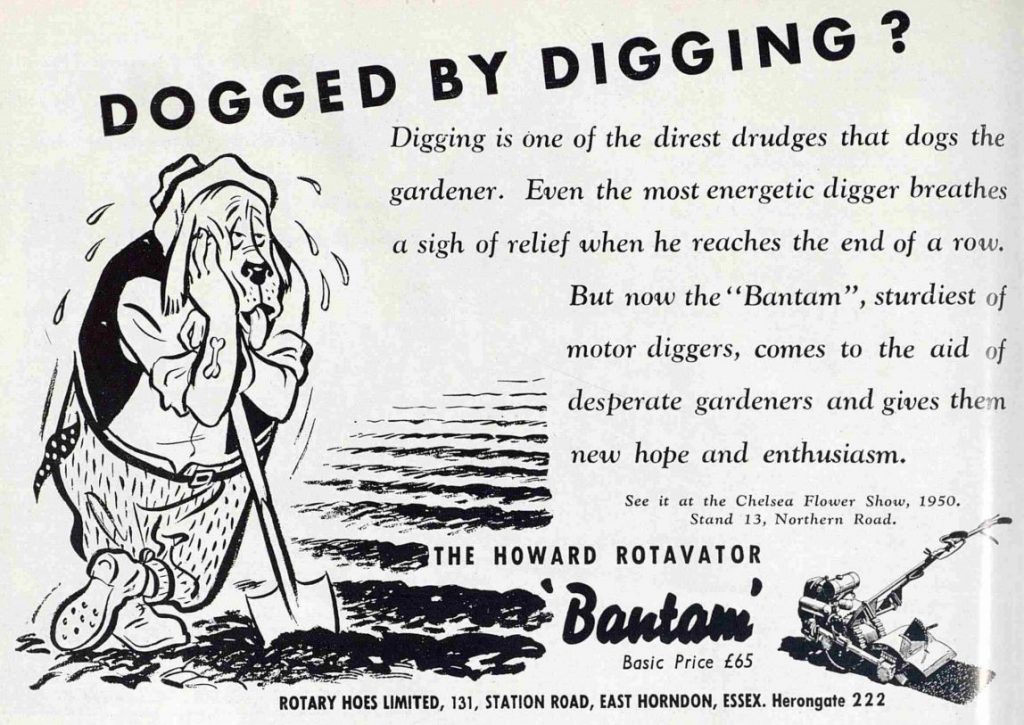
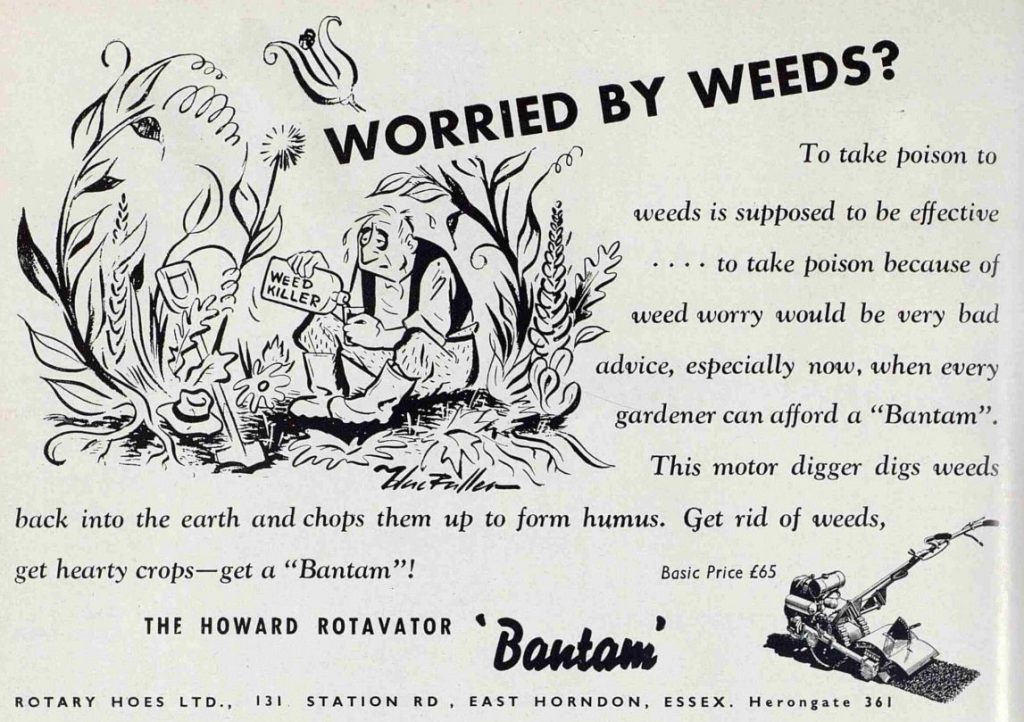
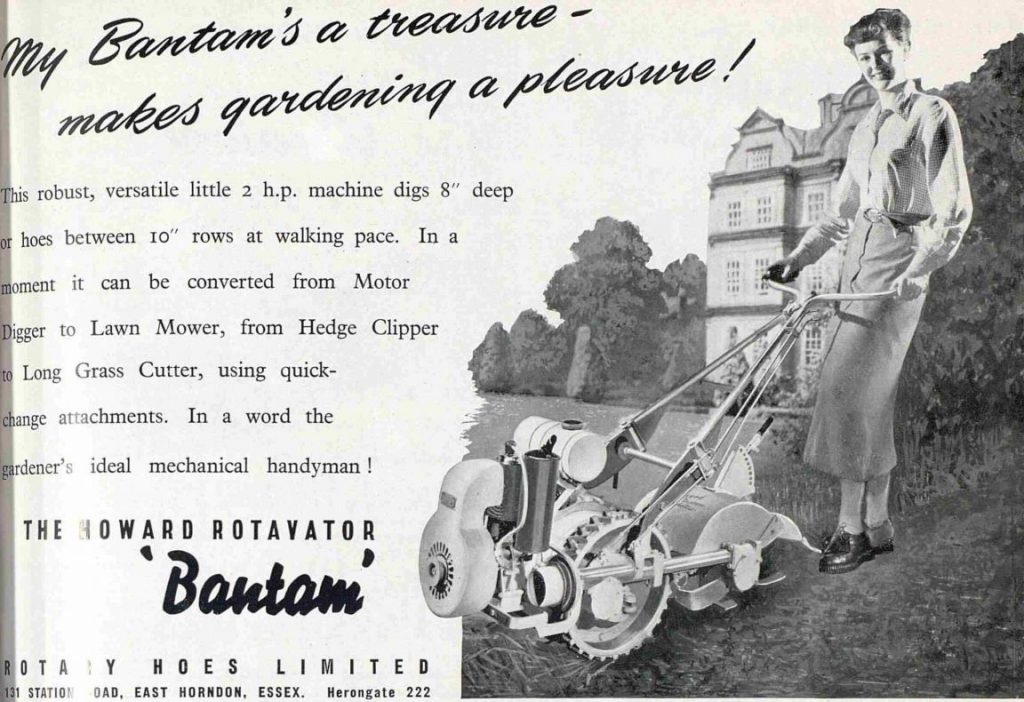
All from 1950 are the following four adverts for the Howard Rotavator ‘Bantam’. Each is carefully crafted to highlight the difficulties of gardening that the Bantam can overcome: Digging, weeding and labour saving. 


The fourth advert proves that an oily machine can be a great fashion accessory for the owner outside their 16thC Elizabethan mansion. 

There are more Howard images in the VHGMC Howard gallery pages.


Dogged by digging? Howard Bantam 1950


Worried by weeds? Howard Bantam 1950


Gardening? I though I knew it all! Howard Bantam 1950


My Bantam’s a treasure – Howard Bantam 1950


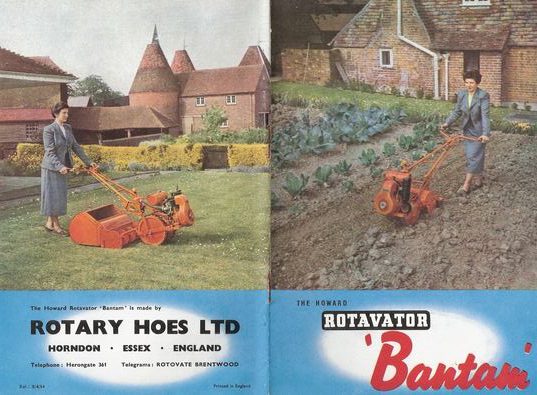
Howard Bantam Brochure

by alan

Before Starting Engine…

March 19, 2017 in Articles

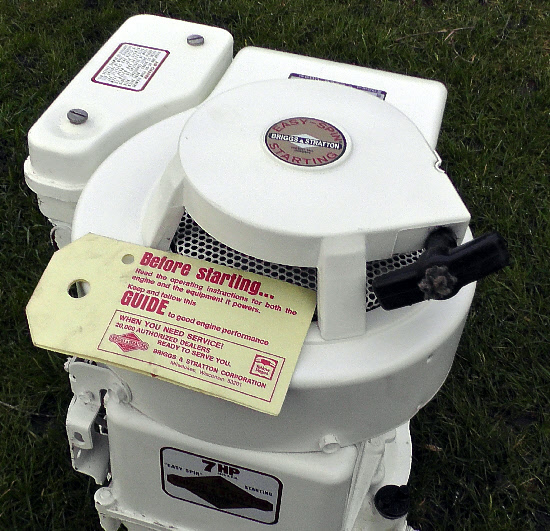
Briggs and Stratton engine with 1976 engine maintenance card

Briggs and Stratton engine with 1976 engine maintenance card

Engine maintenance is of the utmost importance, for without a running engine we are going nowhere apart from the workshop to do some problem solving. 

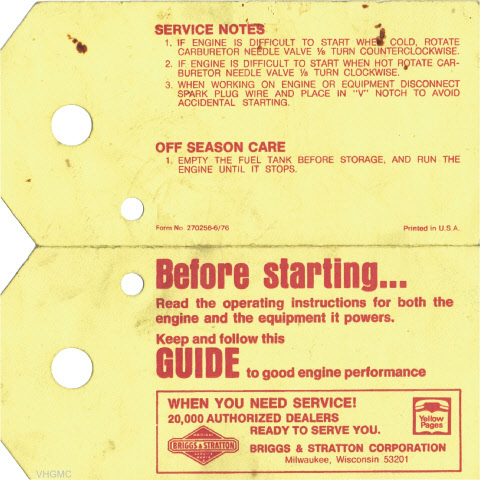
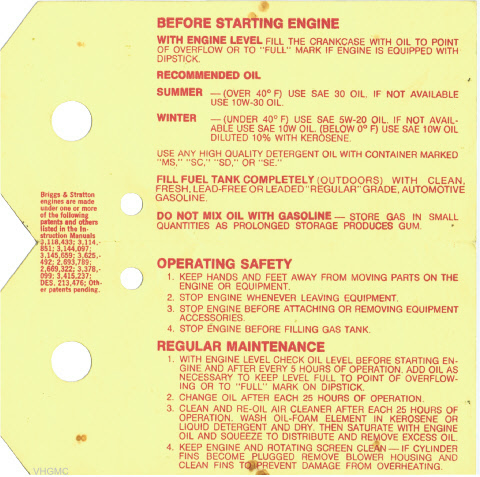
Illustrated right and shown as a full scan at the bottom of the page is a 1976 dated Briggs and Stratton engine instruction guide supplied with a new B&S engine and usually attached to the engine or pull cord.

These instructions were issued with engines as an important piece of information for the operator and as such contain the message ‘Keep and follow this guide to good engine performance‘ but we wonder how many instruction guides were kept or did they end up oil-stained on the workshop bench to be discarded at a later date?

Before Starting Engine…

The B&S guide details the recommended oil levels and also the oil to be used in summer (over 40F or 4C) and winter (under 40F or 4C) and colder (under 0F use SAE 10W oil diluted 10% with kerosene). These engines would have been supplied worldwide and powered many implements in varying temperatures from mowers in summer to snowblowers in the depths of winter. 

Looking at the offerings of cheap and cheerful mowers at a DIY store over the weekend we noticed they still have labels with instructions, although limited sometimes to just informing the operator that the engine contains no oil and needs purchasing separately. I know of someone who omitted to fill a new mower engine with oil and it had a very short life indeed. 

As we know, dragging the mower out at Easter, chucking in some of last years winter-stored fuel and hoping it starts is not the best idea, sensibly the B&S guide recommends for ‘Off Season Care’ to ‘Empty the fuel tank before storage and run engine until it stops’. For a new season then ‘Fill fuel tank completely (outdoors) with clean, fresh, regular grade automotive gasoline’. 

According to the B&S guide for regular maintenance the engine oil should be checked before starting the engine and after every five hours of operation. Also change the oil after each 25 hours of operation, re-oil the air cleaner at 25 hours, washing the oil-foam element in kerosene or detergent and then dry, saturate with engine oil and squeeze to remove excess oil – I remember that from college years ago. How many domestic lawnmowers get that treatment nowadays? 

Finally ‘Service Notes’ on the guide helpfully advise that if the engine is difficult to start when cold then rotate the carburetor needle 1/8 turn counterclockwise, if it’s hard to start when hot then turn it 1/8 turn clockwise. ‘When working on engine or equipment disconnect spark plug wire…to avoid accidental starting’  – I’m sure we all know stories about someone accidentally starting an engine via turning the mower blade.

Briggs & Stratton Engine Maintenance Card

1976 Briggs & Stratton Engine Maintenance Card – Side 1

Briggs & Stratton Engine Maintenance Card - Side 2

1976 Briggs & Stratton Engine Maintenance Card – Side 2

by alan

Christmas 1910

December 19, 2016 in Articles

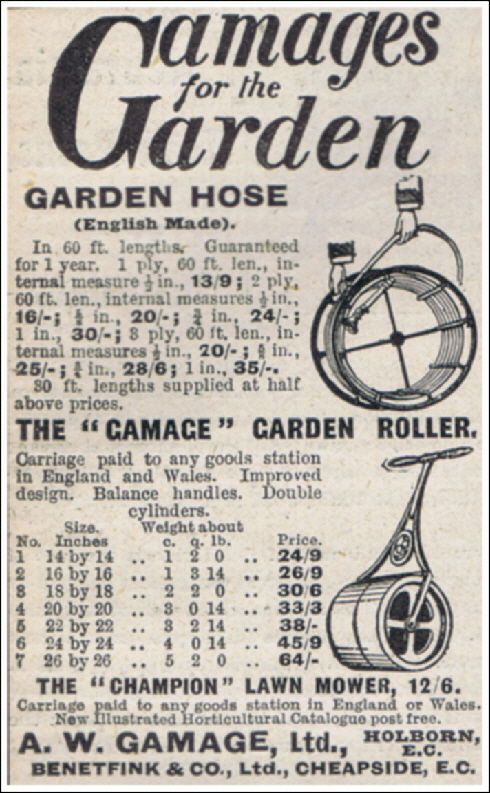
A.W. Gamage LTD of Cheapside, London, supplied a lot of garden sundries. 1910.

A.W. Gamage LTD of Cheapside, London, supplied a lot of garden sundries and hand-powered tools. 1910.

Chances are that for many VHGMC members a bit of tinkering about with machinery in the workshop may be on the agenda over the Christmas and winter period. As we all know most of the powered machines we collect, use and tinker with now wouldn’t have been around a  century a go although, to be fair, there was probably some very clever people considering some working ideas.

I’ve got a copy of ‘The Gardener’ magazine dated 1st January 1910 (and the entire year throughout 1910 as well) and it’s interesting looking back at what tools and equipment was or more obviously wasn’t available. Bear a thought then for those gardeners over a hundred years ago who lacked the tools and machinery we have today.

In the early 1900’s gardening magazines were still tilted towards the bigger house and garden where a gardener(s) would be employed yet they were also inspiring the home gardener too. ‘The Gardener’ magazine has an almost excessive list of hands-on manual garden jobs to be done throughout the entire year. 

Amateur gardening at this time was gathering pace and looking for perfection, this can easily be seen by the multitude of gardening adverts tempting gardeners to invest in every conceivable gadget, sprayer and chemical to keep the bugs at bay and achieve spectacular results in the flower and vegetable gardens at the risk of poisoning themselves into the deal. Looking through the many 1910 adverts in the magazines; lawnmowers were mostly of the push-along variety, powered tools were a far-off dream, mechanisation in the average garden was mostly limited to wheeled hoes with various attachments, seed drills and hand-powered equipment and on bigger gardens some horse or pony power. Whatever the job forward planning was of vital importance, there was no popping down to the local tool-hire centre to borrow a rotavator or other machinery on a weekend to speed up the process and make things easier, we are incredibly privileged to have the powered machinery and tools we have today. 

BUCO hand cultivator. The cheapest investment for garden, field and nursery. 1910.

BUCO hand cultivator. The cheapest investment for garden, field and nursery. 1910.

According to the 1910 gardening magazine what could our gardener potentially look forward to in early January? Although the magazine details everything on a day-by-day basis I doubt anyone followed it so strictly and any mechanised tool would have been welcomed but, outdoor work could begin with trenching, digging and manuring vacant ground as a warm-up exercise for Saturday 1st January. Other possible tasks are to scrape moss and lichen from fruit trees, roll lawns and repair walks and drives, plant new hedges, trim wall climbers and prepare beds for roses. Monday 3rd January allows for a spot of easy gardening in the cool greenhouse where tidying Pelargoniums and Primulas is a must, propagate Chrysanthemums, vaporise Cinerarias, and select and order by post flower seeds from the numerous seed catalogues available. Tuesday lets the gardener relocate to the hot greenhouse to repot Dipladenias, Gloxinias and Achimenes – plants which were incredibly fashionable at the time but have since faded into the background. Exhausting as it is, the list of potential daily chores goes on throughout the year, as to what to grow, what’s in vogue and some new-fangled technique to try – whatever the weather there was something that could or simply must be done in the garden now and the gardening magazines of the day knew what was best for both the reader and their garden and kept them on a very strict line.

Abol advert and syringe from 1910. Kills most things!

ABOL advert and syringe from 1910. Kills most things!

I’m sure the gardeners of 1910 would no doubt be mighty impressed to see the vast array of advanced tools, gadgets and mechanisation that developed through the last century, and also the machines and tools that we have kept, maintained and still use from the past decades. To us they are vintage machines, to 1910 gardeners they would have been a fantastic Christmas gift.

We also have more time to enjoy the garden nowadays, entertaining on the patio, powered tools and mowers in every garden, not to mention a vast selection of vegetables and exotic fruit in the shops all year round that we don’t have to struggle to grow in our own gardens. Who would have thought it – certainly not a gardener from 1910 in a cold garden in January.

Click on the adverts above for a larger, easier to read version. 

Leather Horse LAwn Boots by Allen of Reading. 1910.

Leather Horse Lawn Boots by Allen of Reading. 1910.

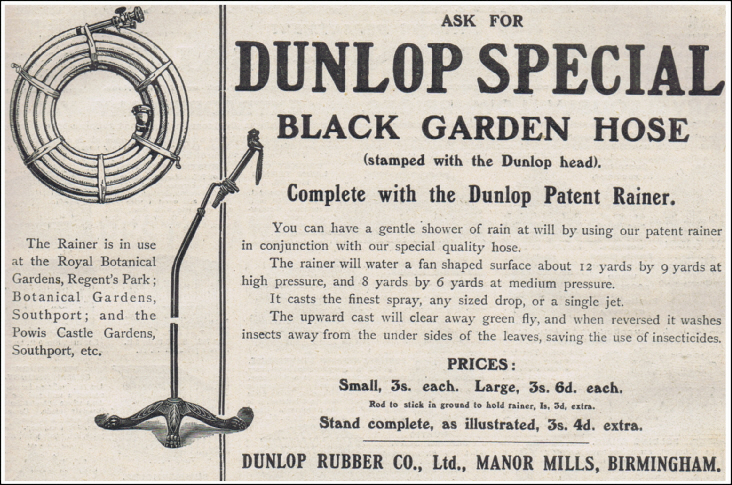
Dunlop Special Black Garden Hosepipe and Dunlop Patent Rainer 1910

Dunlop Special Black Garden Hosepipe and Dunlop Patent Rainer 1910

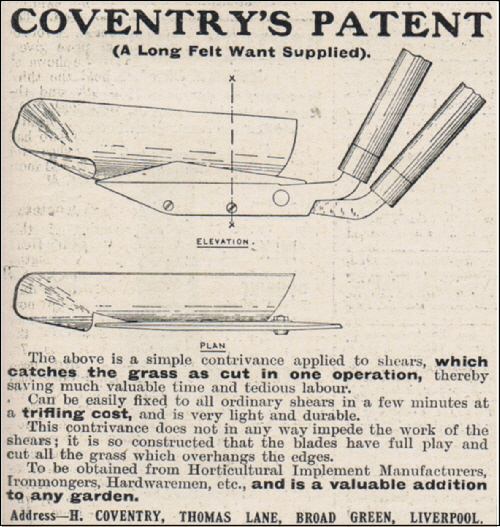
Coventry's patent grass edging shears 1910.

Coventry’s patent grass edging shears 1910.


by alan

Nash Roller Tractor – 1950 report and adverts

November 29, 2016 in Articles

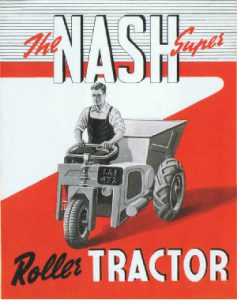
Nash Roller Tractor

Nash Roller Tractor

We have probably all done some research online or through archives looking for information about our respective machines and it’s usually easy to find at least an advert or a brochure image about the items that we collect. Admittedly some machines and manufacturers may have out-foxed us, perhaps the machine is one of those rebadged affairs or produced in small quantities as a trial run, or even an established company invented a new brand name, stuck it on a few machines then gave it up as a bad job and went back to the drawing board leaving the name to dissolve into history. 

However, sometimes a small amount of research can surprisingly bring up a wealth of information with ease and one such machine is the Nash Roller Tractor. 

Research and general prodding about of the newspapers brought up not only an advert with a price but also another detailing the tractors vast ability. Also an advert for the display of the Nash Tractor at the Dairy Show in Olympia in 1950 and more interestingly (and very rare) a contemporary newspaper report about the tractor and how it functions. 

Although we are aware that some of these advertorials (advert + editorial) for any machine can be a tad on the biased side at times as they may well have been paid to have been written or printed they still make for fascinating reading.

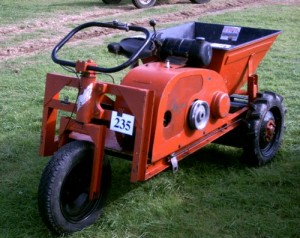
Nash Truck

Approx.1952 (we think) petrol Nash machine

Nash are mentioned in some detail in the book ‘70 Years of Garden Machinery‘ (if you haven’t read this worthwhile encyclopaedic book detailing garden machinery then it’s here on Amazon for more info), 70Yogm says that the Nash tractor was launched in 1950 and this ties in with the adverts below that we have found, all the adverts then are right from the start of the Nash Roller Tractor production and marketing.
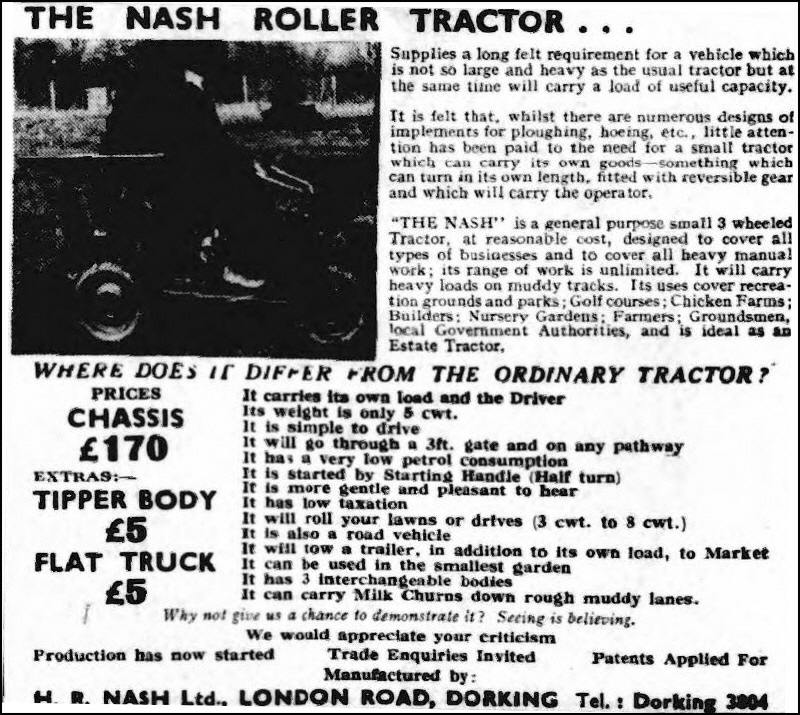
Click on any of the adverts for larger, easier to read images.

nash-roller-tractor-1950-advert
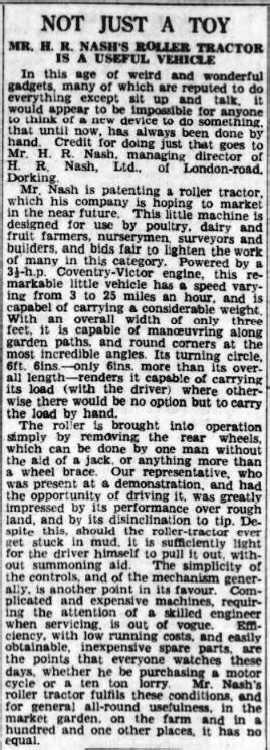
The above advert advises that regarding the 1950 launched tractor The Nash is a general purpose small 3 wheeled tractor, at reasonable cost, designed to cover all types of businesses and to cover all heavy manual work; it’s range is unlimited”. This is echoed by the 1950 editorial (below right)  that “this little machine is designed for use by poultry, dairy and fruit farmers, nurserymen, surveyors and builders and bids fair to lighten the work of many in this category.

nash-tractor-not-just-a-toy-advert-1950The editorial is titledNot Just  A Toy, Mr H R Nash’s Roller Tractor is a Useful Vehicle continues: Powered by a 3 1/2 hp Coventry-Victor engine, this remarkable little vehicle has a speed varying from 3 to 25mph and is capable of carrying a considerable weight. With an overall width of only three feet, it is capable of manoeuvring along garden paths and around corners at the most incredible angles. It’s turning circle, 6′ 6″ and only 6″ more than it’s overall length renders it capable of carrying it’s load with driver where otherwise there would be no option but to carry the load by hand

The roller is brought into operation simply by removing the rear wheels which can be done by one man without the aid of a jack or anything more than a wheel brace. Our representative who was present at a demonstration and had the opportunity of driving it, was greatly impressed by it’s performance over rough land and by it’s disinclination to tip. Despite this, should the roller-tractor ever get stuck in mud it is sufficiently light for the driver himself to pull it out without summoning aid

The simplicity of the controls and of the mechanism generally is another point in it’s favour. Complicated and expensive machines requiring the attention of a skilled engineer when servicing is out of vogue. Efficiency with low running costs and easily obtainable, inexpensive parts, are the points that everyone watches these days.

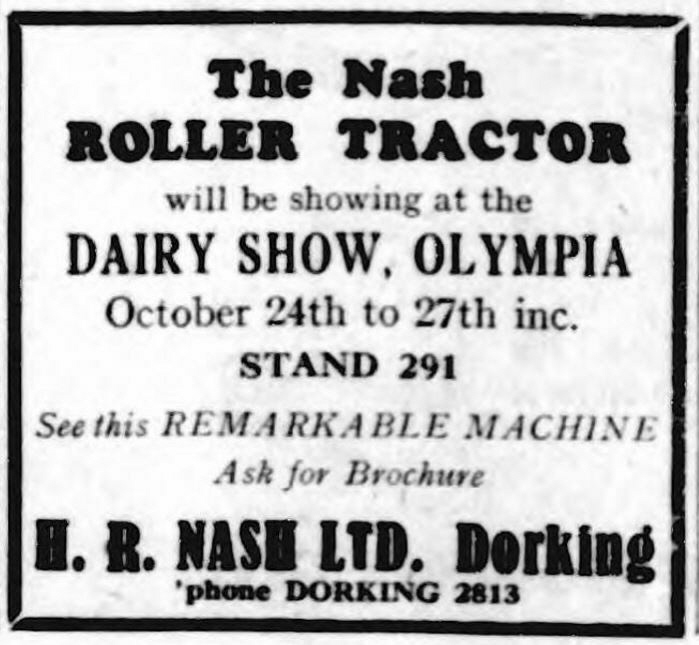
Having adverts and glowing reports is all very well but actually having a machine on display at an event is an even better way to catch the attention of the public and hopefully take a deposit and fill the order books. The Nash Roller Tractor was on display at the Dairy Show, Olympia on the 24th to the 27th October 1950.

nash-roller-tractor-olympia-1950

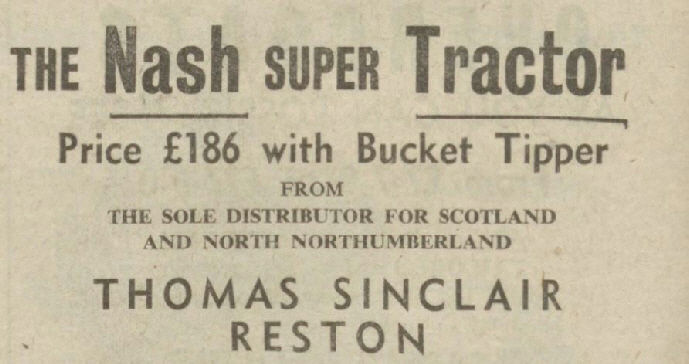
As with many machines there would have been distributors dotted around the country. The following advert is for Thomas Sinclair, Reston, Berwickshire in 1951.

nash-tractor-advert-scotland-1951
As well as Nash, as far as we can tell, Thomas Sinclair also sold Cletrac, Avery, David Brown and Oliver Tractors too. 

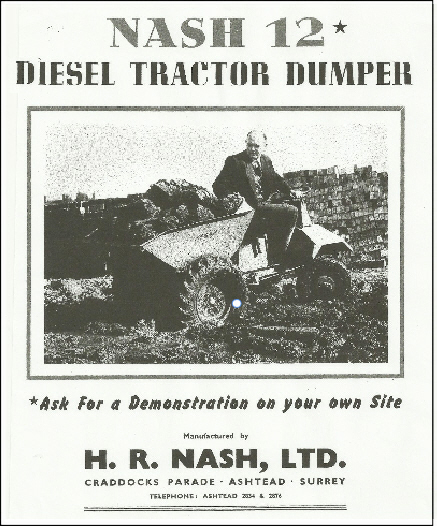
Finally from the VHGMC archives an advert for a diesel Nash. The Nash Roller Tractor developed through the years and in 1953 the four-wheel Roller Tractor Dumper was introduced. The Nash 12 shown below, had a 12 cu ft tipper, a choice of diesel engines, and a demonstration on site. 

We have had a look online but cannot find many Nash Roller Tractors, whatever happened to them all? 

nash-12-diesel-tractor-dumper-advert


by alan

Newark Vintage Tractor Show Entries 2016 & Video from 2015

August 22, 2016 in Club News

VHGMC STand Newark Tractor Show 2015
Newark Vintage Tractor Show on the 12th and 13th November is fast approaching and the closing date for entries is the 16th September. 

Entry forms can be found at: https://newarkvintagetractorshow.com/exhibitors.html

The VHGMC also has a video of images from the 2015 show to see what was there: 


https://youtu.be/AnSGIvXJfC0