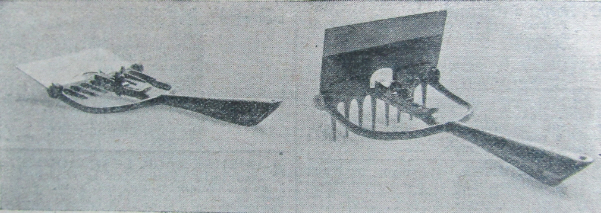
Sometimes, unusual tools appear in advertisements. The tool I have found was called the ‘Plymouth Hoe’ and dates from 1909. But, to confuse research, Plymouth Hoe also happens to be a well-tended public park area on the seafront in Plymouth.
The Plymouth Hoe dates from 1909
The invention by Mr Joseph Carroll incorporated a hoe, a Dutch hoe and a soil rake into one implement. Costing 4s 6d, it could be ordered carriage paid from Mr Carroll, 200 Manchester Road, Ince, Wigan – a terraced house nearly 300 miles away from Plymouth, and so the hoes’ name remains a mystery.
It is an interesting tool; it features a pivot that allows the hoe to be adjusted and to also use the rake. There appears to be a locking mechanism. The tool looks to be well constructed and presumably done by a manufacturer local to Wigan, but who knows?
Really, it is a curious little tool from a bygone era, and a reminder that there’s always something new to discover. I think that’s a pleasant thought.
We are all probably familiar with the early pony-drawn lawn mowers of the 19th century. These machines transformed the maintenance of large grounds, making the task of mowing more efficient and quicker.
Yet alongside these mowers were also pony-drawn lawn sweepers. These sweepers played an important role in keeping lawns around country houses immaculate, collecting clippings, leaves, and debris.
In the 1800s, pedestrian lawn and path sweepers were already being produced; more on those later. Also, horse-drawn sweepers could be found cleaning the streets of towns and cities; in 1869 The Bristol Waggon Works Company Limited were making street sweeping machines.
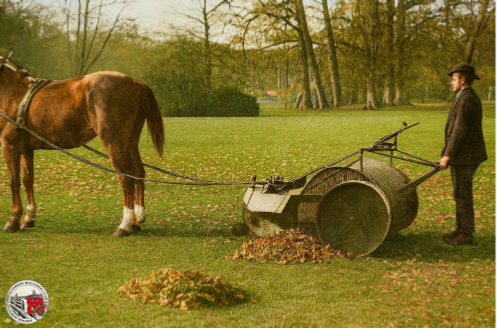
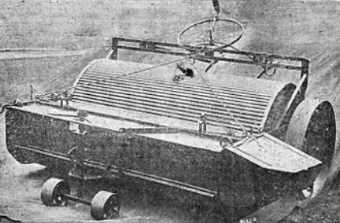
One lawn sweeper in particular, as illustrated below in colour, has an interesting history of development and some posh addresses:
Mr J. Challis’ improved lawn sweeper in 1899. He was the head gardener at Wilton House, Salisbury.
Mr Challis’ sweeper starts with an earlier patent by another gardener. In early 1895, William Sutton, Clerk of Works at Petworth Park, Sussex, and Edwin Walter Pull, Head Gardener also at Petworth (I’ll refer to these gentlemen as Sutton & Pull) applied for a patent for ‘An Improved Lawn Sweeping and Collecting Machine’. This was the predecessor of, and similar to, Mr Challis’s shown in the colour image, but there is an early 1900s photo of an original sweeping machine at Woolverton Hall upon which all improvements were made.
When Sutton & Pull were working at Petworth Park, it was the residence of Lord Leconfield. It is now a National Trust property known as Petworth House and Park. Sussex. Petwork Park’s substantial lawns would be labour intensive, and with significant surrounding tree coverage with the usual autumn leaf fall, a lawn sweeper would be a sound idea.
Sutton & Pull’s 1895 sweeper had two 2’ 4” wheels, and two 9” wheels; all were made of iron. The large wheels powered a set of five adjustable revolving brushes within the rear drum. The brushes swept the debris into a collector at the front, which could be emptied by either being completely detached or by opening a lid….and therein lies the problem as it wasn’t easy to empty!
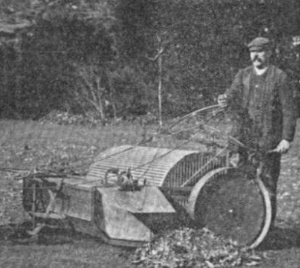
Mr Challis with his lawn sweeper
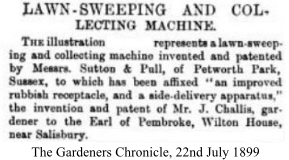
To make emptying easier, Mr Challis, the head gardener for the Earl of Pembroke at Wilton House, Salisbury, took Sutton & Pulls sweeper and created his own lawn sweeper design, he secured a patent in 1899. Contemporary articles state this certainly was an adaptation of Sutton & Pull’s earlier design, thus Challis’ new machine (as in the colour and black & white images) was a combination of his and theirs. The patent drawings show similarities. (See excerpt)
The modifications that Mr Challis made to Sutton & Pull’s sweeper enabled the leaves and general lawn debris to be ejected from the side of the collector once it was full. This meant that the operator didn’t have to stop, which sped up the sweeping process; adverts claimed ‘Remarkable saving of time. Reduction in amount of labour. Economy in cost of working’. One man with a lad, a light horse, and a 5’ sweeper was claimed to be able to clear a fifteen acre lawn in one day and save the labour of fourteen men.
The sweepers emptying improvement was two doors, with one at each end of the collector, and a pusher that slid within the collector. This device was connected to cables around a hand-operated wheel which opened the doors and moved the slider. It was ingenious if convoluted. I think the wheel and handle mechanism around which the cables pass is a bike wheel, as shown in the image.
The mechanics of Mr Challis’ lawn sweeper
The manufacturer was Mr Peter Buchan, Engineer, Caledonian Iron Works, Chichester. Mr Challis was available to give demonstrations at Wilton House.
Mr Challis’ improved lawn sweeper was advertised in several gardening magazines and had favourable reviews. Mr Challis was a talented gardener and had gardening correspondence in magazines, as well as judging shows and being knowledgeable in his field. However, it is unknown how many sweeping machines were sold, although they were still being advertised in 1915.
I wonder if any have survived the last one hundred years, or perhaps they all ended up as scrap when their use and pony power were no longer needed. The use of engine-powered machinery was creeping in, for example, in 1900 Thomas and William Coldwell applied for a British patent for a ‘self-propelled machine for rolling, mowing or sweeping lawns‘.
Pedestrian Lawn Sweepers
As mentioned, pedestrian-powered lawn sweepers were available earlier than Challis’ pony-drawn design; several featured in gardening magazines.
Well-known manufacturers were Thomas Green and Ransomes. Several patents included one by Thomas Green in 1878.
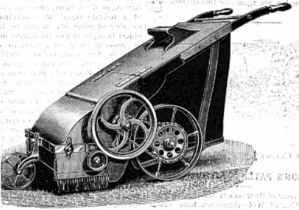
John Lampitt, Lawn Sweeper, 1890
In 1890, John Lampitt and Co., engineers at the Vulcan Works, Banbury, were advertising a pedestrian lawn and path sweeper, as illustrated. This was the Davis Patent Lawn Sweeper. Four sizes of this machine were made. Apparently, they sold well and were in demand.
A simple design, the wheels rotated an internal brush and threw debris into a rear collector. The airflow also created suction, which aided the process.
The sweeper could collect in both wet and dry weather, and lift leaves, pine cones, sticks and stones. It could pick up leaves from gravel paths without disturbing the surface.
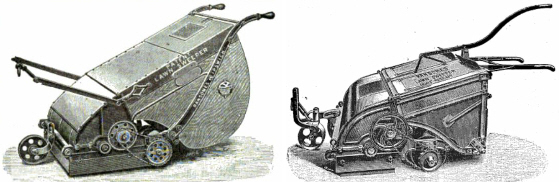
Ransomes, Sims and Jefferies Ltd, Orwell Works, Ipswich, were promoting two lawn sweepers in the mid-1890s. This again was the Davis Patent and was available from them in two sizes.
The smaller model, illustrated below on the left, had a sweeping width of 2′ with four brushes driven by a chain from a rear roller. It was intended to be used by two men with one pulling the machine and the other pushing.
The larger machine, illustrated on the right, was to be pulled by a pony or small horse. It was 5′ wide but had a 4′ sweeping width. It could be emptied by using the central lever to raise the collector.
Satisfied customers were the gardeners Mr Norman who worked for the Marquis of Salisbury at Hatfield, and Mr Taylor who worked for Lord De Saumares at Shrubland Park, Suffolk.
Ransomes Davis Patent Lawn Sweeper 1895. The right side machine says ‘Davis Patent’ upon it.
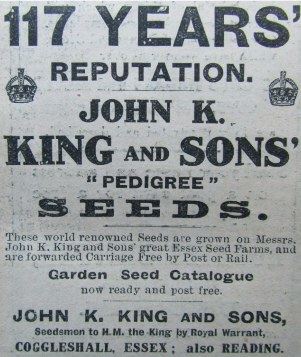
In recent issues of The Cultivator magazine, Andrew Hall wrote about seed packets and the people and companies behind some of the famous names, such as Carters and Suttons. Indeed, some of the seed merchants go back a long time. For example, as in the shown advert, by 1910 John K. King and Sons had 117 years of reputation and at the time a Royal Warrant to the King.
As collectors of horticultural items, even the smaller items, such as the seed packets and garden requisites, are as important as the machinery. Still, it’s easy to forget that there was a person behind every purchase. Who were the people buying those seeds, pondering over a new spade in Woolworths, or considering a new rotavator from the Howard brochure? Every item has a history and a story to tell.
For the rest of this article, we shall head to Scotland.
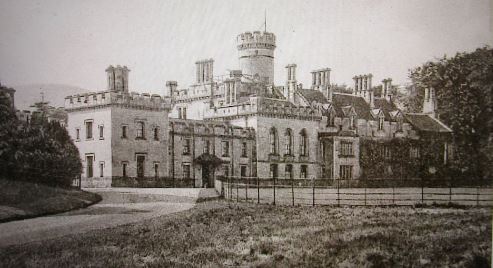
Dreghorn Castle, Edinburgh, around 1900.
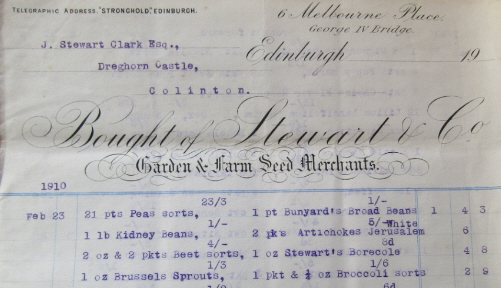
Among my archive is a 1910 seed order compiled at Dreghorn Castle, Colinton, Edinburgh, when James Stewart Clark was the tenant. Essentially, the Dreghorn property was a 17th-century mansion with subsequent enlargements over time, and was reportedly situated in a beautiful park. No doubt with ornamental or pleasure gardens, a vegetable garden, and the staff to maintain them, with a range of tools and paraphernalia of that time.
The gardener’s seed order is quite interesting and tells of what was being grown in the early 1900s. It was sent from Dreghorn Castle to Stewart & Co, Garden & Farm Seed Merchants, 6 Melbourne Place, (on the corner of Victoria Street), Edinburgh, in February 1910. This building was demolished in 1967.
For the vegetable garden, many items were ordered in ounces – cabbage, onions, turnips, radish, cauliflower, and sprouts – but there were also specific varieties:
1 oz Musselburgh Leek
1 pint Bunyard’s Broad Beans
2 packets White Jerusalem Artichokes
1 oz Stewart’s Borecole (kale)
1 packet Celery Major Clarke’s Perfection
1 packet Cucumber Lockie’s Perfection
Peas, parsnips, spinach, kidney beans, and two packets of herbs rounded out what must have been a very respectable harvest. Some of the seed varieties there were ordered are now considered ‘Heritage Varieties’.
Also ordered were 3 pecks of potatoes at 10 shillings. I had to look up what quantity a peck is: 2 imperial gallons, or one quarter of a bushel.
The ornamental and display areas got a good ordering of seeds too, including Godetia, Malope, Alyssum, Canterbury Bells, Gypsophila, Clarkia, Nigella and sweet peas. And 8 packets of ‘Choice Flower Seeds of sorts’ – I wonder what they were.
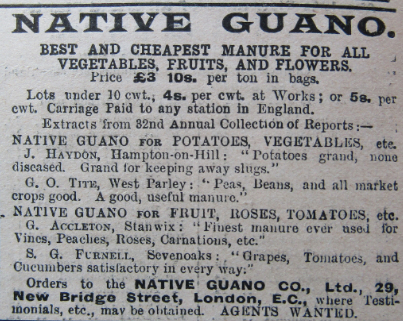
1910 Guano Advert
The labour aspect would have been great for any substantial garden of this time, with minimal mechanisation unlike today. The soil preparation with digging and manuring, as well as seed sowing, thinning or pricking out, and where necessary hardening off and planting out – within the order is 800 tallies (plant labels). And then the watering, hoeing, and the constant care.
Several items were ordered along with the seeds. Fertilizer and soil improvers included 2 cwts Canary Guano (of which many importers’ fortunes were made), 1 cwt bone dust, and 1 cwt nitrate of soda.
The list was amended on the 19th March 1910 to include 1 pair of secateurs at five shillings, 5 dozen Pinks Mrs Simpkins (Carnations), and one gallon of the ‘Most efficient mildew destroyer’!
It’s a snapshot of a moment in time. Dreghorn Castle, structurally struggling and owned by the War Office, was set on fire and detonated by the army in 1955 – films of this destruction taking place can be seen on YouTube. Today, the site is Dreghorn Barracks, adjacent to the Edinburgh bypass. Although there are specimen trees, woodland and parkland still visible, sadly, there’s no evidence left of the once productive gardens.
No matter what someone collects, there’s always that one item or model that proves elusive – and garden tractors and ride-on mowers are no exception.
Over the years, I’ve come across makes and models of ride-ons that seem to have vanished completely from the UK, with no surviving examples known to exist.
You might expect that, with today’s internet, social media, online auctions, and marketplaces, even the rarest machines would eventually reappear. But that’s not always the case.
I’ve compiled a list of “unaccountable” models in the UK – machines that, as far as I can tell, have disappeared. For this blog, I’ve chosen just five that might still be hiding somewhere, perhaps forgotten in a shed or under a heap of scrap.
So, what exactly is an “unaccountable” machine? My definition is simple: these are models that were definitely sold or imported into the UK when new. Photographic evidence of their presence here, or trade or test reports done in the UK with physical machines is always great. But also newspaper adverts and show coverage, and also useful are UK price lists and specific UK brochures.
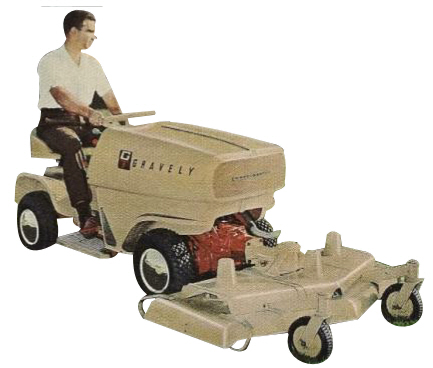
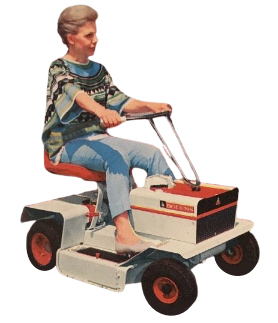
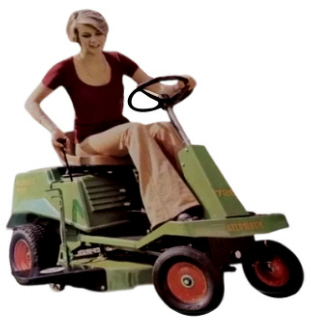
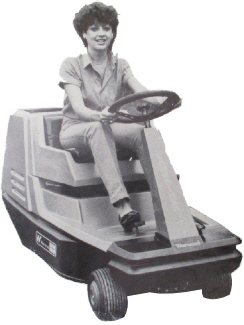
Listed in date order, the five models I’ve chosen are: the 1961 Gemco Reelrider, the 1964 Gravely Westchester, the 1966 Bolens Suburban, the 1973 ATCO Atcomatic, and the 1985 Westwood Lawnrider.
Somewhere, perhaps, one survives in the UK…
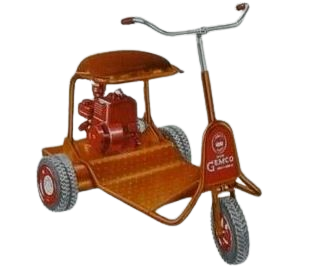
1: 1961 Gemco Reelrider
The USA-made three-wheel 24” Deluxe Gemco Reelrider was advertised in UK newspapers in the early 1960s. Adverts also appear for second-hand models, so some must have been sold from new. F. H. Burgess, Burton Road, Lichfield, was one of the retailers.
The Gemco mowers were made by the General Mower Corporation – hence where the Gemco name comes from – based in Jefferson Avenue, Buffalo, New York. USA.
The Reelrider was built around a tubular steel frame, running on 10” semi-pneumatic puncture-proof tyres. It had a 2 ¾ hp Briggs and Stratton engine through a v-belt clutch to a chain drive.
The rear 24” cylinder mower had five tempered alloy blades, and was mounted on self-adjusting bearings. The cutting height could be varied from 7/8” to 2 and 1/8”.
2: 1964 Gravely Westchester
The USA-made 1964 Gravely Westchester four-wheel tractor is an interesting machine. It could be bought in the UK in the mid-1960s.
The Westchester was based on a Gravely two-wheel walk-behind tractor. This meant that several of the front-mounted attachments for the walk-behind would also fit the Westchester as front-mounted implements, including mowers, a snow blade, a sprayer, and a snow blower.
The Westchester was designed by the Studebaker car company, which owned Gravely. It had fibreglass body panels, a Gravely single-cylinder 12 hp engine, and an 8-speed transmission, similar to the two-wheel model, but it featured rear axle steering.
Several UK dealers are mentioned as selling the Westchester, including J. H. Hancox Ltd, Solihull. The importer was Belos Gravely Ltd, Seghill, Northumberland, who listed it in their literature with UK prices.
It would be assumed that the four-wheel Westchester would be a better solution than the two-wheel with a sulky seat attached – but for some customers it wasn’t. According to Gravely, they agreed to buy back Westchester models from unhappy customers, with many subsequently upgrading to the new 1967 four-wheel Gravely 424 tractor. I wonder if this was the fate of the Westchesters in the UK?
3: 1966 Bolens Suburban
Bolens imported a vast range of ride-on mowers and garden tractors to the UK. However, the 1960s Suburban, which is well documented in the UK, seems to have vanished with no examples appearing to have survived on these shores. In 1968 the new Suburban was advertised at £230.
The Suburban was a basic ride-on mower, powered by mid-mounted 4 or 5 hp Briggs and Stratton engines with a mower deck directly underneath. They have basic tiller steering, but do have pneumatic tyres and sprung and padded seats.
In the mid-1960s, the revised white-painted Suburban (earlier models were painted gold-coloured), was well advertised in newspapers, including photographs of the Suburban in UK showrooms. They even appear in the television series ‘The Prisoner’ filmed outside at Portmeirion and indoors at MGM Studios at Borehamwood between 1966 and 1968.
4: 1973 ATCO Atcomatic
In 1973, ATCO introduced the Atcomatic rear-engine riders; they were on sale for a few years.
The models were the 26” cut 7 hp 726E electric start and 726R recoil start, and the 32” cut 8 hp 832E. All had forward and reverse hydrostatic drive.
It is currently unknown where the Atcomatic was manufactured; the use of Briggs & Stratton engines often points to the UK or the USA.
Brochures, price lists, adverts and second-hand adverts exist for the Atcomatic, yet no examples of these mowers have reappeared from the back of sheds or garages.
After being discontinued, in 1980 ATCO started importing lawn tractors made by Dynamark in the USA, branded as ATCO. Then, in 1986 until 1992, ATCO manufactured in Stowmarket the familiar classic design dark-green tractor models.
5: 1985 Westwood Lawnrider
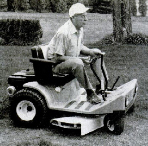
Westwood designed, made and imported a range of ride-on machines, but one model has remained elusive: The Lawnrider.
The only photo that seems to exist is on the right, from a 1985 trade report.
The UK-made Lawnrider was announced in 1985. It was to be a revolutionary rear-engine rider encased in a wrap-around body shell. It had an electric height adjustment for the 25” rear-discharge mowing deck, and an integrated rear collector and rear roller.
Models were equipped with 6 hp Tecumseh or 8 hp Briggs & Stratton engines. Prices started at £691.
However, although appearing in trade reports as ready-to-go products with prices, it’s possible that none were sold. But optimistically, there may be one or two test models lurking out there.
This model perhaps led to the creation of the 1990 Westwood Clipper rider – although that was another unusual model which had a limited sales life.
Occasionally, a long-forgotten machine may turn up in a book reference or a magazine article, and if we are lucky, an actual example may appear in the tinwork. But sadly, it seems, some of these machines are nothing but a distant memory, perhaps a period advert in a gardening magazine, or an article praising the machine’s qualities which never amounted to any meaningful sales.
Two intriguing machines featured in the June 1965 issue of Farm Mechanization: the Minni-Ho and the Wanten SSEC 2-row thinner.
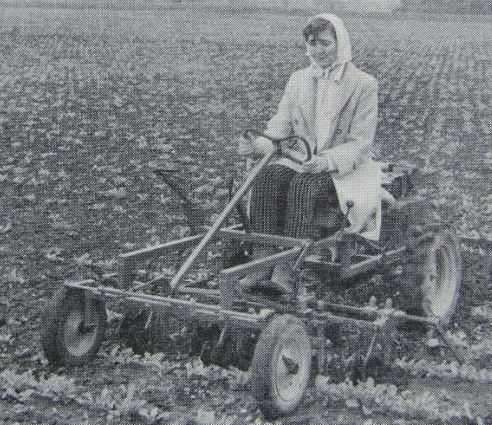
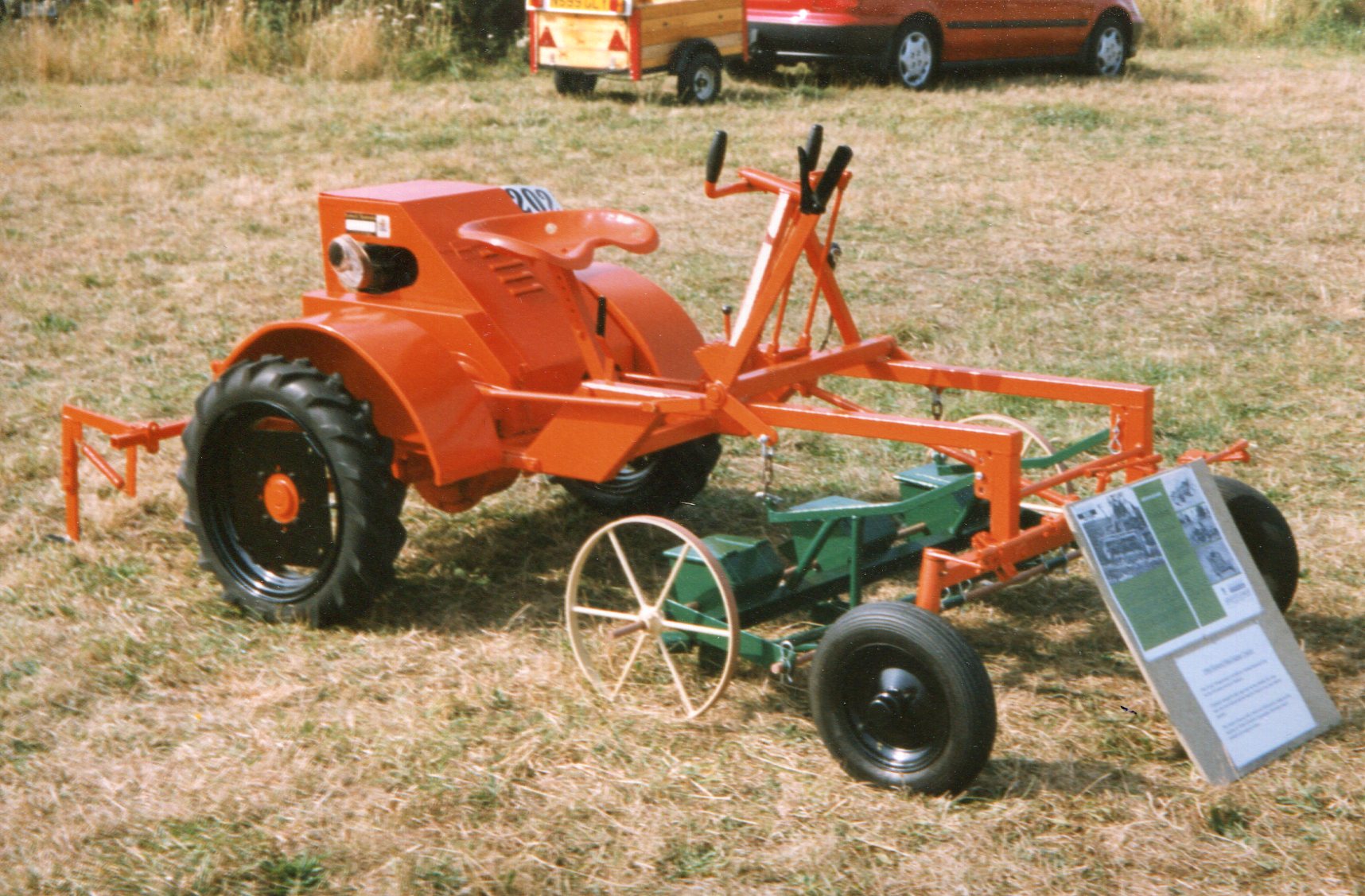
First up, the Minni-Ho. Shown below is this small tool-frame tractor, initially powered by a 2.5 hp four-stroke engine, designed for cross-blocking work. When operated at right angles, as shown in the photo, it could hoe gaps over a 52.5 inch width, leaving plants spaced at about 7.5 inches. Once the first pass was done, the operator could side-hoe along the rows. One user proudly reported tackling twelve acres in just three days – a fair achievement considering the Minni-Ho operated at a steady 2.5 mph. It must have been a slow and bumpy ride across those fields!
The machine was the brainchild of Lincolnshire farmer-inventor Mr H. C. Rothery together with his neighbour, Mr J. E. Morris. To bring their creation to market, Farm Hydraulics Ltd based at 38 Market Place, Boston, Lincolnshire was formed. In 1965, a new Minni-Ho would have cost around £250, but it is unknown if any were sold via Farm Hydraulics Ltd.
However, the Minni-Ho did not disappear into complete obscurity. Later in 1965, Howard Rotavator Co. Ltd. took up the design, calling it the ‘Howard Mini Cross Gapper’. It is said that they intended to produce fifty machines, but that target was never met. Potentially, this leaves few surviving machines. Here is a picture in the VHGMC gallery.
The Howard production model featured a Kohler K91T 4-stroke single-cylinder engine, with a quoted 3.2 hp, and a recoil starter. A two-speed belt-driven gearbox with a hand clutch gave four forward and four reverse gears. The toolframe was raised and lowered by hand.
Minni-Ho was developed by two Lincolnshire farmers in 1965. Although there is some reference that the machine in the photo might have been a prototype, images from the same photoshoot appear on Howard brochures.
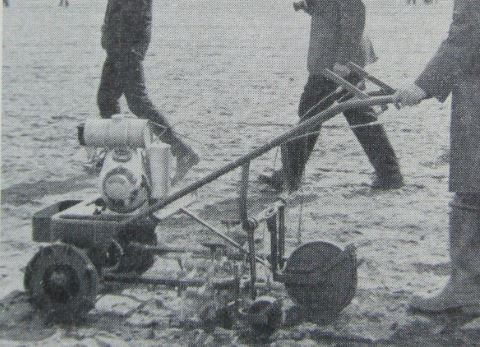
The second machine, illustrated below, the Wanten SSEC 2-row thinner, is another rarity from that same year. It was developed by Mr G. Wanten and the SSEC – the Société Sucrière d’Études et de Conseils (Sugar Research and Consulting Company) in Belgium. The SSEC’s expertise covered the entire sugar beet process from seed to molasses, producing equipment such as precision drills, beet washers, and stone catchers.
Their 2-row thinner was trialled by the Belgian Sugar Beet Institute, 45 Rue du Molin, Tienen (or Tirlemont in French). A 2.5 hp JLO engine powered it, and it was claimed to cover five acres a day, which explains why it was said to have been adopted by a large number of Belgian sugar beet growers – no doubt helped by the flat, easy-going terrain of the region.
Sugar beet is big business in Belgium, and the city of Tienen has long been known as the “Sugar City” thanks to its thriving beet industry and impressive processing facilities. I wonder if any of these 2-row thinners still exist over in Belgium?
Wanten SSEC thinner, developed at the Belgian Sugar Beet Institute in 1965
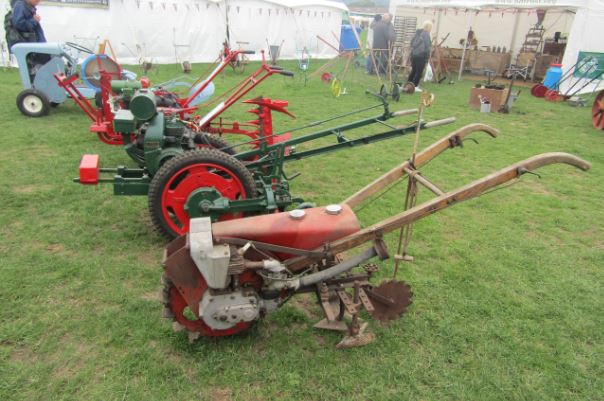
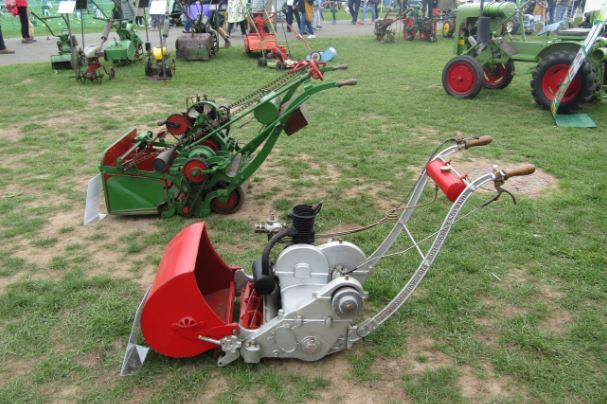
On the 26th-28th September 2025 the VHGMC put on a show stand at the Autumn Show at the Three Counties Showground at Malvern.
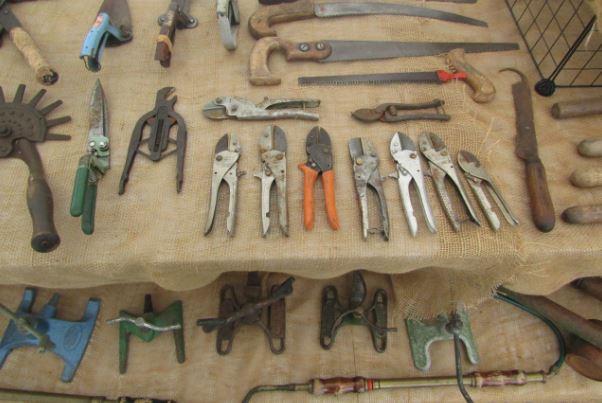
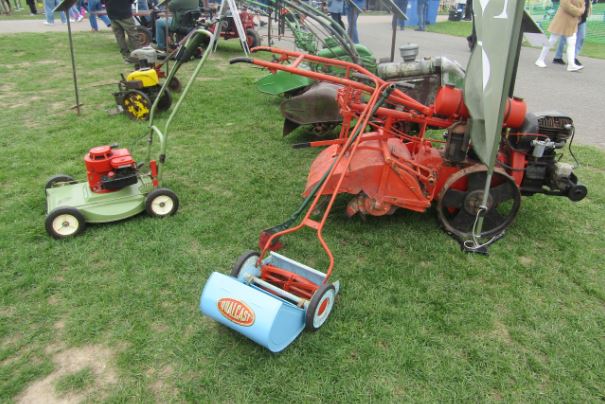
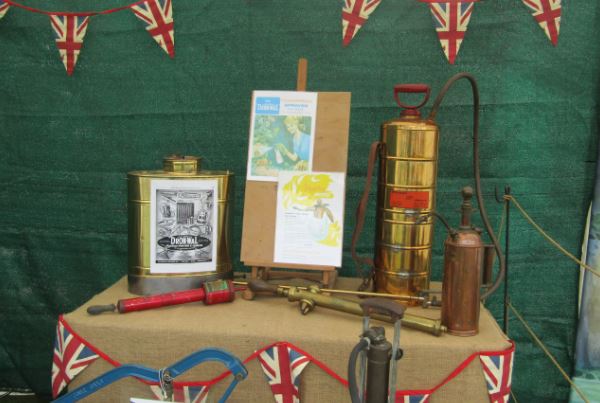
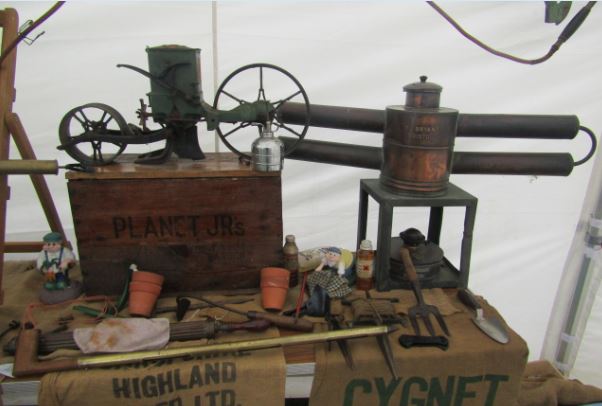
A good range of machines were exhibited with hand tools, walk-behind and ride-on machines, rotavators, and mowers. These included examples from Uni Horse, Barford, Gravely, Atco, Ransomes, Nash, Dron-Wal, and many others.
The video below is just a walk about with the video camera – edited to two and a half minutes. Plus some photographs of exhibits.
It is often overlooked, but many of the manufacturers of vintage horticultural machinery were also involved in manufacturing an array of other items. Just because we know them for horticultural items doesn’t mean they didn’t have interests (or beginnings) in other products.
One modern example is Honda. We know them in horticultural circles for starting to make lawnmowers in 1978 (47 years ago as I write this!), but they also manufacture across a range of areas, including automotive, motorbikes, marine, aircraft, generators, and power equipment.
Going way back to the 1950s, Nutt Engineering of Cambridge, who made the Hayn mowers, had a sideline in producing wire-framed clothes horses – a world away from the Honda empire, but companies need to diversify to keep working.
You may know the USA ride-on mower manufacturers Huffy, Murray, and AMF (American Machine and Foundry), but did you know that in the early-to-late 20th century they all had an interest in the manufacture of bicycles? Indeed, there was a booming industry with bikes, followed by a similar interest in ride-on mowers and powered garden equipment. Manufacturers diversified, expanded, and invested where the market and profits were.
Like the ride-on mowers that Huffy, Murray, and AMF sold in the UK, many of the bikes they produced were sold worldwide.
I have found some USA adverts which show the bikes that these ride-on mower manufacturers made:
Huffy
1967 Huffy bikes and a Huffy Sheraton ride-on mower. At the back-left is the British-designed Huffy-Moulton luxury bicycle. In the foreground, the Huffy Rail dragster.
Huffy, who produced bikes throughout the 20th century, is best known in the UK for their diminutive yet well-engineered ride-on mowers in the 1960s and ‘70s. Along with the mowers, Huffy was advertising 55 bike models including tandems and trikes in America.
In the mid-1960s, Huffy collaborated with the English engineer Alex Moulton and created the Huffy-Moulton bike (see image, right), this was claimed to be the first basic advance in bike design in 70 years. The bike had small wheels, instant acceleration due to gearing and low inertia, and was said to be nimble with light steering.
Interestingly, in the early 1980s, Huffy signed an agreement with Raleigh bikes in the UK, which gave them exclusive rights to manufacture and sell the Raleigh models in the United States. Huffy also sponsored a professional BMX (Bicycle Motocross) team. BMX started in the early 1970s in the USA, and eventually, Huffy had a range of BMX bikes. The Anglo-American BMX Championship, held in the UK in 1982, included the Huffy BMX Racing Team.
It is reported that bikes for the Huffy brand are now made in China.
Murray
1970 Murray Eliminator
Murray is another name that we associate with mowers in the UK. In the 1970s, many Murray ride-on mowers and garden tractors were rebadged and sold as Mountfield-branded machines. In the 1930s, in the USA, Murray started producing bikes alongside car parts and children’s pedal cars. However, in 1985, F. H. Tompkins, the owner of the UK company Hayter, purchased Murray for the mower brand and production, then in 2005 Briggs & Stratton took over Murray. According to research, Murray bikes had been produced until the end of the 1990s.
AMF -American Machine and Foundry
The third company that had an interest in mowers and bikes was AMF. The company manufactured some of the Massey Ferguson lawn and garden tractors starting in 1966, as well as the first ATCO ride-on mowers in the early 1980s. They also produced models branded as Dynamark, which Westwood sold in the 1970s before creating their own range of ride-on mowers. AMF had purchased the Roadmaster brand of bikes from the Cleveland Welding Company in 1950. There were 41 bike models in 1970, and bikes were manufactured until the late 1990s.
1970 AMF Roadmaster bikes. The interestingly named ‘Flying Wedge’ on the left, and Aerobee Renegade. The Flying Wedge had a 5-speed stick shift.
Usually, the questions are quite random but this time they have a theme! How good is your machinery/manufacturer/geography knowledge as the questions and answers all relate to places around the UK and the World.
Reading the questions and answers it becomes apparent how widespread machinery manufacture is before the products even reach the shops in the UK. I’m also amazed how many machines manufactured abroad have had long journeys by sea, rail, road or perhaps air to get to their destination – they may be better travelled than many people!
A pencil and paper is handy to write down the answers. Many of the manufacturers and locations have been mentioned on the VHGMC over the years – also the pictures and captions may help with some.
As always, the answers (which are sometimes much longer than the questions) are at the bottom of the page.
Questions:
Q1: In which cities were Green & Sons located?
1: Thomas Green & Sons of lawn mower fame manufactured numerous machines. They had ironworks in Leeds, but which other city did they work from?
A: Birmingham B: London C: Coventry
Q2: Where was the Bean tractor made?
2: The Bean tool frame tractor was initially a mid-1940s machine but had design changes passing through several manufacturers. The first machines were built at the Blackburn Aircraft Factory, but in which county?
A: East Yorkshire B: Lancashire C: Lincolnshire
(Get this tricky one right and gain bonus points!)
Q3: Over the border to the Ginge factory.
3. In the 1960s the Danish company Ginge set up a new factory far northwards in the UK to produce their lawn mowers. They were still manufacturing in Copenhagen, and had an office in Croxley Green, Herefordshire, but where was the new UK factory?
A: Grantham, Lincolnshire B: Stockton-on-Tees, County Durham C: Irvine, Ayrshire
Q4: Where was Hahn located?
4. In the 1970s, the companies of Ransomes and Hahn had a two-way agreement selling each other’s machinery in their respective countries. Ransomes was based in the UK, but in which country was Hahn?
A: Germany B: USA C: Switzerland
Q5: Morrison didn’t have anything to do with Kangaroos.
5. Flymo had associations with Toro and Norlett in the 1970s. They also had a foray with Morrison selling their imported mowers in the UK in the 1960s. In which country was Morrison based?
A: New Zealand B: Australia C: Canada
Q6: Allett Mowers moved about.
6. In 2021 Geoff Ravenhall restored Allett’s first ever MK1 production mower. It was made in 1965 and powered by a Reliant 3-wheeler four-cylinder engine and gearbox – read about it here on the forum.
Allett is firmly a British company with an amazing history of producing top-notch mowers, however, the company was sold in 1994 and moved north from its premises in Corby, Northamptonshire. But to where did it move?
A: Swansea, Wales B: Arbroath, Scotland C: Belfast, Ireland
Q7: Taking Le Qualcast over La Manche.
7. Qualcast sold their mowers all over the world. Although we are used to seeing English adverts, it stands to reason that they must also exist in other languages. Advertising for the Qualcast Model C in 1923 carried the heading “Le Secret Des Belles Pelouses Anglaises” – but in which country did this advert appear? (And for a huge bonus point can you guess the translation of the advert heading?)
A: Canada B: Austria C: France
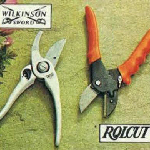
Q8: Where were Rolcut secateurs exhibited early last century?
8. There are many secateur brands and designs in the UK. Rolcut made the anvil-type ones, but at which major show were they first exhibited by Rolcut?
A: The Chelsea Flower Show, London – 1927 B: Ideal Homes Exhibition, Olympia Exhibition Centre, London – 1949 C: The Royal Show, Newcastle – 1962
Q9: Where did the Merry Tiller originate?
9. It can be surprising to find that a machine (or design) has been imported to the UK rather than being home-grown – the Merry Tiller is one such machine. In which country did the Merry Tiller originate?
A: Australia B: Netherlands C: USA
Q10: Bobbing along on a Dixon ZTR.
10. Many horticultural machines (now vintage), as varied as the Dixon ZTR mower, Billy Goat, and Bluebird Scarifier, were sold from the Garden Machine Centre, Sunningdale, Berkshire. Which name is usually associated with this address?
A: T. Parker & Sons Ltd. B: Bob Andrews C: John Allen & Sons
Q11: Where was the Solo Multimot from?
11: In the early 1980s, Solo Power Equipment Ltd of Brierley Hill, West Midlands (later moving to Chorley, Lancashire) imported the Solo Multimot system – it was an engine that could be attached and removed to power various garden machines/attachments. But where was the Multimot from?
A: Germany B: Wales C: Australia
Q12: Where did the Piaggio trucks come from?
12: The usual odd question/answer to finish: The Piaggio 3-wheel commercial truck was sold in the UK in the 1970s and advertised in greenskeeper magazines and the like. It was ideal for golf courses, nurseries or large gardens where it would be useful with a tipping rear body and up to half-ton capacity. Where did the Piaggio truck come from?
1: B: London. Adverts for Greens lawn mowers often show the addresses Smithfield Ironworks in Leeds and New Surrey Works, Southwark Street, London – although earlier London addresses were shown in the 1800s for items including fencing, gates, and verandahs, and large items such as steam road rollers.
2: A: East Yorkshire. The Blackburn Aircraft factory, where the Bean tool frame tractor was made, was located at Brough, East Yorkshire. The town of Blackburn is in Lancashire…..but no aircraft factory.
3: C:Irvine. Ginge mowers were produced at a factory at Irvine Industrial Estate, Irvine, Ayrshire. In the late-1960s the cylinder mowers included the hand-propelled 12″ Prisma and 16″ Futura. Powered cylinder mowers featured the 18″ Meridia and 21″ Atlanta. The mowers were popular and in 1967 were said to have captured 6% of the British lawnmower market. Petrol rotary mowers followed in 1970. There is a VHGMC article about Ginge here.
4: B:USA. Hahn was based in the USA. Two garden-sized ride-on machines brought into the UK were the Hahn LTD 550 ride-on mower and the Hahn GT-700 multi-purpose tractor which could be fitted with a mower, snow blade, sweeper etc. There were Briggs & Stratton-powered pedestrian rotary mowers but these seem quite scarce in the UK.
5: A: New Zealand. Morrison was based in New Zealand. In 1980 the range of mowers advertised included 14, 16, 20 and 24″ Olympic cylinder models, and the M4B and Conquest rear-collect rotaries. In 1969 Gardening Which? magazine tested the Morrison Golden mower priced at £48, it had 4 wheels, rear grass collection, and a 3 hp Kirby/Tecumseh engine.
6: B:Arbroath, Scotland. In 1994 Allett Mowers was sold to Reekie Engineering. Production moved to Arbroath in 1995. Turfmech Machinery purchased Allett in 2007. The mowers are now made in Hixon, Staffordshire. You can read the detailed history of Allett Mowers on their website blog – here.
7: C: France. The heading is from a 1923 advert in France for the Qualcast ‘Modele C‘. The heading translates as “The secret of beautiful English lawns”. The mower could be purchased at L. F. Michon, 46 rue de la Bienfaisance, Paris.
8: A:The Chelsea Flower Show in 1927. The Rolcut secateurs were a success and in the 1930s advertised that they had an Award of Merit from the Royal Horticultural Society and a silver medal from the National Rose Society.
9:C:USA. The Merry Tiller originated in the USA. It was designed by Clayton Merry in 1947. Wolseley in Birmingham had the manufacturing rights in the UK. In 1953 the USA-made Merry Tiller was introduced to the Japanese market and was an immediate hit as it was a simple and lightweight machine with lots of attachments and uses at a sensible price – one never knows which countries machines may end up in!
10:B:Bob Andrews. The Machine Centre, Sunningdale, is associated with Bob Andrews. A wide range of garden machines from an array of manufacturers and suppliers were retailed. John Allen & Sons are associated with Allen machines, Motostandard, Mayfield, and Roper. T. Parker & Sons sold many items but also imported the Australian range of Deckson mowers in the 1970s.
11:A: Germany. The Multimot from the German company Solo consisted of a 1.5 hp 2-stroke engine that could be fitted to a number of different machines such as a hover mower, chainsaw, tiller, etc. There was an earlier Solo system before the Multimot. There are quite a few Solo machines including more traditional-powered rotary mowers in the UK.
12:A, B, and C. All three answers. Andrews Lawn Edgers Ltd, The Garden Machine Centre, Sunningdale, Berkshire, advertised the Italian Piaggio Vespa commercial trucks. The model VC600 could do 60 mpg and transport half a ton; the VC200 could carry slightly less but managed 100 mpg. Both were ideal for running around a horticultural or garden establishment but would later be replaced by machines like the Kawasaki Mule or John Deere Gator.
Footnote:
And that’s all the website front-page posts for 2024.
I was asked how long it takes to find and compile the twelve questions for December. Well, if we add up the hours then it will certainly total a couple of days. The questions were written in early September with this whole article page pre-loaded onto the website to publish itself on a set date in December.
It takes a while to find the questions (made harder this year because I decided to go with a ‘theme’ of locations and places), write the answers, cross-check everything for correctness, then find a picture for each and crop and upload, and a general bit of ‘nip and tuck’ to tidy up the questions and answers. And have the whole thing previewed on laptop/tablet/mobile to make sure it displays as intended.
To aid and assist….(or perhaps hinder)…the website spell-checks and grammatically susses everything out as I type but it gets very confused with manufacturers and machine names that it’s not familiar with. Then an analyzer (some AI malarky) decides to criticize the whole thing by giving a readability score out of 100. Anyway, you have read this far so the words must have been strung together right proper-like at my desk in Yorkshire. Happy Christmas!
This is the third in a series of ‘Guess the company’ quizzes – and is more difficult than the first two and the clues are not in date order. Can you determine which single company the clues refer to?
Clue 1: This UK company made most of their own gardening machines and by 1987 30% of production was sold abroad.
Clue 2: A successful company, the assets included a full-size helicopter in a brown livery with the company name.
Clue 3: The company started small in a former warehouse in High Wycombe in the 1960s, but nearly twenty years later it was eventually bought in a £9m deal.
Clue 4: In 1985 an unorthodox ride-on mower was produced. It was called the Clipper and had an engine protruding at the front. It had chain-driven small front wheels and strange steering. It was a short-lived model!
Clue 5: A slight deviation from garden machines, in the 1980s the company also advertised a range of small groundwork machines for DIY excavation projects. These included two four-wheel dumpers and a small digger.
Clue 6: Several small garden tillers/cultivators were made including the Gemini, Imp and Groundhog. In 1973 the Imp had a 15″ working width, a 2.5 hp Aspera engine and a centrifugal clutch, and cost £60+vat.
Clue 7: Although a range of pedestrian mowers was made, in the 1980s rebranded Ibea mowers started to be sold by the company. These included the Rotastripe (rear roller), County and Enduro (4-wheel).
Clue 8: The company is best known for their range of ride-on mowers, the early/vintage ones are popular and have a following of enthusiasts. These include the early W series models which were petrol-driven, in 1984 a diesel model was added. The W series was replaced by the S and T series.
Scroll down for the answer……
All the clues point to the company Westwood Engineering Ltd.
The company started in the late 1960s at Fryers Works, Abercromby Avenue, High Wycombe. Around 1973 they moved to Plympton, Devon.
The company originally manufactured many pedestrian lawnmowers and tillers, including the Sabre mower range and the Westwood Imp 2.5 hp cultivator with a 15″ working width. Westwood also listed the Rockwell electric hedge trimmers.
Westwood got into the ride-on mower market in 1971 with the launch of the Lawnbug. To have larger lawn tractors, Westwood sold the American Dynamark tractor range in the 1970s. However, by the mid-1970s the more familiar tractors that we associate with the W-series were manufactured by Westwood.
The Westwood tractors can be found worldwide, and in the 1980s were rebadged as Ginge in Denmark and Agro-Trac in Austria. They also had cosmetic changes and rebadged as the Honda-powered Lawnmaster made by Bartram Mowers Ltd in Norwich.
In 1985, Ransomes, Sims & Jefferies purchased Mountfield for £9m.
Away from horticultural machines, the Westwood company advertised the ‘Muck Shifters – clue number 5 and illustrated below. These were diggers and dumpers for small projects – such as in a back garden where larger machines couldn’t gain access. The ‘Muscleman’ was a small digger that could dig down to 7′ deep; the ‘Muck Truk’ was a 46″ wide 4-wheel dumper that could carry up to 400KG; the ‘Skip Truk’ was a high-lift version of the Muck Truk that could lift high enough to tip into a skip.
Westwood Clipper (Clue 4), and the Muck Shifters with the Muscleman digger and the Muck Truk (Clue 5)
Earlier this year there was a discussion on the forum about how many different manufacturers (or brands) had produced engines that were fitted to horticultural machines. The list became long and would have been longer if I hadn’t stopped adding to it.
One engine name that didn’t get mentioned or added to the list was Vertex. Internet searches indicate that these engines had a Villiers connection.
The reason that I mention Vertex is that I have been researching Mountfield lawn mowers and these two-stroke engines began to be fitted to a few models in the mid-1970s – Mountfields own literature and price lists show the use of the 4 hp, 2-stroke engines in 1975. Although I have found a brochure showing these Mountfields with the Vertex engines, I’ve yet to find one of the mowers in real life – what happened to them all? If you are someone who owns such a mower and scouring the internet for info, then you have a rare survivor!
Mountfield M6 Power Drive fitted with a Vertex engine.
In 1977 and while the engines were already being fitted to their mowers, G. D. Mountfield announced they were now taking over production of these engines and would produce them at their Maidenhead premises, they were marketed as ‘All-British Built’. In fact, in 1977 Mountfield advertised for Skilled Production Machinists to start immediately to set up and run the recently-formed Vertex Engine Division at a new production facility being built in Maidenhead – the advertised wage was £4000 plus relocation expenses.
Mountfield were quite upbeat about their engines. Apparently, they had exceptionally high torque over the whole working speed range giving unmatched power. One trade report (AMJ) stated that the engines would be ‘…a welcome replacement to the engines of US and Italian extraction as seen in previous models’. However, people who maintained Vertex engines in their line of work have told me that they weren’t the best!
Classed as medium-sized professional mowers, in the late ’70s, the three models fitted with the Vertex engines were the 18″ M4 Professional, 18″ M4 Power Drive, and the 21″ M6 Power Drive as illustrated. All three machines were fitted with snorkel air cleaners, and polythene grass boxes were optional. In 1975, Mountfield had listed the M6 Power Drive 2-stroke at £177.50 – which was £19 more than the equivalent 4-stroke.
In the early 1980s, the Vertex models were still advertised, but with other new mowers being more important, an always-evolving market, and whatever issues the Vertex engines may have had, they seem to have soon vanished.
One thing is certain: even with relatively modern machines, some do not appear on the scene or on auction websites. Machines don’t have to be old to have disappeared into obscurity leaving only some fleeting bits of literature and adverts behind.
But I do wonder where all the Mountfield Vertex mowers went!