Lincoln Steam 2012

March 26, 2013 in Show Reports

Written by Steve Woollas.

August seems so long ago but Lincoln steam, or to give the event it’s correct title The Lincoln Steam and Vintage Rally took place in glorious sunshine at the purpose built show site owned by The Lincolnshire Agricultural Society, adjacent to the A15 at Grange-de-Lings north of Lincoln on the 18th & 19th of August 2012.

Lincoln is the third in a trilogy of steam rallies held over the first three consecutive weekends in the eastern side of England commencing with Pickering, then Driffield, then Lincoln, and, for many a continual pilgrimage takes place to each in turn.

People travel far and wide to Lincoln and it was pleasing to meet club members who had travelled over from the Isle of Man for the event.

Lincoln steam appears to grow each year although the showground boundaries do not, and it is testimony to the organisers’ careful and strategic planning that all exhibits are accommodated within their allotted areas. This year the programme listed in excess of 1550 entries, including some of the 100 full size steamers, a further 100 miniature steamers and over 30 musical organs. Tractors amounted to 330 entries of which 50 fell into the horticultural category. with some 230 stationary engines, 28 awning displays, 130 entries in the models hall including 24 Meccano displays and in excess of 550 vintage/classic vehicles and a large trader market there has to be something at Lincoln for the whole family to view, admire and marvel upon.  
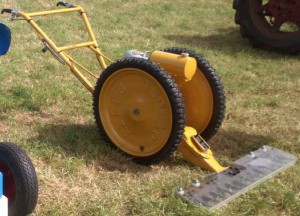
Allen Scythe fitted with a Villers engine. It is painted yellow because it spent it's working life on an airfield.

Allen Scythe MK2 fitted with a Villiers 11C engine. It is painted yellow because it spent it’s working life on an airfield.


Tractors have their own display area with a “drive through” parallel ring and paraded each day at 2pm lead by horticulturals and the commentary lasts for around 3 hours – not all by me you will be pleased to know!

First in the ring for the horticulturals was one of the nicest Fiddle Drills I have ever seen complete with instruction sheet attached to the body of the drill, along with a demonstration of how the march along in time with the hand movement when drilling, i.e one movement of the bow in time with each step forward. Another interesting item was a 1939 Vivian Lloyd Brush Cutter. One trusty steed was present and attached to the “working end” was an unusual Howard Rotavator attachment.  

I was interested to see some early versions of some machines present including a 1937 Ransome MG2 with the early Sturmey Archer T Type engine fitted, the 1941 allen Scythe MK2 (pictured) fitted with the Villiers 11C engine, finished in yellow livery as this machine spent it’s working life on an airfield. Cliffords were well represented with two Clifford Juniors in the line up, as were Ransomes with examples of MG2, MG5, MG6 and MG40. A 1951 Monrotiller Series One in original paint and transfers made an interesting item in the Parade as did in total contrast a nicely restored 1951 Bolens with cultivator in green and yellow. 

Note: This article has been reproduced and edited from the November 2012 issue of The Cultivator and written by Steve Woollas. 

Ride On Machines

March 25, 2013 in Machinery

Trusty-tractor

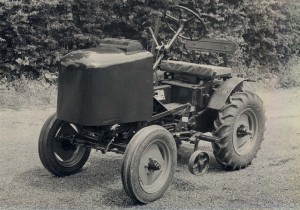
There are many ride-on machines and garden tractors available such as this Trusty Steed dating from around 1950

Popular with collectors, enthusiast and exhibiters are ride-on machines. The most common are the garden tractor or ride-on mower types but there are many others too such as tracked crawlers like the Bristol, the three wheeled Gunsmith and the Opperman Motocart.

Whether you are collecting a machine for preservation, restoring & showing or to use on the horticultural plot there are machines ranging from the 1920’s through to the 1990s.

Some of the more common garden tractors of the ride-on mower types which tend to date from the late 1970’s onwards are Atco, Westwood, Roper and Mountfield to name just a few. Many of these lower-spec machines were aimed at the weekend gardener with a large lawn to mow and occassional trailer work. These entry-level tractors often had ‘bigger brothers’ with more power and capabilities.

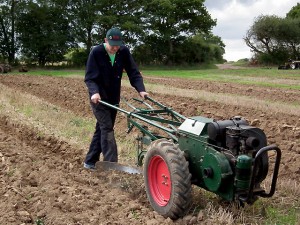
More robust garden tractors capable of serious work such as pulling a plough on an allotment, powering a rotavator and snow clearing work include well-known brands like the American Wheel Horse tractor range (1950’s -90’s) and the 1960’s UK Martin-Markham garden tractors. These tractors and others which are suitable for ploughing are also great for horticultural ploughing events which VHGMC members can take part in at various locations.

Ransomes Crawler & Bolens Ride-a-matic

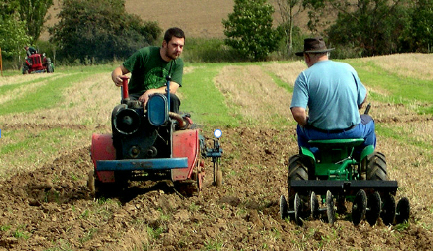
Ransomes crawler and Bolens Ride-a-matic working the ground at a ploughing event

Through the decades demand and innovation has created many diverse machines tailored for specific jobs. Machines such as the David Brown 2D (1955-61) that can be used with numerous implements like cultivator tines, a row thinner and a reversible plough – an ideal machine for crop and open field work. Another machine is the 1950’s Scottish designed Rollo Croftmaster, created for working on Scottish small holdings up to 10 acres in size, this is a compact yet substantial four-wheeled tractor.

Bonser truck

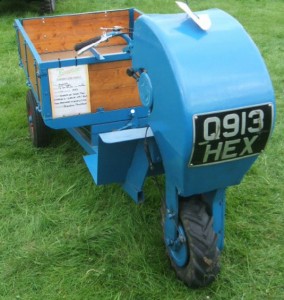
Bonser truck from the 1960’s. In excellent restored condition at a show.

Out of the field and into the yard, still classified by the VHGMC as ride-on machines there are a varied range of trucks available. Some with timber bodied rear loading areas and some with tipping bodies too. The three-wheeled Wrigley motor truck (1930’s onwards) and the Bonser truck are two well known makes and always make a good exhibit at a show.

Popular with the tracked crawler users are the Ransomes MG2 and the later MG5. These can often be seen at shows and ploughing events. Also in the ride-on-machines category are the Bristol tracked crawlers.

Many enthusiast tend to collect one or two makes of specific machines and as well as the machines themselves they will collect literature, original brochures and price lists for their specific machines. This makes a collector a very valuable source of knowledge and very helpful advice.

Walk Behind Machines

March 25, 2013 in Machinery

2012-11-10-1076

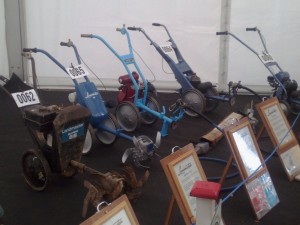
A collection of Landmaster motor hoes being shown with various attachments.

The range of pedestrian-controlled machinery is certainly extensive and it is all covered by the VHGMC. Whether it was built in the 1920’s or the 1990’s it is all the same to us.

The walk-behind category is probably the largest one in the club and encompasses everything from the humble cylinder lawn mower to the larger Iron Horse type tractors that compete at ploughing matches.

Now that insecticide sprays are widely used in agriculture the motor hoe has completely disappeared, yet these were widely used in the 30’s, 40’s and 50’s to combat weed infestations and these remain one of the main collectible machines of our club members. They are generally light and easily transported yet very eye-catching, and were always painted in bright colours to increase their appeal.

Walk behind machines are excellent for showing or using.

Walk behind machines are excellent for showing or using.

Another favourite of collectors is the rotavator that has been used on allotments since it’s invention in the 1950’s and is still a firm favourite today, with manufacturers varying from Atco to Wolseley with every company in between.

The appeal of this machinery is that the collector can restore it using very few tools and in a very small workshop. It is generally inexpensive to buy and is widely available, and when the restoration is finished the restorer can use it at many of our club working events so that the work is never finished when the restoration is complete. You can actually play with the finished article, or even use it for what it was deigned to do originally – assist in growing food.

Hand Tools

March 25, 2013 in Machinery

Vintage hand-tools covers more than just a collection of garden shears or grandad’s pre-war spades and forks in the allotment shed.

There is a vast and eclectic range of tools, powered by electric, petrol or human power. Although the term hand-tools tends to automatically refer to smaller items like shears used in the garden it does also cover a broader area including pushed hoes, garden sprayers, insecticide dusters and lawn edgers to name just a few.
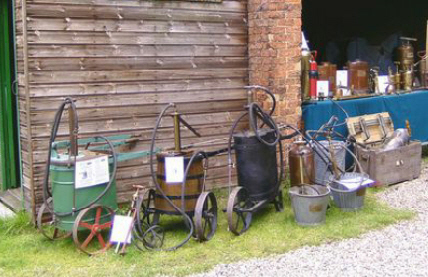
Garden sprayers

An excellent and interesting display of garden sprayers. These are all hand-powered with some being small for domestic garden use and around the greenhouse and the larger wheeled versions for larger application or commercial use.


This is a fascinating and growing collectors area where superb collections of items can, mostly, be gathered relatively easily. These are sometimes exhibited or displayed as a group of items such as secateurs through the decades, or perhaps as a collection produced by a single manufacturer such as the 1960’s range of Black & Decker hedge-trimmers. These displays of hand-tools appeal to the viewing public who can often remember using them or recall their grand-parents having them many years ago.

Collecting hand-tools can be a great hobby especially when one has a manufacturers brochure or a catalogue and the challenge is on to find the one elusive item advertised!

Many vintage hand-tools in the UK were made by UK companies rather than being imported from the US or Europe. So it is very easy to find UK engineered items at vintage auctions or even car-boot sales.
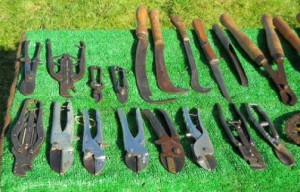
Secateurs

A selection of secateurs and cutting tools


Some of the most well known companies in the UK are Jalo (push hoes), Sheen of Nottingham (flame guns), Fisons, and Sisis (both making lawn fertiliser spreaders in the 1950’s & 60’s), There is quite a long list of manufacturers and a wide range of products they manufactured too.

Although there are many Uk manufacturers there are US manufacturers that imported their tools into the UK like the Planter Junior company . Their wooden-handled hoes were incredibly popular and sold in huge numbers from the 1930’s onwards. Some of their hoe models were available with a small plough and a seeder too. These are collectible, can be found quite easily and make a good exhibit.

Most hand-tools are items in their own right but some hand-tools can be attachments or additional to a much larger machine. For example the Wolseley Merry Tiller had attachments which could include a hedge trimmer and chainsaw – both of which worked via a flexi-shaft from the Merry Tillers petrol engine. Similar items were available for other makes too such as an electric-powered hedge-trimmer running from an Allen scythe and the range of implememts manufactured by the Tarpen company.