by alan

Machines in the North East – 1988

June 14, 2018 in Articles, Machinery

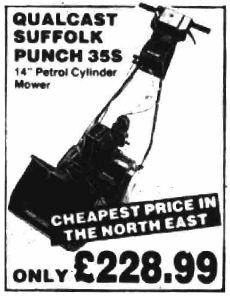
Qualcast Suffolk Punch 35S and the cheapest price in the North East

This month our search for machinery takes us to the north-east of the UK, to be more precise it’s to a now defunct chain of home improvement stores by the name of Dickens. By all accounts Dickens was a fantastic place to shop. They said that they had ‘…the biggest, the cheapest and the widest range of mowers in the world…’. They also had tillers, rotavators, lawn rakes etc and there’s a very short video clip at the bottom of this article – can you name any of the machines?

It can sometimes be a mystery as to who sold which machine, take any vintage machine and if really lucky a search of the chassis or tin-work may perhaps result in finding a dealership sticker, generally it may be a local mower shop or an agricultural supplier. These details are helpful in determining where a machine originated from or at least the point where the transaction was logged. We are aware that there’s garden equipment and machines from the 1970’s and 80’s finding their way into collectors hands, yet these machines may not have originated from that trusty local lawn mower dealer or from an agricultural supplier, these 1970’s and 80’s machines may simply have been picked up from the local DIY store or catalogue company, think B&Q, Argos, Woolworths and even Green Shield Stamps.

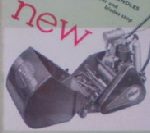
This takes us onto Dickens home improvement stores, they were like an independent B&Q and actually were eventually bought out by B&Q. Dickens advert shown below from April 1988 at the start of the mowing season to attract the spending public shows a vast range of electric and petrol mowers and strimmers too. Who knew there were so many different models on sale at this time? A transcript of this model list and prices will be at the bottom of this article for perusal. Or click this link to see a larger image of the advert.
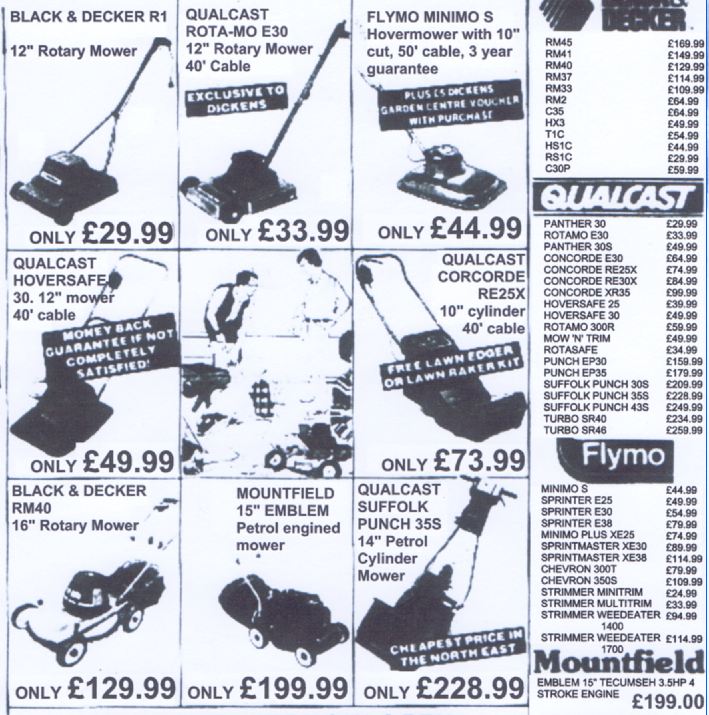
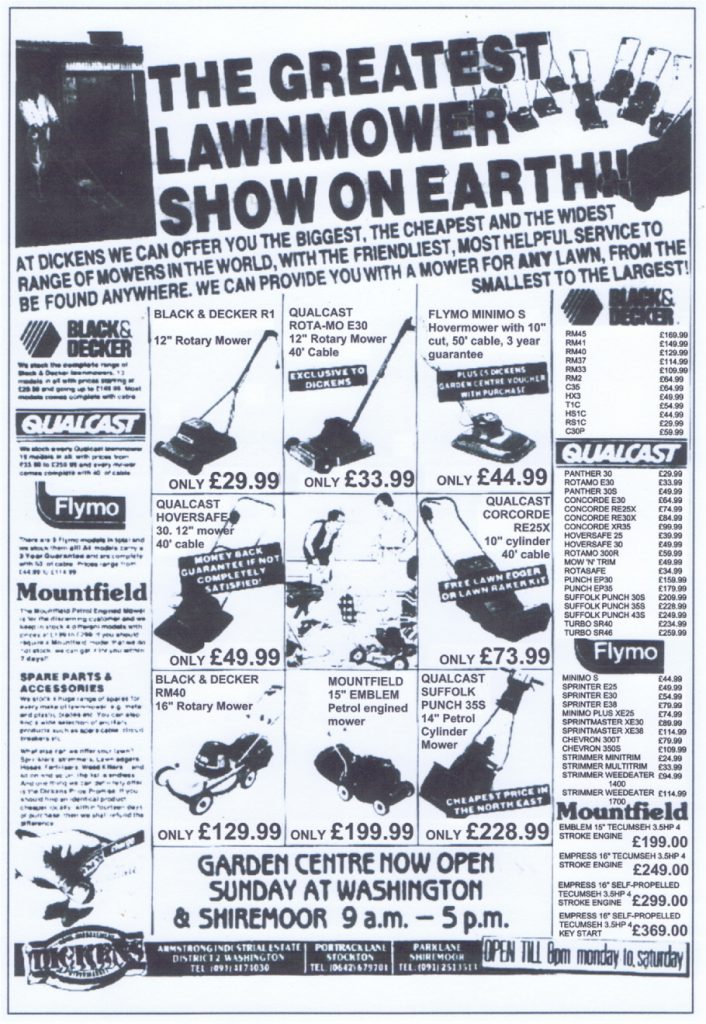
Dickens Home Improvement Hypermarket Advert 1988


Briefly, there is a huge range of electric mowers. What’s the difference between the Qualcast Concorde RE25X and the RE30X apart from £10.00 ? Or the Flymo Sprinter E25 and E30 ? A brochure would be mighty helpful!

Of note is the advert showing there is a petrol Flymo Strimmer Weedeater 1400 and also a 1700 model – potentially a rare machine now as many may have expired through the last 30 years. The price then was £114.99 which is equivalent to some £308.00 today so a hefty investment for a homeowner.

Mountfield have some mowers and all with the 3.5hp Tecumseh engine. Mountfield were mentioned in a previous article where some machines were made until 1982 in a factory in Luxembourg (article here) but where these would have been made is unknown. Business-wise there is a connection between Mountfield and Norlett of Belgium; then Qualcast bought Norlett, and further Qualcast/Flymo at the time had a production plant at Newton Aycliffe, County Durham not far from Dickens. It’s all very complicated and tenuous – but with Dickens saying they had ”…the biggest, the cheapest and the widest range of mowers in the world…’ it makes one wonder if they were mostly sourced from the nearest factories at a bargain price perhaps? 
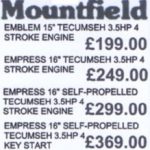
There isn’t a Mountfield electric mower in the bottom right corner of Dickens advert, they may not have been manufacturing them at the time, but their petrol mowers show that the price nearly doubles between the Mountfield Emblem 15″ and the 16″ self propelled with electric start, both with a 3.5hp Tecumseh engine – would that be a premium product at the time? 


There also happens to be a brilliant Youtube video for a 1976 Dickens television advert. This advert briefly shows machines on display in their garden centre with a tiller, rotavator and mowers at about 50 seconds. https://youtu.be/E3xiHJwIaQ8

Can anyone name the machines being shown in the video below?

Is that a Norlett Beaver Powaspade in gold and white? (see above comment re:Norlett/Flymo/Qualcast) 


The machines in the printed 1988 advert with prices:

Black & Decker RM45  £169.99
Black & Decker RM41  £149.99
Black & Decker RM40  £129.99
Black & Decker RM37  £114.99
Black & Decker RM33  £109.99
Black & Decker RM2  £64.99
Black & Decker C35  £64.99
Black & Decker HX3  £49.99
Black & Decker T1C  £54.99
Black & Decker HS1C  £44.99
Black & Decker RS1C  £29.99
Black & Decker C30P  £59.99

Qualcast Panther 30  £29.99
Qualcast Rotamo E30  £33.99
Qualcast Panther 30S  £49.99
Qualcast Concorde E30  £64.99
Qualcast Concorde RE25X  £74.99
Qualcast Concorde RE30X  £84.99
Qualcast Concorde XR35  £99.99
Qualcast Hoversafe 25  £39.99
Qualcast Hoversafe 30  £49.99
Qualcast Rotamo 300R  £59.99
Qualcast Punch EP30  £159.99
Qualcast Punch EP35  £179.99
Qualcast Suffolk Punch 30S  £209.99
Qualcast Suffolk Punch 35S  £228.99
Qualcast Suffolk Punch 43S  £249.99
Qualcast Turbo SR40  £234.99
Qualcast Turbo SR46  £259.99

Flymo Minimo S  £44.99
Flymo Sprinter E25  £49.99
Flymo Sprinter E30  £54.99
Flymo Sprinter E38  £79.99
Flymo Minimo Plus XE25  £74.99
Flymo Sprintmaster XE30  £89.99
Flymo Sprintmaster XE38  £114.99
Flymo Chevron 300T  £79.99
Flymo Chevron 350S  £109.99
Flymo Strimmer Minitrim  £24.99
Flymo Strimmer Multitrim £33.99
Flymo Strimmer weedeater 1400  £94.99
Flymo Strimmer weedeater 1700 £114.99

Mountfield Emblem 15″ Tecumseh 3.5hp 4 stroke engine £199.00
Mountfield Empress 16″ Tecumseh 3.5hp 4 stroke engine £249.00
Mountfield Empress 16″ Self Propelled, Tecumseh 3.5hp 4 stroke engine £299.00
Mountfield Empress 16″ Self Propelled, Key Start, Tecumseh 3.5hp 4 stroke engine £369.00
by alan

Then and Now – 1910

April 29, 2018 in Articles

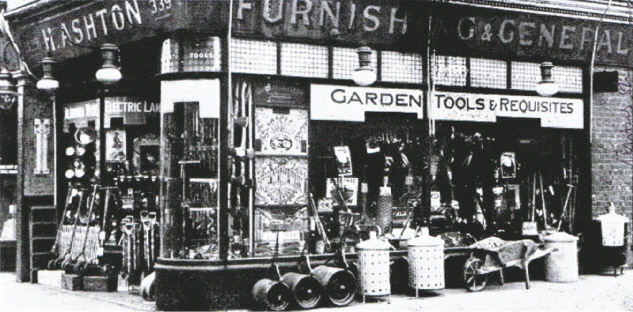
Our latest Then & Now picture is from 1910 and features Ashton’s of East Sheen. The sign in the window announcing the stock of Garden Tools & Requisites and the array of merchandise on the pavement tells us that they probably stocked everything the early 20th century gardener could want.

The image is typical of many shops from that time. Ashton’s featured an expensive curved glass window on the corner, the thermometer  on the wall to the left of the image, the lamps hanging on elegant supports and the impressive sign writing to catch the eye – one would like to think this was a shop of some quality.


The items on display include wooden D handled spades by the entrance, incinerators (of the same design of today), a display of hand tools in the window along with wire netting and seed adverts. The timber wheelbarrow looks a beast with a steel-rimmed wheel and even if some person tried to schlep it away down the street they’d no doubt be out of breath after a couple of hundred yards. 

The lawnmowers and particularly the rollers are of interest. I’m guessing they may have been manufactured by Thomas Green & Sons who were at the New Surrey Works, Southwark Street, London about a ten mile distance from Ashton’s shop. 

But long gone is Ashton’s, little did they know that a century later their wares would make an awesome horticultural display at a vintage show: They’d have thought we were mad!

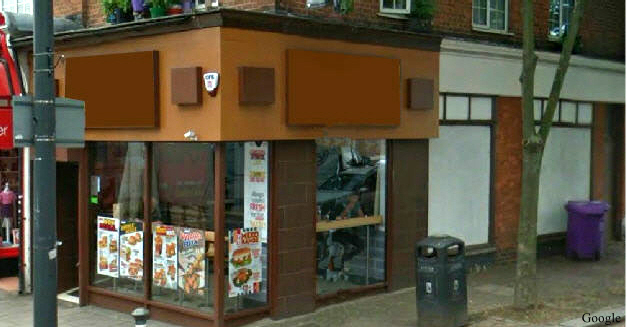
And now the shop is a fast food outlet as in the image below.

by alan

Tractor World Scotland 2018 Photos

March 26, 2018 in Show Reports

Photographs and sale items of horticultural items at Tractor World Scotland 2018. 

Click the link below:

Tractor World Scotland 2018 Report

by alan

What was on sale in 1960….

March 16, 2018 in Articles, Machinery

A selection of garden equipment in 1960

1960 is our year of choice for this article, it was the year that The Beatles was officially named and formed, the Mark 1 Mini had only just recently been introduced and in space exploration the first probe was launched to go to Mars although it failed to reach it’s target. 

Back down on earth and with our new Mini on the driveway trying to out-shine next doors Morris Oxford, there was also a whole host of equipment available for the garden.

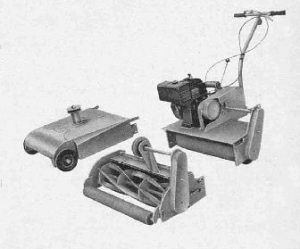
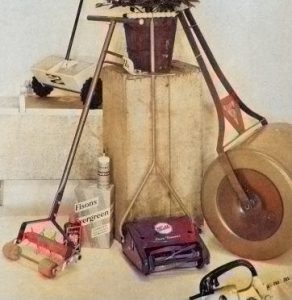
The image on the right shows some of the items that no self-respecting suburban homeowner should be without to keep their garden as tidy as possible.

Clockwise from top left is the Fisons Evergreen fertilizer spreader able to treat 64 sq yards of lawn on each fill-up. The price was 59s 6d for the spreader and the fertilizer itself was from 3s 11d. 

The Greensleaves garden shears on top of the box were 34s 6d and were available from Derry & Toms the London department store in Kensington. 

For a more upmarket experience why not shop at Harrods? They were retailing the illustrated lawn roller which could be filled with either water or sand, available in several sizes with a range of prices starting at £3 7s 11d up to nearly £7. One’s chauffeur could fetch it home for ones gardener…..

The Army & Navy Stores were selling the small Webb Lawn Trimmer push mower for the smaller areas of lawn for £7 19s 7d, whilst the push lawn aerator was £4 15s and another Harrods purchase. 

The Tarpen Little Giant chainsaw in the very bottom right corner of the first picture could be used with a single hand and cut through 4″ branches, the price to you in 1960 was £22. 


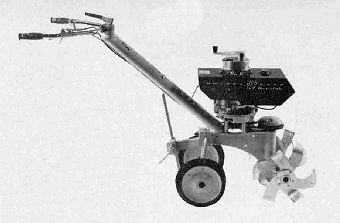
Shay Rotogardner 125

There were many machines on sale in 1960 which were engine powered. One such was the self-propelled Shay Rotogardner 125, pictured right, powered by a “four-stroke Aspera engine and impulse starter making it easy to operate” according to sales literature. It had specially tempered steel tines that “will break up any soil“. The cost of the complete machine as pictured was £67. 

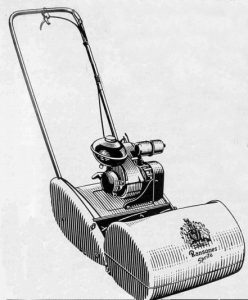
Or how about something to cut the lawn such as the Ransomes Sprite pictured below. In April 1960 Ransomes were advertising this as a new mower with 14″ cut and as being ‘the lowest priced motor mower in it’s class‘ costing £32.17s.3d. For something more expensive on sale at the same time and also from Ransomes was their Marquis mower with 18″ or 20″ cut powered by a Clinton 4-stroke 117cc engine, prices started at £74.1s.9d, and £89.0s.6d for the 20″, an electric version was also available.


Ransomes 14″ cut Sprite for £32.17s.3d.

Webb battery mower

Through the decades battery-powered machines have been a bit of a novelty, if one didn’t want a petrol mower or be tethered by an electric cable to a three-pin plug then in late 1960 Webb had the answer with their ‘new to the market‘ rechargeable battery mower model, no mess, no fumes or noise. Webb previously showcased a remote controlled battery mower to the general public in 1959 at the Chelsea Flower Show but this one is just the ordinary walk-behind type – there’s a great vintage image on our Webb gallery of a sale of a battery mower taking place.

The battery mower cost £58.19s.5d for the 14″ cut and £48.19s.10d for the 12″ cut. They were available from ‘all large stores and hardware shops‘ so Webb were reaching out to a large customer base and could see some potential.

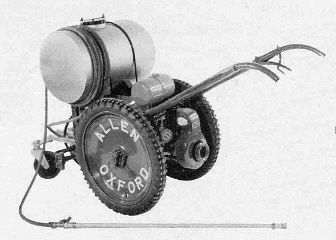
Still in 1960, Godfrey’s of Marylebone Lane, London, were advertising the “Allen Universal Self-propelled Motor Scythe” with a two or four stroke Villiers engine – pictured below.

The image shows it with an attached spray tank and four foot lance, apparently all the attachments just plugged in. The machine itself was £98.15s; the spray tank was £23.10s; spray pump including lance was an additional £39.4s.6d. 

Allen Scythe with spray tank, pump and lance

Hayter Scythe with a Villiers 4-stroke engine.

Several manufacturers designed machines that were able to take attachments just like the Allen scythe could with the sprayer. Hayter made the Hayter Scythe – pictured right is a model which consisted of a power unit that could be used as a rotary scythe or cylinder mower. Powered by a Villiers 4-stroke, 265cc engine and with a three-speed gearbox and kick start the machine had adjustable cutting height for the scythe attachment and could be converted to a 30″ cylinder mower complete with roller, a good machine for a larger garden where the most use could be gained from it. Again available from Godfreys, or A.T.Oliver & Sons, Luton or our favourite (who most have sold every machine ever created) Robert. H. Andrews Ltd, Sunningdale. Price: £119.10s; cylinder mower an extra £47.16s; and the grass box another £7. 15s. 

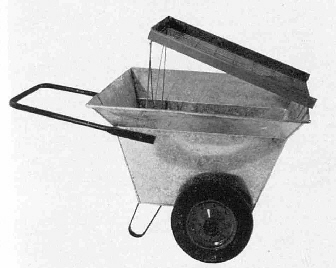
For helping around the garden in the early 60’s, the Army & Navy Stores were selling a light but strong metal wheelbarrow with pneumatic tyres for £15.4s.6d. The image below shows it fitted with a useful screen for sifting soil made by Barrowscreen. Sold by Woodmans of Pinner the Barrowscreen cost 34s 11d and could fit any barrow.

Wheelbarrow by Army & Navy Stores 1960. Fitted with a soil sifting Barrowscreen.

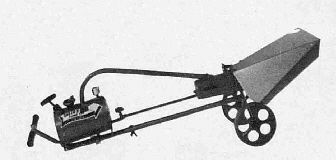
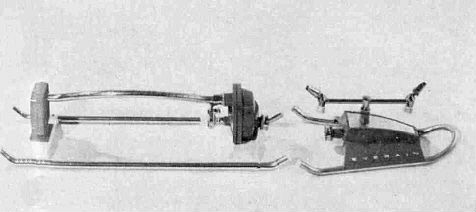
Finally, two smaller items which could have graced a 60’s shed was a flame gun on wheels called the Sheen-X. and also garden sprinklers from the American Everain range, both items illustrated below.

The Sheen-X had a tank that could hold one gallon of paraffin and could destroy surface and deep rooted weeds with ease. Price was £12.17s.  The Everain sprinklers were both adjustable, the larger one could cover up to 2400 square feet, the smaller one a 50 foot diameter. Prices were £6.7s.6d and £3.12s respectively.

Sheen-X paraffin powered flame gun.

Everain garden sprinklers.

by alan

VHGMC in the Telegraph newspaper 2009

March 3, 2018 in Club News


In April 2009 the Telegraph newspaper ran an excellent article about the VHGMC with the headline of ‘Down Tools? Not these vintage gems’.

The Telegraph article can be read online and can be found at:

https://www.telegraph.co.uk/gardening/gardeningequipment/5124249/Vintage-garden-machinery-Down-tools-Not-these-vintage-gems.html


The VHGMC featured in the Telegraph newspaper in 2009 –  Click this image for a larger version


by alan

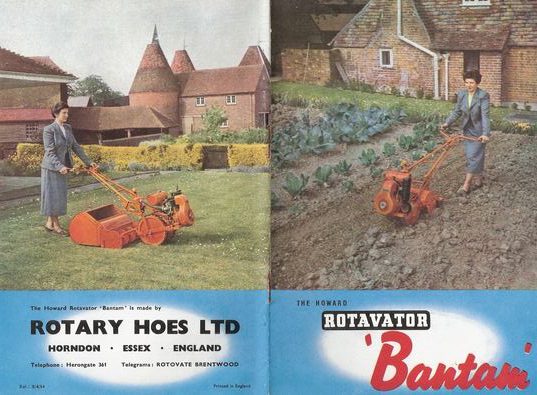
Howard Bantam 1950

February 22, 2018 in Articles, Machinery

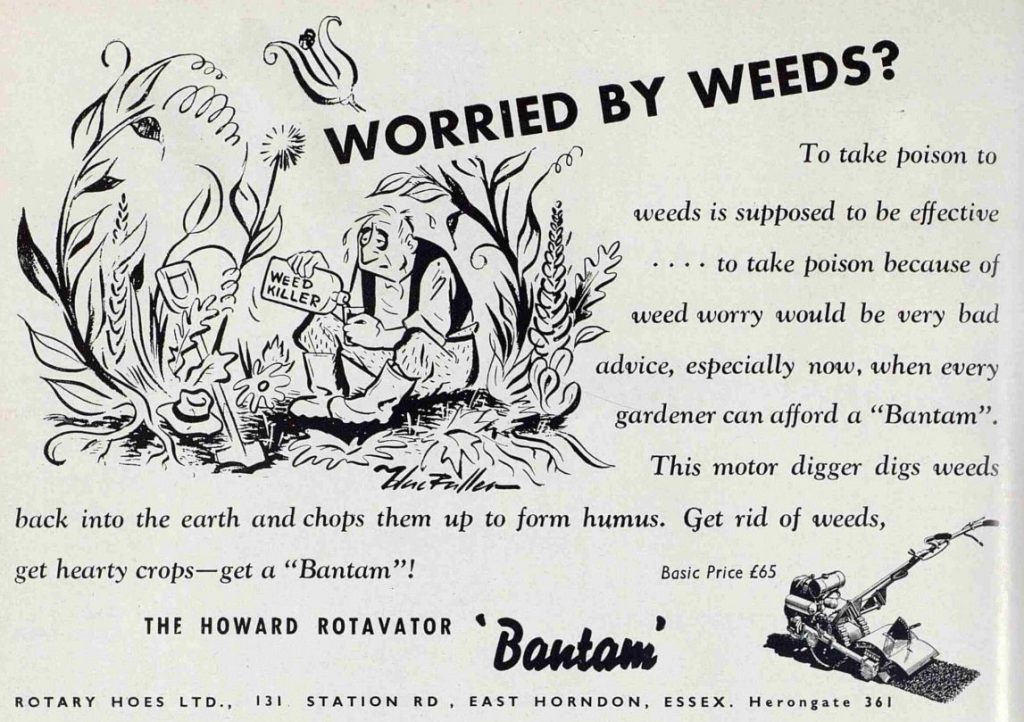
Humour can capture the attention of the prospective customer far easier than any serious advertising might.
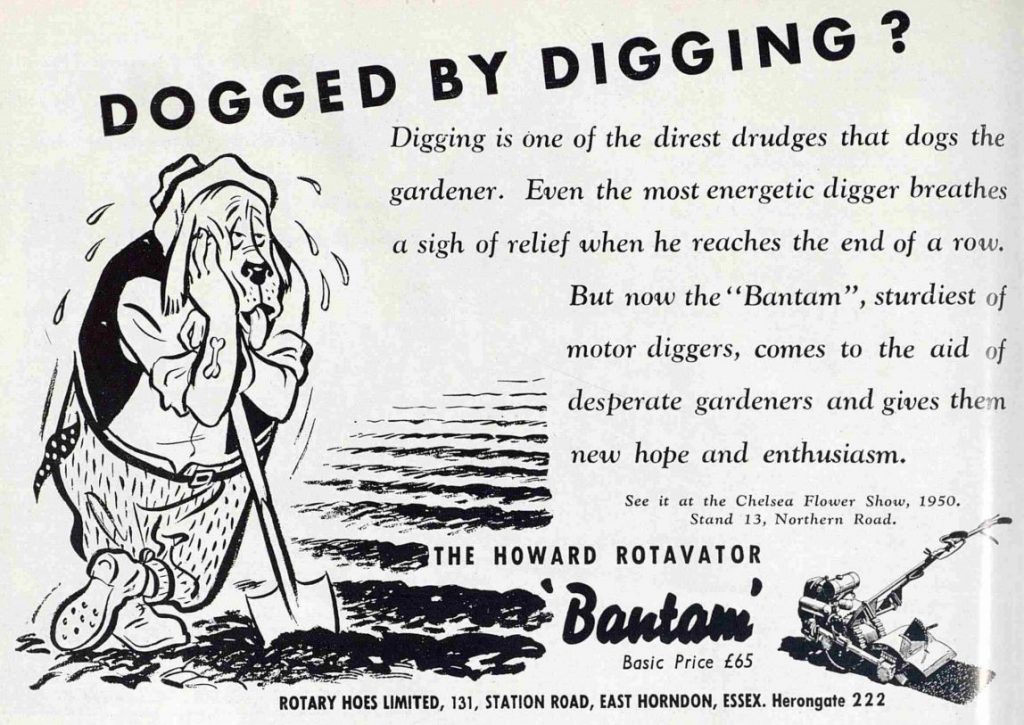
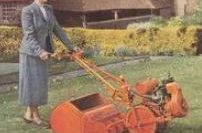
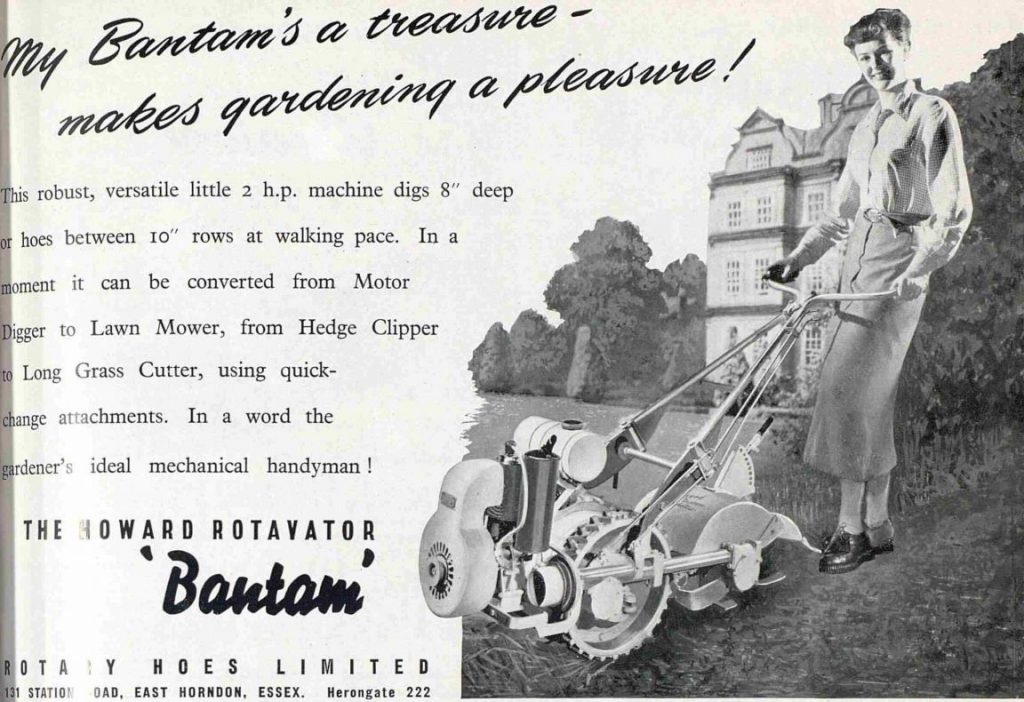
All from 1950 are the following four adverts for the Howard Rotavator ‘Bantam’. Each is carefully crafted to highlight the difficulties of gardening that the Bantam can overcome: Digging, weeding and labour saving. 


The fourth advert proves that an oily machine can be a great fashion accessory for the owner outside their 16thC Elizabethan mansion. 

There are more Howard images in the VHGMC Howard gallery pages.


Dogged by digging? Howard Bantam 1950


Worried by weeds? Howard Bantam 1950


Gardening? I though I knew it all! Howard Bantam 1950


My Bantam’s a treasure – Howard Bantam 1950


Howard Bantam Brochure

by alan

G. D. Mountfield Adverts

January 20, 2018 in Articles

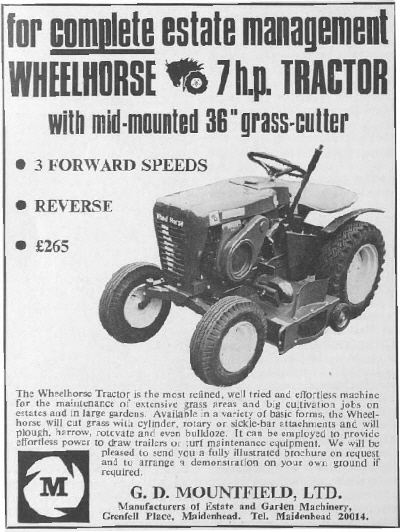
Mountfield 7hp Ride-on-mower in 1973

G.D.Mountfield of Maidenhead are well known to be associated with a large range of horticultural machinery and accordingly the company did a vast amount of advertising.

Mountfield started their ‘proper’ marketing in 1967 after the appointment of Robinson Scotland and Partners who handled the marketing, advertising and public relations. Advertising was planned for amongst others the Sunday Times, Observer, Daily Mail and the Times.

Later advertising appears not only in gardening publications or through trade magazines but also in glossy magazines of the 60’s, 70’s and 80’s such as The Tatler and Country Life – a place to market a premium brand but ultimately with a limited audience too.

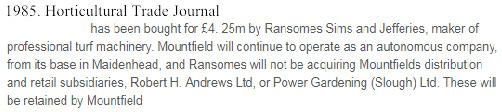
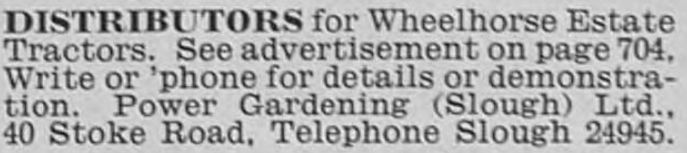
It was reported in 1985 that Mountfield had been acquired by Ransomes, Sims and Jefferies for £4.25m. Although this did not include Mountfield’s distribution and retail subsidiaries of Robert. H. Andrews Ltd (see gallery) or Power Gardening (Slough) Ltd which were retained by Mountfield (source). Power Gardening (Slough) Ltd residing at 40 Stoke Road, was the distributor of Wheel Horse products from the 1960’s onwards (source)  although the address on adverts they refer to is one of Mountfield’s at Grenfell Place, Maidenhead.

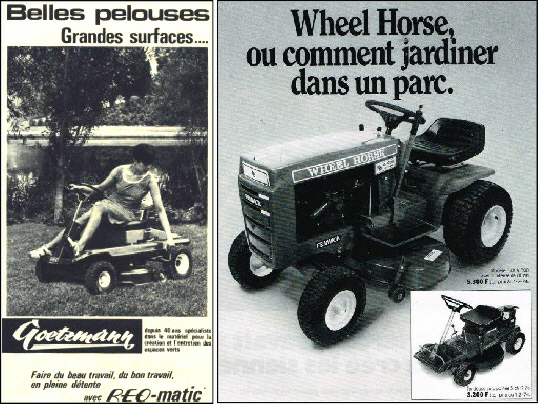
Mountfield were involved in the sale of various machines in the UK, most notably the Wheel Horse garden tractors and the Reo range too. But just as Mountfield marketed these machines here so did others in other countries, for example in France; Fenwick of St.Ouen and also the workshop of Goetzmann based in Lingolsheim near the Geman border. Goetzmann also retailed the Jacobsen ride-on mowers such as the Jacobsen Chief. The image below shows two French adverts.

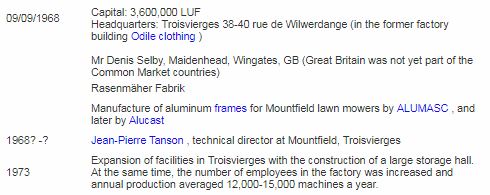
It should be noted that from about 1968 to 1982  G. D. Mountfield were involved in  a factory in Troisvierges, Luxembourg (source1) , (source2) making their lawnmowers – potentially making Mountfield a widespread company that probably pulled in merchandise and components from across the world.  The Troisvierges factory was not too far, approximately 120 miles away, from where European Wheel Horse tractors were assembled in Belgium that  Power Gardening (Slough) Ltd distributed.

Reo and Wheel Horse mowers being retailed in France by Geotzmann (left) and Fenwick (right).

Through the decades Mountfield appear to have dabbled in the advertising world by changing their adverts rather frequently although 1967 when advertising agents Robinson Scotland and Partners took over was a year when several adverts for different machines were consistent. Here is a short selection of different small-sized adverts that we have for Mountfield showing just a few of the machines they retailed, although their machinery range was vast. These adverts span fourteen years from 1965 to 1979:

1965 – Mountfield with address at Grenfell Place, Maidenhead.

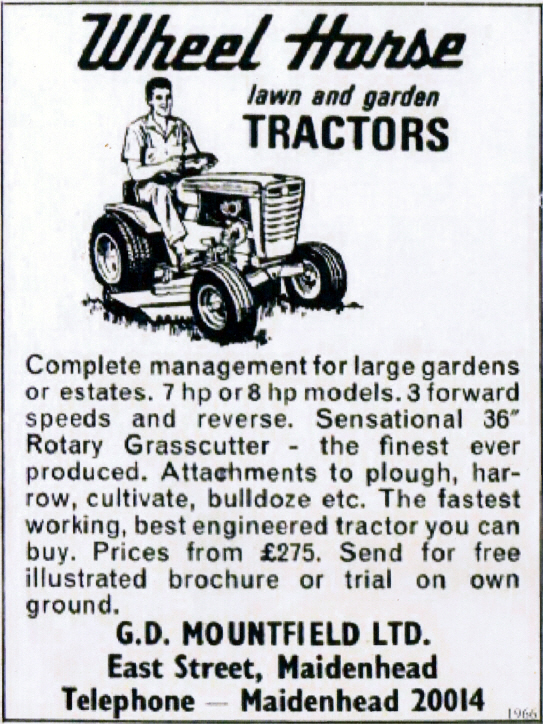
Mountfield marketed wheel Horse and  this advert comes from 1966. The address has changed to East Street, Maidenhead.

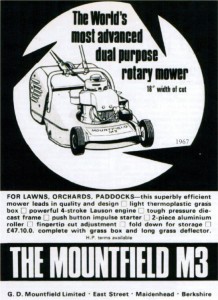
Mountfield M3 lawn mower and price of £47.10. in 1967

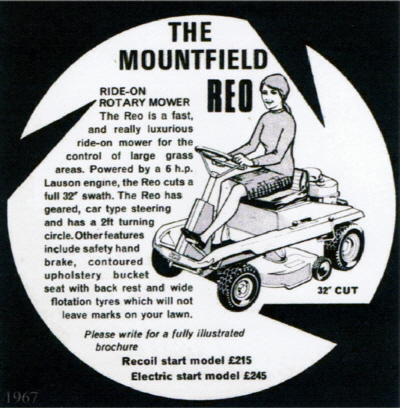
Mountfield Wheel Horse Reo Mower with price of £215 and £245 for the electric start model in 1967

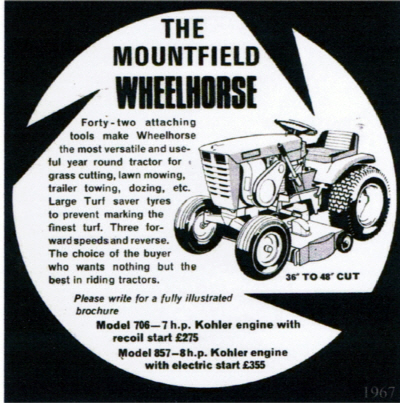
Mountfield Wheel Horse Advert with price of £275 (7hp recoil start) and £335 (8hp electric start) in 1967

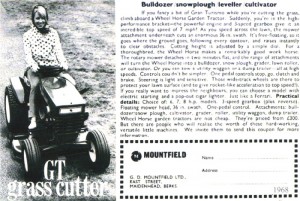
Wheel Horse Mountfield 1968

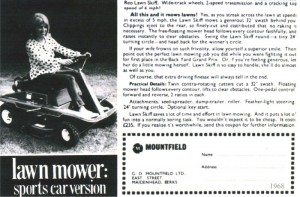
Mountfield  Reo ride-on mower advert 1968

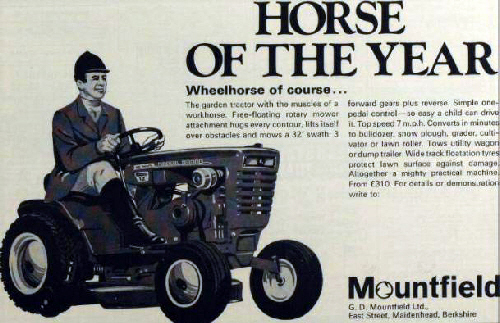
Mountfield ‘Horse of The Year’ tractor advert 1970

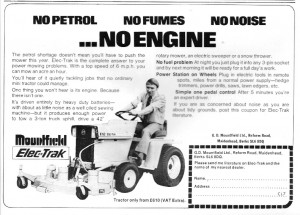
Mountfield also marketed General Electric Elec-Trak machines in the mid 1973-1976

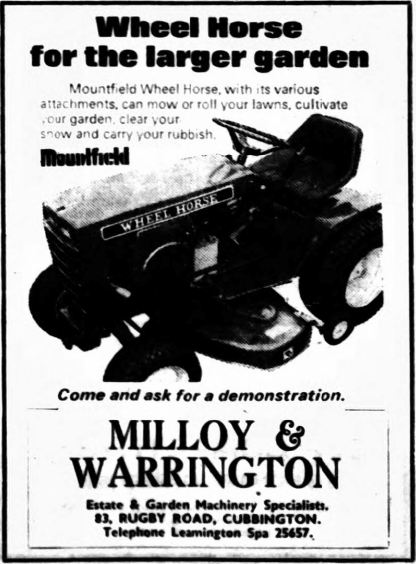
In 1975 Milloy & Warrington of Cubbington, Leamington Spa were retailing the Wheel Horse with a small mention of Mountfield.

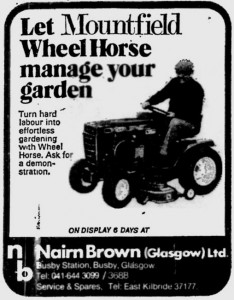
Wheel Horse Mountfield Advert for Nairn Brown (Glasgow) in 1979

by alan

Nobby Fletcher and Bolens

December 12, 2017 in Articles

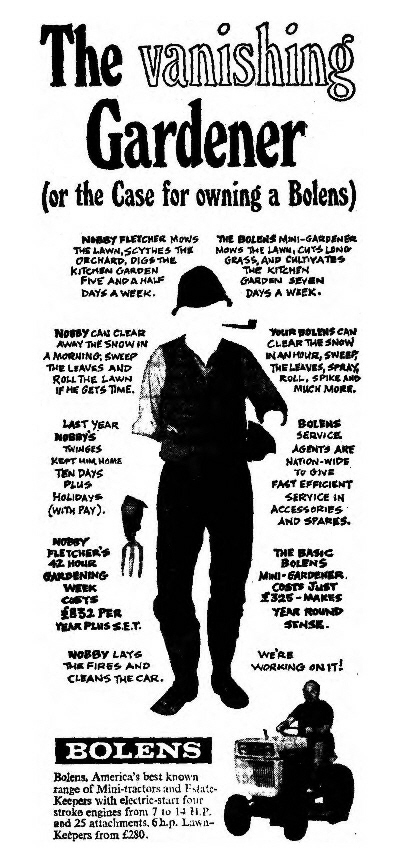
Nobby Fletcher is a fictitious character who appeared in a Bolens advert in 1970, reproduced below, promoting the assets of owning a Bolens garden tractor. 

Nobby Fletcher appears to be somewhat of a dogsbody working five and a half days per week mowing the lawns, scything the orchard, tending the kitchen garden, sweeping leaves, rolling the lawns, as well as lighting the house fires and cleaning the car. He’d probably be out in the December snow and frost clearing the driveway and cursing his chilblains and rheumatic joints and all for £16 per week in 1970. No wonder then that Nobby needed 10 days off work with twinges and aches and pains. 

I’m pretty sure that Nobby Fletcher would have welcomed the use of a Bolens tractor to help with the chores around the garden and especially the snow clearing in winter. Hopefully Nobby got a look at the attachments brochure and persuade his employer to buy the lot, after all what use is a great tractor with no implements or a valuable good gardener to use them too? 

1970. UK Bolens tractors advert. 7-14hp engines and 25 attachments. The 6hp lawn tractor started from £280.00. The garden tractor started from £325.00.


by alan

Ginge mowers and tools

November 13, 2017 in Articles, Machinery

Ginge-Raadvad, owners of the Royal Danish Foundry and By Appointment To The Royal Danish Court

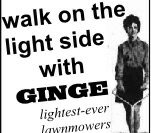
During the late 1960’s a hugely successful Danish manufacturer by the full name of Ginge-Raadvad was launching their range of lawn mowers and garden tools into the UK market. Marketed as Ginge (pronounced Ging-ha) nowadays it is a little known make but had big ambitions with some snazzy sales patter, yet although the name is known there’s zilch been written about the company in the UK. It’s a bit like tapioca pudding, we know the name and what is but fail miserably at describing it in any meaningful way. 

But Ginge in the UK has thankfully left a paper trail of adverts and news articles from 1967 to 1978 before gently taking a back seat.

All manufacturers regardless of the machines or tools they are making seem to have a pretty good and ambitious start and Ginge were no different. Although Ginge came to the UK and then silently went leaving behind a few mowers and little evidence of being here, they had actually been making mowers for a long time and obviously knew what they were doing. In the Danish Foreign Office Journal of 1951 they are stated as making ‘a mower powered by 1.5hp, 4 stroke continental engine, oil bath filter, rope starter, auto reverse and magneto ignition‘. I cannot find a picture of that mower but I’m guessing it’s a cylinder side-wheel mower (2 wheel). 

It’s often difficult to pin down when a manufacturer actually launched their products. Thankfully Ginge must have had a decent secretary or marketing person who sent out some sales copy to a few magazines as the Gardeners Chronicle & New Horticulturalist of 1967 has a glowing  report: ‘This year [1967] sees the introduction of the Ginge range of lawnmowers and gardening equipment to the UK. Among the mowers is a 12″ machine weighing only 17lbs claimed to be the lightest ever. This is the Ginge Prisma, the recommended retail price of which is only £6 14s 9d including the rust proof [plastic?] grass collecting box‘. This is followed by the impressively named World’s Press, News and Advertisers Review with ‘Ginge-Raadvad (UK) LTD [their full trading name] , subsiduary of Danish manufacturer of the Ginge range of lawnmowers and gardening equipment to be launched in the UK in 1967′. 

Handtools

Before getting on to the mowers which Ginge are best known for, they also made a range of handtools and equipment too.

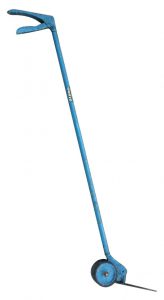
Ginge Long Handled Grass Shears 1968

1968 saw the launch of a range of Ginge products. These included the long-handled grass shears (£3 15s), pictured right, also standard grass shears (£1 17s 6d) and a long-handled self-sharpening lawn edger (£3 5s). An additional advert from the same time states there was a garden roller (£6 19s 3d) and a hose reel too. Gardeners Chronicle in 1968 commented that the new hose reel was “..easy to operate and easy on the eye, rotates smoothly and noiselessly” 

It’s worth mentioning that Ginge thought that  garden hoses were worth exploring. In 1973 Ginge-Raadvad considered ordering from a supplier a huge 80 miles of reinforced PVC garden hose with a guaranteed life of at least 10 years, this was under consideration for launch in the UK market (Source: Europlastics Monthly, Vol.46).  

The 1972 59R oscillating sprinkler costing £1.98 was claimed to be the cheapest on the market. It watered lawns up to 1900 sq ft and was one of three oscillators, the other two cost £2.45 and £3.15. There was also the ‘675’ Turret sprinkler. 

1974 saw  “Eight Ginge sprayers, from small household models suitable for window boxes and small garden flowers, right up to super automatic sprayers with capacities of 3, 5 and 7 litres. Ginge trowels, a plant fork, cultivator and weed iron“, (Source: Amateur Gardening 1974)

As we can see Ginge was certainly taking on the domestic garden from all angles and aiming to be in everyone’s garden shed and on their lawn too. 

Lawn Mowers

The 1967 launch of the mowers included an advert in Gardeners Chronicle stating that ‘You’ve never seen such  good-looking lawnmowers in your life until you’ve seen the Ginge range. Never handled such smooth running grass-cropping machines until you’ve whipped round your lawn with Ginge‘.

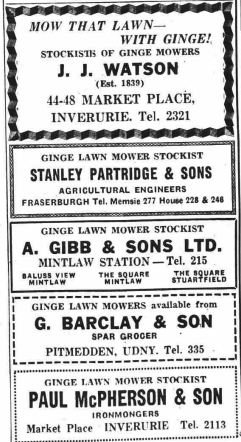
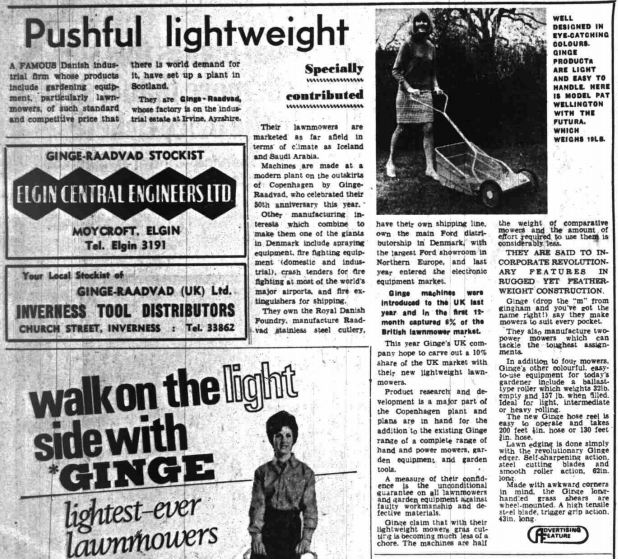
Several adverts for Ginge mowers appear in April 1968 in Scotland. This is hardly surprising since Ginge had a newly set up factory at Irvine Industrial Estate, Irvine, Ayrshire, as well as manufacturing mowers at their factory in Copenhagen. There was also an office at Croxley Green, Herefordshire, although the address appears to be a residential street so presumably an outpost office. 

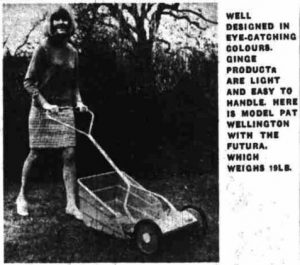
The mowers available were all cylinder mowers, the hand propelled Prisma 12″ (£6.19.9d) and Futura 16″ (£8.19.9d). As shown in the image, right. 
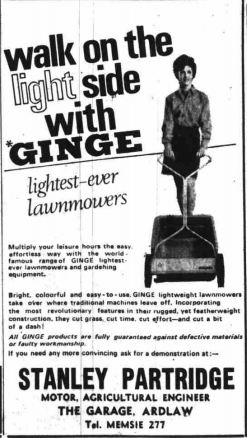
Powered cylinder mowers were the Meridia 18″ (£34.19.9d) and the Atlanta 21″ (£49.19.9d) in the same style as in the image. A year later in 1969 the Meridia and Atlanta prices had increased by £5 each.

According to newspaper reports it was claimed that since the launch of these machines in 1967 they captured 6% of the British lawnmower market in the first twelve months. It was hoped to increase this to 10% with their new lightweight mowers. One of the key selling factors was an “unconditional guarantee on all lawnmowers and garden equipment against faulty workmanship and defective materials“. (source). 

Following in 1970 were two 19″ rotary mowers powered by  4-stroke, 3hp Aspera engines, the mowers differed in engine specifications with one having an auto-choke. Prices were £23 and £28 for the better spec machine. Cutting heights for both were 3/4″, 1 1/2″ and 1 3/4″. 

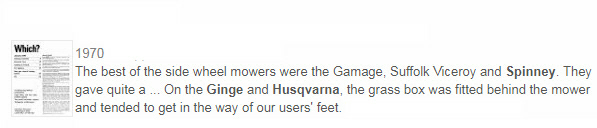
However ambitious Ginge were with their mowers there’s nothing like a bit of comparative testing to spoil the party. Enter one consumer magazine to put the spot light on a range of mowers in 1970. Pitting the Ginge against similar side-wheel cylinder mowers such as one from Gamage, the Suffolk Viceroy MK11, Spinney side wheel mower, Husquvarna from Sweden and the Qualcast B1 was certainly going to cause a squabble on the front lawn. Which was best? 

Ginge

The comparative tests found that the Gamage, Suffolk Viceroy and Spinney mowers all gave a good cut on short grass and they all easily tackled medium grass in one cut and even did quite well on the long grass. Apparently ‘the other mowers were not quite so good‘, oh dear, not the best outcome. Additionally it was found that the rear-mounted grass box on two mowers including the Ginge got in the way of the operators feet. (1970 magazine reference for mower test). Good news though was that the build quality of the Ginge stood up to scrutiny and the mower roller survived unscathed in acid tests ‘unlike the others‘. 

1970 also saw the MI 04 Orbita mower being as the ‘lowest priced four-stroke rotary mower on the UK market’ at £23.00. (source: Surveyor magazine)

Advertising in Amateur Gardening in 1973 ‘Ginge have taken the hardwork out of mowing. They’ve produced a selection of lightweight Hand Mowers, Motor Mowers and Rotary mowers that literally glide through the grass‘.

1974 saw Ginge offering seven lawn mowers: three hand mowers, three motor cylinder mowers and one rotary mower.

In a 1975 copy of the Agricultural Machinery Journal, Ginge are reported to still importing the 12″ Prisma mower as well as the Futura and Comet range, they were obviously popular mowers and must have worked well. Also stated is that Ginge were importing three 3.5hp rotary mowers with 15″ and 19″ cuts priced from £59.00 to £78.50. Cylinder mowers also included two 18″ 2hp self propelled mowers priced £94.50 and £105.00 respectively. 

It then all starts to fizzle out just a mere 8 years after an ambitious 1967 start in the UK with 1975 when we start to see a change and Sheen of Nottingham were offering a 3.5hp four-stroke Ginge mower for sale. 

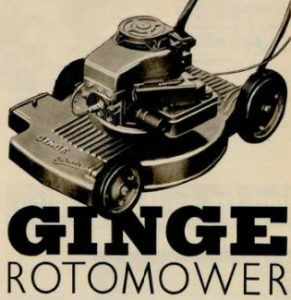
Ginge Rotomower

Announced in 1976 the Agricultural Machinery Journal state that ‘…mower maker Ginge-Raadvad has given up its central operation in the UK and appointed four importers to handle the range’ . In 1977 Sheen were reported as having taken on the range of Ginge mowers (Source: Agricultural Machinery Journal April 1977) and by 1978 Sheen were importing quite a range of Ginge mowers including the handmowers of: HD28 (28cm cut) at £24.50; HD38 (38cm cut) at £28.50; H26 De Luxe 38cm cut at £37.00. All prices included the grassbox. There was also the R48HB 19″ rotary mower with a 3.5hp Briggs and Stratton engine. 

1976 saw the closure of Ginge’s Croxley Green office in Herefordshire. But what happened to the Irvine factory? Anyone know?

The Ginge name continued in the UK under presumably different importers. 1992 sees an advert for the Ginge Garden Caddy, an open steel frame on wheels designed for holding garden debris and carrying tools. The caddy had a guide price of £50.00 and was available from Ginge of Denmark. 

And after much research that is the current known story of UK Ginge. 

Ginge mower dealers Scotland 1968

by alan

Sprayers, Misters & Dusters *cough, splutter*

September 25, 2017 in Articles

I have been collecting some sprayer demonstration images for a few months now, and for a bit of light-hearted fun, these images show the marvelous ingenuity and brave stupidity of some of the sprayers and dusters that graced the mid-20th Century. There were certainly some clever chaps on our shores who took the bull by the horns and from a few bits of pipe, a two-stroke engine and sheer determination created sprayers and dusters to rid the land of pesky pests with the aim of better crops all around. 

OK, on the negative side perhaps killing bugs wasn’t always advantageous to the whole food chain but in 1951 it was estimated that in many parts of the world 10% of food crops and in some cases as much as 20% were spoiled by pests and disease. Where there’s a potential problem then there’s someone with a potential answer and our chaps stepped in with a multitude of solutions.

Observe from the pictures the ingenuity of the people who designed and made these machines – and the machines worked too!

Pests and bugs exist everywhere and the first image (below) that caught my eye was a sprayer for use in limited areas where bugs have found a safe haven – like under a rock half way up a mountain pass. This sprayer was affixed to a donkey which is ideally suited for difficult terrain such as mountainous areas or Blackpool beach. It comprises of a hopper with 30lbs of dust and is powered by a Villiers engine rattling in the donkey’s ears. The sprayer never went into production and donkey number 26 got a reprieve. 

Donkey sprayer in demo mode

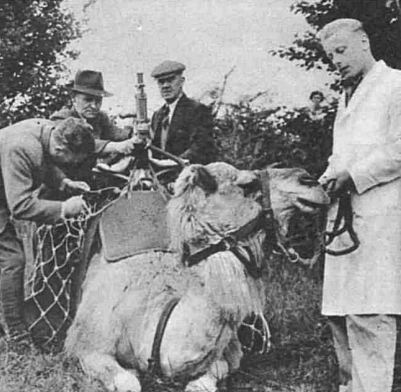
Donkey power can only be surpassed by one other and that is Camel power. The sprayer pictured below was developed in the UK for use in the cotton fields of Sudan and two panniers each held a 15 gallon plastic tank. The camel was provided by a local zoo for the demo day, the camel looking suitably miffed that it has had it’s day off completely ruined.

Camel powered sprayer proving difficult to attach at a demonstration 1951.


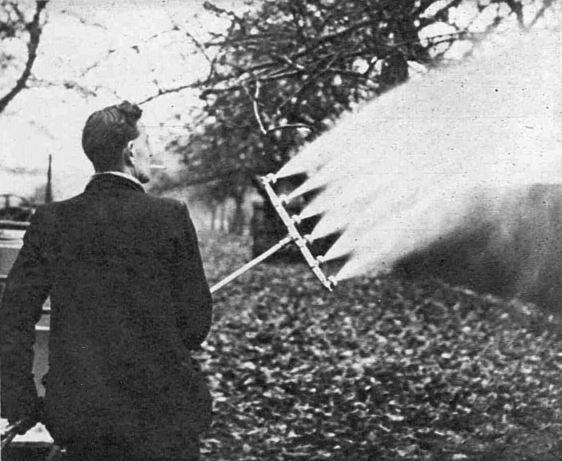
Health and safety was never of the utmost importance yet at these demonstrations one cannot be sure what was being sprayed or at whom, this seems to be a recurring theme through all the following images. Observe the chap below with a Drake and Fletcher exhibit and cigarette in mouth, the 1947 caption actually reads “This is a good one!!”. We hope the chemical could not ignite. 

“This is a good one!!”

…Or how about just spraying the visitors during a demonstration?

Dusting demo at Wroxham 1959

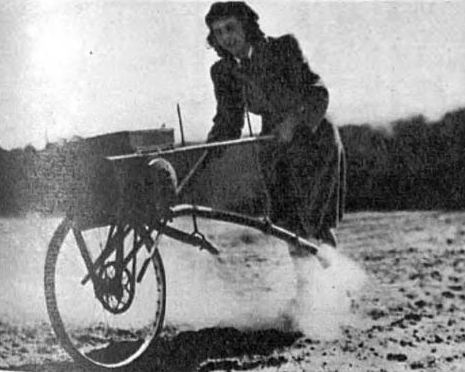
Seeing sprayers demonstrated at an events day is possibly a good idea, yet old images make it seem a little primitive somehow. This 1947 Skip Crop Duster shown below was described directly as using a bicycle wheel – why invent the wheel when one already exists? Used for distributing insecticide between narrow rows it is demonstrated in a somewhat back-ache inducing position. 

Skip Crop Duster 1947 with cycle wheel at the front and soon to be crippled operator at the rear.

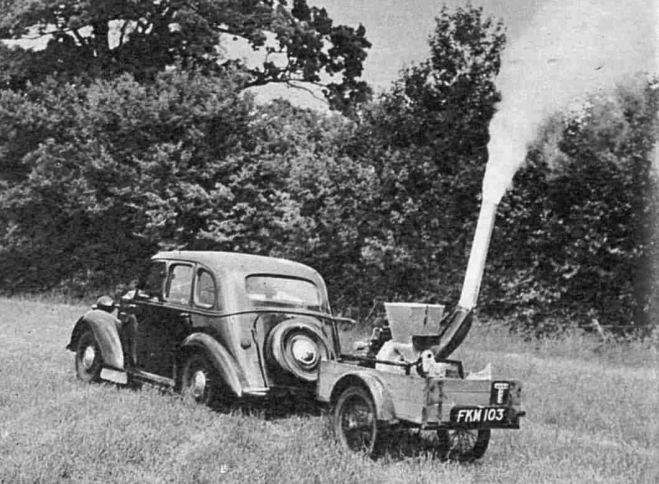
Fancy something that can be ridden? Then, below, enter stage-right one car (in lieu of a tractor), trailer and a spraying machine. Designed for dusting high trees and no doubt drifting over the outskirts of the nearest town this machine could decimate bugs galore at whatever height they decided to hide. On the back of the trailer is a large letter T for ‘trailer’.  This machine was actually called the ‘Dustejecta’ – great name. To me this image looks like the exhibitor is setting off home across the showfield but has accidentally left the machine running.

1951 Dustejecta for trees and high places

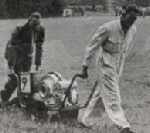
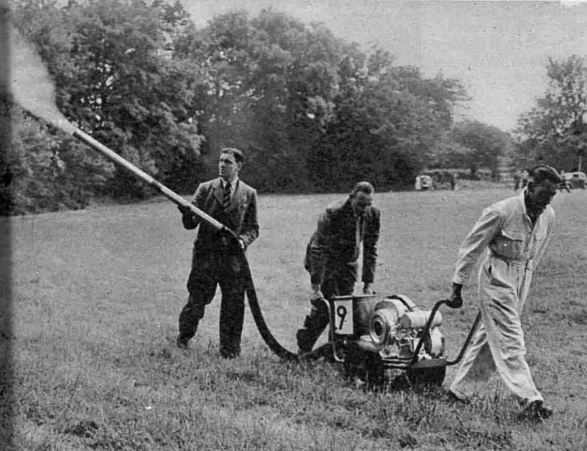
The Power Dusting Machine, below, was designed to be people-powered and designed for rough ground where a couple of unwilling accomplices could drag the machine along, over, or up whilst the operator used the hose for bug reduction purposes. It seems very labour intensive. Protection was not high on the agenda although suits and ties were. 

Power Dusting Machine, Evesham. 1951


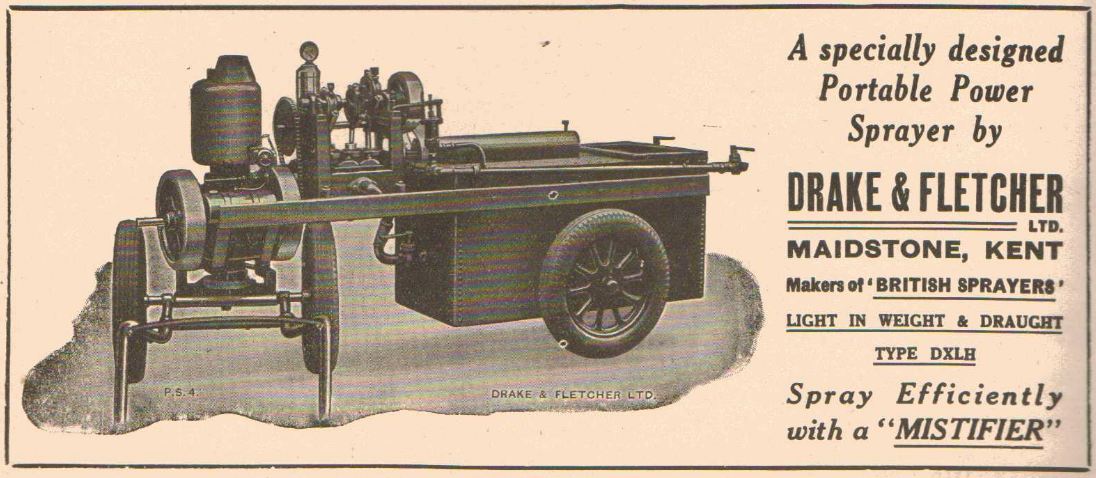
Finally an image from 1938 of another great machine, sadly no photos of it in use but you can imagine the workers designing the machine, carefully working out how it would operate and function in the field, with the folk in the workshop and foundry making the parts, they would have been immensely proud of their work in producing this sprayer. This is the magnificent British made Drake & Fletcher ‘Mistifier’. Anyone got one, I’d like to have a go and I’ll bring my proper Health & Safety gear!

Drake and Fletcher ‘Mistifier’ 1938