
Manufacturers Of Tillers – Part 1
April 13, 2026 in Club News
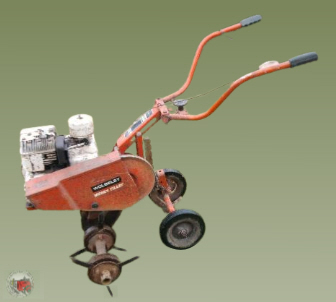
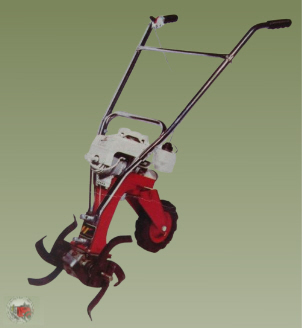
Not long ago on social media, someone asked for help with what they referred to as their Merry Tiller. As it turned out, it wasn’t one at all but just a mix-up where the name had become a catch-all for any tiller. The machine in question was actually a blue-painted Templar tiller. But one can understand where the confusion arises as the design of many of these tillers is much the same, and they serve the same function.
For this article, I have looked at front-tined tillers from the 1970s and ’80s, and these are machines that are now between 40 and 60 years old. The surge in tiller (or powered cultivator) models reflected a growing national interest in home-grown produce at that time. More and more people, who previously may have been adverse to using a spade on their weekend off work, were turning over patches of soil to create vegetable plots at the end of the garden.
When it came to buying machinery, customers trust the names they already know; for example, if a mower from a particular brand had served them well, it made sense to choose the same maker for a tiller. Recognising this, manufacturers were quick to put their own badges on cultivators and claim a share of the flourishing market. However, there are some obvious rebranding of machines. Additionally, some companies owned several brand names or bought out other firms, thus there are models straddling different brands, but that can be a minefield to get into!
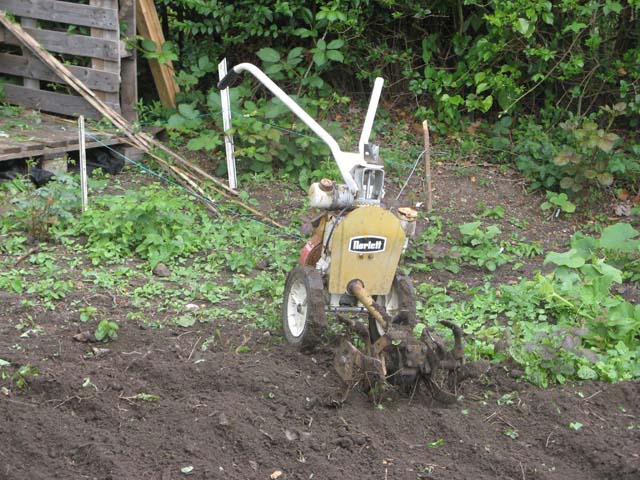
I have a list of machines, but have selected fourteen brands that come up for sale second-hand, excluding Merry Tiller as in the above picture.
Here are the first seven machines in my list as part 1, the next seven will be in part 2
It should be noted that specifications on even just one model can vary, including supplied engines and horsepower.
All the clickable picture links in the text are photos in the VHGMC gallery pages, there are no external links.
Templar
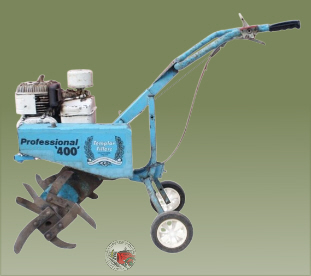
The Templar Tiller was launched in the mid-1970s, and advertised as The Best Value Cultivator In The World! It was made by Templar Tillers LTD, initially based in High Wycombe.
The company was owned by racing driver Tony Hazlewood, the brother of Gerry Hazlewood who owned Westwood, and it is easy to see the design similarities between the Templar and Westwood tillers.
This blue-painted tiller was first advertised with a Briggs & Stratton 3 hp four-stroke engine, but other engine sizes were added. In 1977, there were 4 hp and 5 hp models.
Model numbers have included the Professional 300, 400 and 500, with the first digit indicating horsepower.
Westwood
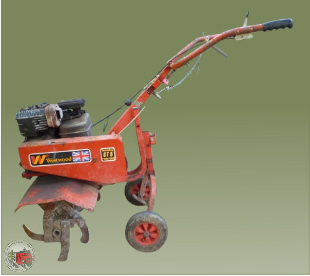
Westwood Engineering LTD was founded in 1969/70 and was initially based in High Wycombe before relocating to larger premises in Plympton, Devon around 1973. They originally produced items such as pedestrian mowers and tillers.
One of the early cultivators was the Westwood Imp, which was a French-built machine – here is a picture. It was a diminutive tiller with a 2.5 hp two-stroke Tecumseh/Aspera engine, a centrifugal clutch, and a worm-drive gearbox. The cultivating width was 15”. It had a single 10” wheel at the rear, and adjustable and detachable handles. In 1973 it was £60.
In 1974, four Westwood Groundhog models were launched – here is an advert from 1976. They were advertised with Briggs & Stratton engines in 3 and 5 hp as the G/3 and G/5, and with a 4 hp Aspera engine as the G/4. The G5R gained a reverse gear. All had adjustable handles to make work easier. Later the models were revised as the 5 hp Groundhog GT5, as shown in the above picture, and the 3 hp GT3; both had a working width of 14″-26″, and digging to a 14″ depth. Pneumatic and solid tyres were optional, as were spadelug wheels, a furrower and a tool frame set with hoes and tines.
A low-specification version of the G/3 was the Groundhog G99. This had a 3 hp engine, and fixed handles.
A smaller model, the Gemini, was introduced in 1977 as a light garden cultivator. It was initially fitted with a 2 hp Suffolk engine, but when later revised as the Flymo DM it had a Briggs & Stratton engine. The Gemini and Flymo DM used the same attachments, including the wheelbarrow with front wheels.
Flymo
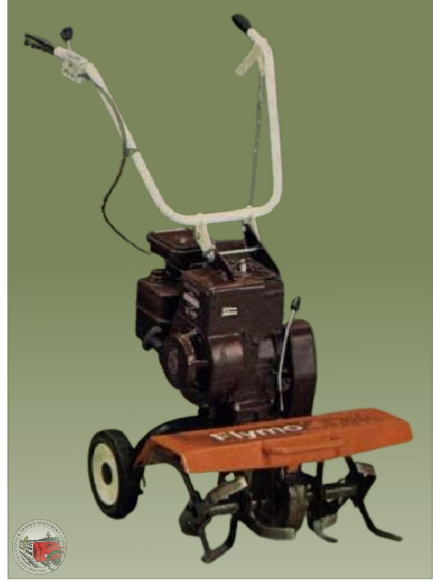
The Flymo DM tiller was a popular model in the early 1980s, as shown in the picture. Appealing to a large audience, it was widely advertised and could also be acquired from the Argos catalogue. The DM was a revision of the 1970s Westwood Gemini tiller.
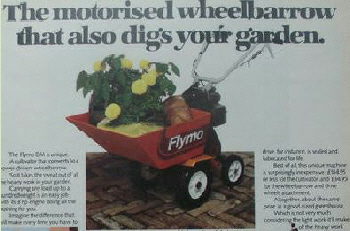
It came with transportation wheels, depth skid, and foldable handles so it could fit in a car boot for transportation to the allotment. It was powered by 4-stroke Briggs and Stratton engines. They could be fitted with inter-row weeders, finger rotors for fine tilth, a dozer blade, a potato harvester, and a furrower. A front-mounted wheelbarrow attachment with wheels could also be attached – here is a picture.
At the same time, Flymo also made a 750 watt electric tiller named the DME. It had a 10″ maximum cultivation width, and an 8″ depth.
In 1982, the petrol DM was £149, and the electric DME was £110.
Flymo also rebranded and sold the model GTM and GLM which were originally Norlett Tillermate models. The 1980s Flymo PowaSpade was also a Norlett product – here is a picture.
Norlett
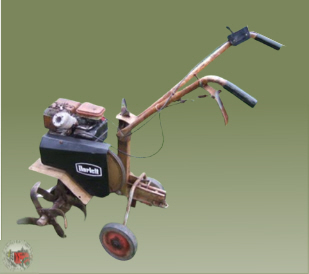
Norlett made the Tillermate and Versatiller, sold in the UK from the 1970s.
Briggs and Stratton four-stroke engines seem to be the powerplant of choice.
Models had 3, 4, or 5 hp engines. On some models the handles were adjustable left or right, but the basic Tillermate had fixed handles. Typically, they are fitted with four rotor blades.
In 1978 the professional model 5 hp Automatic Tillermate was announced – here’s a picture. It had five forward speeds and reverse. It had four blades, but could have six which gave a maximum working width of 130 cm (51″). Accessories included a plough, ridger, harrow, potato lifter, etc.
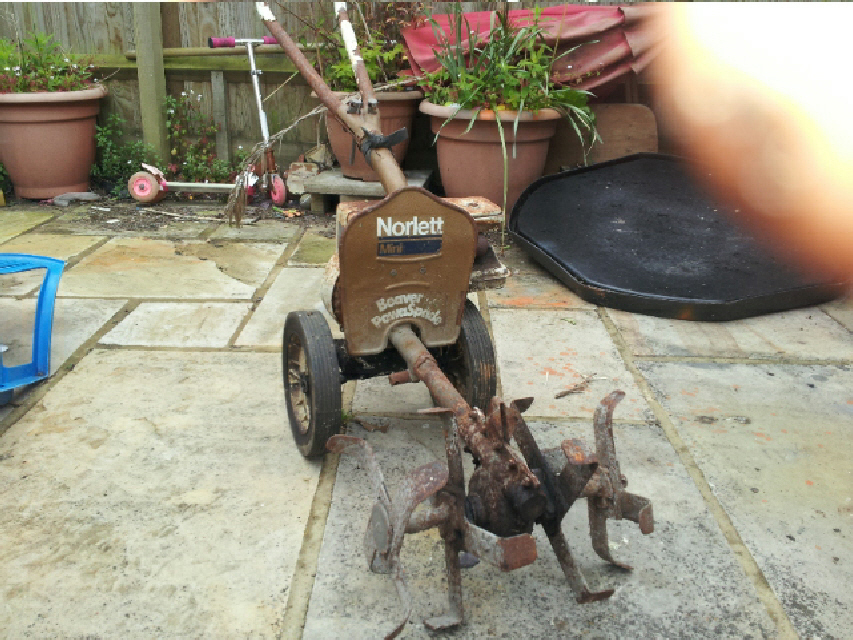
Norlett are probably better known for the small, domestic, soil turning machines called the Beaver Powaspades (aka Versatiller 10), in electric and petrol versions – here’s a picture. With a 2.5 or 3 hp Briggs and Stratton engine, the compact Powaspade could dig to a depth of 12″ and a width of 5.5 to 12″. The electric version, new in 1978, was said to be ideal for inside greenhouses and polytunnels
Wolseley Webb Wizard
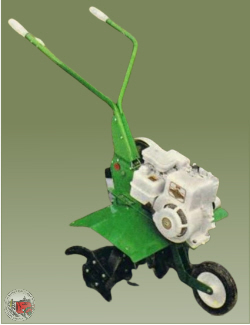
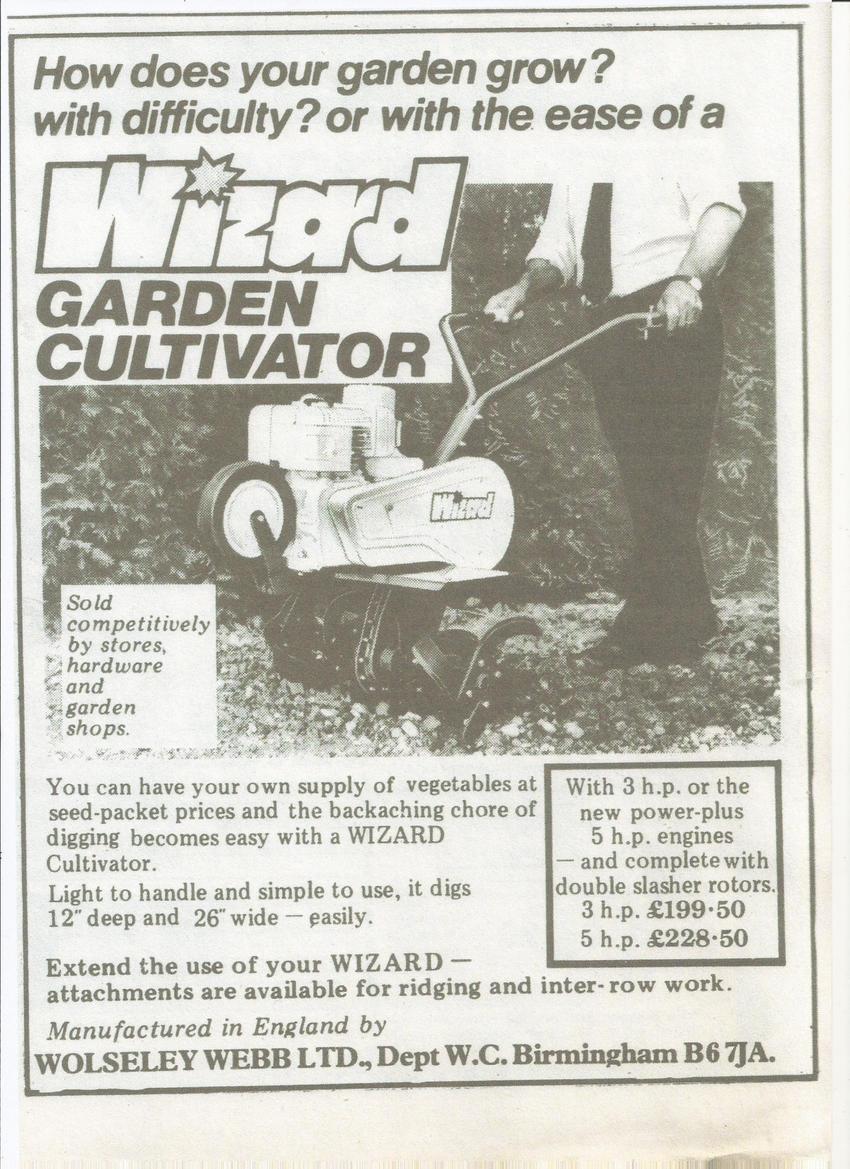
Leaving all their senses behind, in the 1970s Wolseley Webb embarked on a range of badly-conceived domestic cylinder mowers called Wizard. For good measure, a couple of tillers were thrown into the Wizard range. All the Wizard machines were painted bright green and white. They were manufactured in Birmingham. Here is a newspaper advert for the tillers.
Two tiller models existed, capable of a 26″ width and 12″ depth. The model AC.3502 had 3 hp, and the AC.3504 had 5 hp. Both had Briggs and Stratton four-stroke engines, and folding transport wheels and handles.
The smaller model was said to be ideal for the ambitious home gardener, while the larger hp model was more suited to the allotment. They were equipped with double slasher rotors, with optional narrow rotors for inter-row work.
In 1978, the 3 hp AC.3502 was priced at £188, but could be purchased from Argos at a discounted £152.
Mountfield
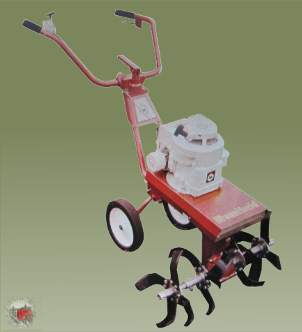
Mountfield began making tillers in the 1960s with the model M1. This was a tool frame tiller, with the engine and handles removable and attachable to a 4-wheel rotary mower deck. The tiller could also power a hedge trimmer and tow a small trailer.
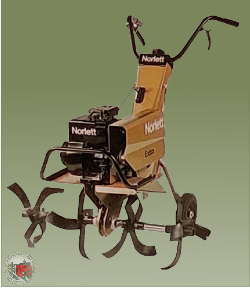
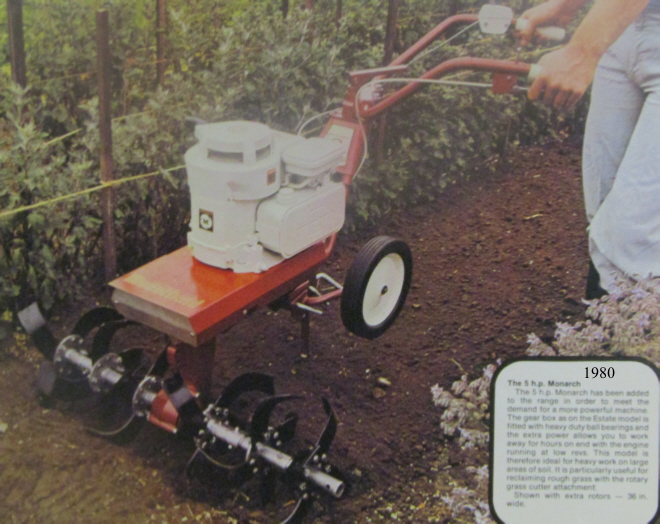
By the early 1970s, the M1 had been updated to include the Briggs & Stratton-powered 5 hp Monarch, 4 hp Estate, and 3.5 hp Super as shown in the picture. All had an adjustable working width of 14” to 36”. Optional were furrow and row crop attachments, extension rotors, disc coulters, depth control wheel and front weights. They could still power a lawnmower. In 1971, the Estate with two pairs of rotors was £95. Here is a picture of the Monarch model.
In the 1980s, there was the updated M1 Gardener. This basic tiller was powered by a 3.5 hp Briggs & Stratton engine, mounted on a distinct circular chassis, which, like the 1960s model, could still be used to power a four-wheel rotary mower deck.
In the 1990s, the tillers included the Manor 5 hp and 3 hp- here is a picture. This basic single-speed 3 hp machine had a 24” width, adjustable and removable handlebars, and front transport wheels. The substantial Manor 5 hp had the same working width but gained rear transport wheels, and could be fitted with a reverse gear on the model 5R.
Texas
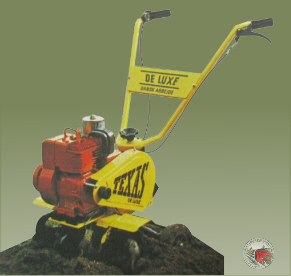
The Texas range of cultivators was made in Denmark, and production started in the 1960s. Initially, they began to be brought into the UK in the 1970s by Danarm Ltd, who also imported Bertolini cultivators.
The most common models are the single forward-speed Briggs & Stratton-powered 3 hp TV3, and 5 hp TV5 and TD5 as shown in the picture. Additionally, a reverse gear was on the TD5B, and a two-speed forward-reverse on the TD5BR. By 1985, prices ranged from £315 to £459.
Models could have 10″ pneumatic tyres, plant protection discs and digging tines, and handles that adjusted left and right.
The following models, although quite rare, were the Kawasaki-powered 521 with 5 hp, and the 721 with 7.5 hp. However, the 521 can be found fitted with a Briggs & Stratton engine. They had forward and reverse gears.
Also from Texas was the two-stroke Tecumseh-powered Mini Tex with an 11″ working width. Additionally, the Lilli and Futura models.