
A Scottish Seed Order
February 6, 2026 in Club News
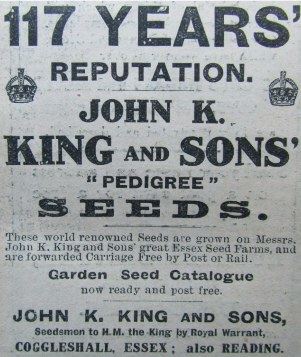
In recent issues of The Cultivator magazine, Andrew Hall wrote about seed packets and the people and companies behind some of the famous names, such as Carters and Suttons. Indeed, some of the seed merchants go back a long time. For example, as in the shown advert, by 1910 John K. King and Sons had 117 years of reputation and at the time a Royal Warrant to the King.
As collectors of horticultural items, even the smaller items, such as the seed packets and garden requisites, are as important as the machinery. Still, it’s easy to forget that there was a person behind every purchase. Who were the people buying those seeds, pondering over a new spade in Woolworths, or considering a new rotavator from the Howard brochure? Every item has a history and a story to tell.
For the rest of this article, we shall head to Scotland.
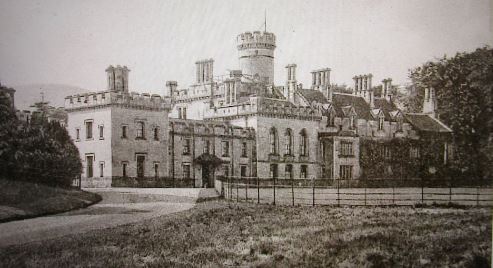
Among my archive is a 1910 seed order compiled at Dreghorn Castle, Colinton, Edinburgh, when James Stewart Clark was the tenant. Essentially, the Dreghorn property was a 17th-century mansion with subsequent enlargements over time, and was reportedly situated in a beautiful park. No doubt with ornamental or pleasure gardens, a vegetable garden, and the staff to maintain them, with a range of tools and paraphernalia of that time.
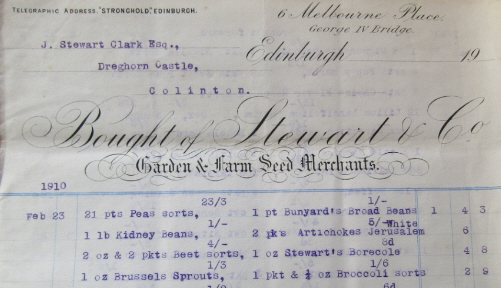
The gardener’s seed order is quite interesting and tells of what was being grown in the early 1900s. It was sent from Dreghorn Castle to Stewart & Co, Garden & Farm Seed Merchants, 6 Melbourne Place, (on the corner of Victoria Street), Edinburgh, in February 1910. This building was demolished in 1967.
For the vegetable garden, many items were ordered in ounces – cabbage, onions, turnips, radish, cauliflower, and sprouts – but there were also specific varieties:
- 1 oz Musselburgh Leek
- 1 pint Bunyard’s Broad Beans
- 2 packets White Jerusalem Artichokes
- 1 oz Stewart’s Borecole (kale)
- 1 packet Celery Major Clarke’s Perfection
- 1 packet Cucumber Lockie’s Perfection
Peas, parsnips, spinach, kidney beans, and two packets of herbs rounded out what must have been a very respectable harvest. Some of the seed varieties there were ordered are now considered ‘Heritage Varieties’.
Also ordered were 3 pecks of potatoes at 10 shillings. I had to look up what quantity a peck is: 2 imperial gallons, or one quarter of a bushel.
The ornamental and display areas got a good ordering of seeds too, including Godetia, Malope, Alyssum, Canterbury Bells, Gypsophila, Clarkia, Nigella and sweet peas. And 8 packets of ‘Choice Flower Seeds of sorts’ – I wonder what they were.
The labour aspect would have been great for any substantial garden of this time, with minimal mechanisation unlike today. The soil preparation with digging and manuring, as well as seed sowing, thinning or pricking out, and where necessary hardening off and planting out – within the order is 800 tallies (plant labels). And then the watering, hoeing, and the constant care.
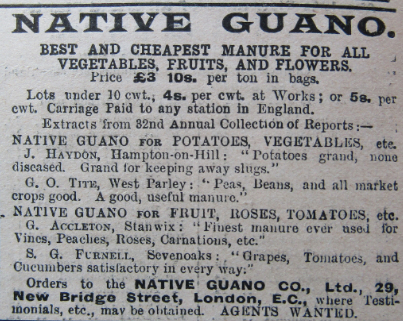
Several items were ordered along with the seeds. Fertilizer and soil improvers included 2 cwts Canary Guano (of which many importers’ fortunes were made), 1 cwt bone dust, and 1 cwt nitrate of soda.
The list was amended on the 19th March 1910 to include 1 pair of secateurs at five shillings, 5 dozen Pinks Mrs Simpkins (Carnations), and one gallon of the ‘Most efficient mildew destroyer’!
It’s a snapshot of a moment in time. Dreghorn Castle, structurally struggling and owned by the War Office, was set on fire and detonated by the army in 1955 – films of this destruction taking place can be seen on YouTube. Today, the site is Dreghorn Barracks, adjacent to the Edinburgh bypass. Although there are specimen trees, woodland and parkland still visible, sadly, there’s no evidence left of the once productive gardens.


